Not always, but far more nonprofits pay the same as a coffee shop than ever need to. Visa and Mastercard both keep charity categories in their published fee schedules, which means a properly set up donation can carry a lower base cost than an ordinary retail sale. The catch is that the charity break touches only one part of what you pay, it only reaches you if your account is coded and priced so it can pass through, and plenty of organizations sign up for a simple flat rate that quietly swallows it. This guide explains where the money in a card fee goes, which part the charity programs change, why so many nonprofits still pay the full retail price, and how to check your own statement in an afternoon.
The short answer
- The card networks do treat charities differently. Visa and Mastercard each publish charity interchange categories, so a qualifying donation can cost less at the base level than the same card used at a store.
- Your processor’s markup is not discounted by any rule. The processor sets its own margin and fees, nonprofit or not, so the total you pay depends on what you negotiate.
- Flat-rate pricing usually hides the difference. If you pay one blended percentage on every gift, a lower base cost underneath tends to stay with the provider.
- Setup decides whether you qualify. Your account has to be categorized as a charitable organization, which is a matter of documentation and accurate coding, not a box you tick.
- The fastest check is your own statement. If it shows one percentage on everything and never mentions interchange, you cannot tell whether you are getting the charity treatment, and that alone is worth a question.
Who wrote this, and what we will not claim
Nationwide Payment Systems (NPS) publishes this guide. We are a U.S. payment processor based in South Florida, in business since 2001, so we have a stake in how nonprofits choose their processing, and we say where we are a poor fit further down. We do not quote rates in this article on purpose. Card-network schedules change, our own pricing is set account by account, and a number printed here would be out of date or wrong for your organization. What we can do is show you how the pricing works so you can read any quote, ours included, with confidence.
Nothing here is tax or legal advice. Your accountant should have the final word on how your organization records and reports fees.
Where a card fee actually goes
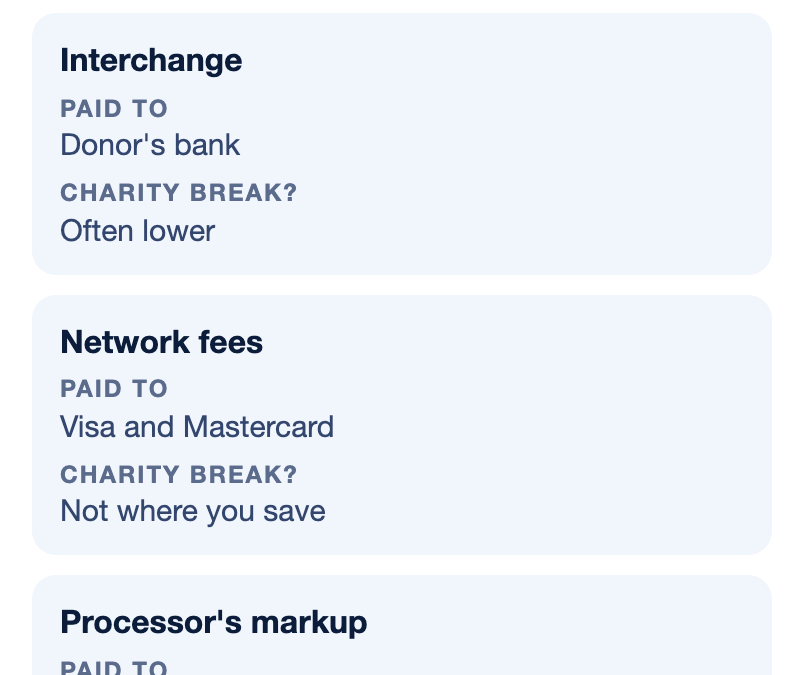
Most people picture a card fee as one charge from one company. It is really three costs stacked together, and the question of whether nonprofits pay less only makes sense once you can see them separately.
1. Interchange, which goes to the donor’s bank
Interchange is the largest piece of most card fees. It is paid to the bank that issued the donor’s card, and its level is set in schedules that Visa and Mastercard publish. The schedule has many categories, based on things like the kind of card, how the card was accepted and the type of business taking it. This is the layer where charities get special treatment, because the schedules include categories written for charitable organizations.
2. Network fees, which go to Visa and Mastercard
The card brands also charge their own smaller assessment and network fees on each transaction. These are set by the networks and passed along to the merchant. They are a modest share of the total for most organizations, and they are not where a nonprofit saves money.
3. The processor’s markup, which goes to the company you sign with
Everything above interchange and network fees belongs to your processor and any partners in the chain. This covers their margin, plus whatever monthly, gateway, statement or equipment fees they charge. No card-network rule lowers this part because you are a nonprofit. Some processors choose to offer nonprofits better terms, and many do not, so this is the piece you negotiate.
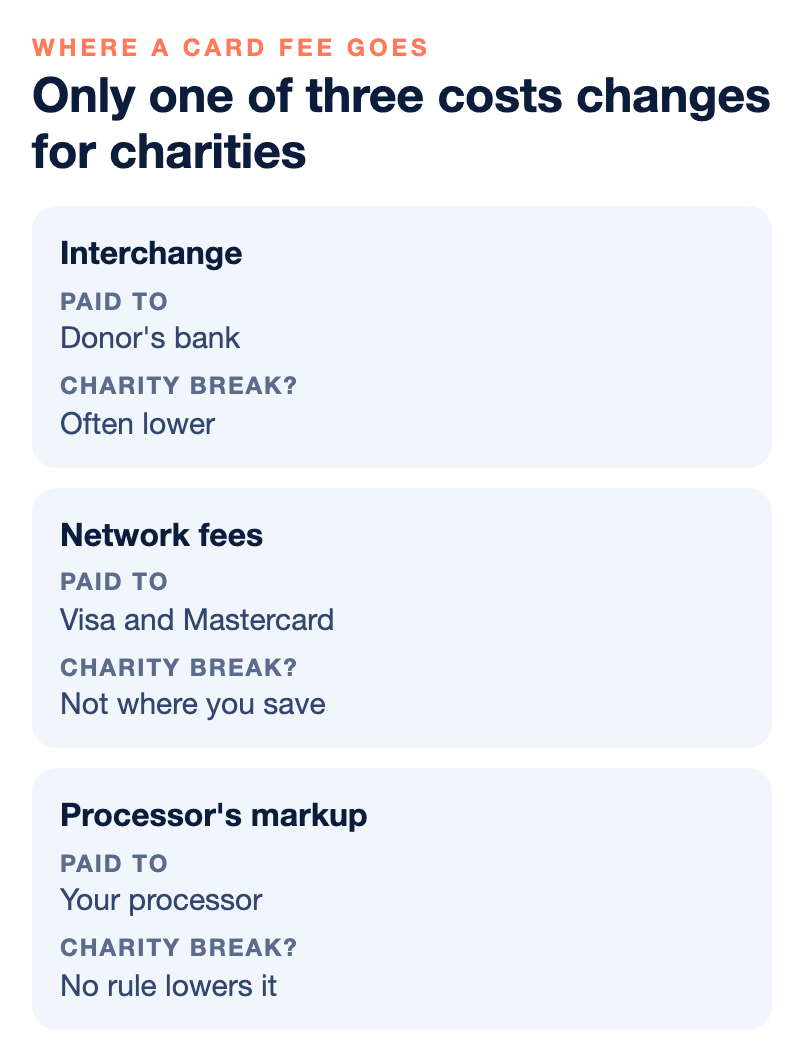
Put together, the honest answer to the question in the title looks like this. At the interchange layer, a qualifying charity often does pay less than a for-profit business. At the markup layer, a nonprofit pays whatever its contract says. The total you see on your statement is the sum of both, which is why two charities of the same size can pay very different amounts for the same donations.
What the card networks actually do for charities
Both major networks set aside charity categories in their interchange schedules. Visa’s published U.S. interchange schedule lists charity categories alongside its retail and other programs, and Mastercard maintains charity programs across its consumer and commercial card products. We cover the full range of industry programs, from education and healthcare to government and B2B, in our guide to special interchange rates for Visa and Mastercard. Here we focus on what those charity categories mean in practice for an organization taking donations.
Three points matter more than the rates themselves. The first is that the categories apply to transactions from merchants that are set up as charitable organizations, so the coding on your account comes first. The second is that the conditions differ by card type and by how the payment is taken, whether in person, online or through a recurring schedule. The third is that the schedules are revised from time to time, so a figure someone quoted to you two years ago may no longer be current. When you compare offers, ask each provider which charity categories your transactions are expected to qualify for, and ask them to show it on a sample statement.
Debit cards add one wrinkle. Debit cards issued by the largest U.S. banks follow a federal pricing rule that applies to every merchant, so on those cards a charity is unlikely to see a separate charity break. The charity categories tend to matter most on credit cards and on debit cards from banks that fall outside that rule. This is one reason a nonprofit whose donors mostly give by debit card may notice less difference than one whose donors mostly use rewards credit cards.
Why many nonprofits still pay the same as everyone else
If the networks have charity categories, why do so many nonprofits end up paying a retail price? In our experience it comes down to a handful of setup and pricing choices, most of them made in a hurry when the organization first needed a donate button.
The account is coded as the wrong kind of business
Every merchant account carries a Merchant Category Code, a short number that tells the card networks what kind of business is taking the payment. If your account was opened under a general retail or services code, your donations are treated like ordinary purchases and never reach the charity category. This happens more often than you would think, especially when a volunteer set up the account on a payment app or when the organization moved processors and nobody checked the coding. A processor also cannot pick a code just because it is cheaper. The code has to describe what your organization really does, and underwriting will usually ask for nonprofit documentation to support it.
The price is one flat percentage
Flat-rate pricing is popular with small nonprofits because it is easy to understand. You pay the same percentage on every gift, whatever card the donor uses. The trade-off is that you cannot see the interchange underneath, so if your donations qualify for a lower charity category, the difference typically stays with the provider rather than coming back to you. Interchange-plus pricing, sometimes called cost-plus, works the other way. It passes the real interchange through and adds a stated markup on top, so a lower charity cost shows up on your statement as a lower charge. We explain the main pricing models side by side in our guide to merchant account pricing models.
Flat rate is not always the wrong choice. A very small organization that takes a few dozen gifts a year may value the simplicity more than the savings, and that is a fair call. The point is to make it knowingly.
Online gifts are sent without the right information
A growing share of donations arrive through a website form, a text-to-give link or a monthly recurring plan. How those payments are sent to the networks affects which category they fall into. A donation form that is not set up to pass the expected data, or a gateway that sends transactions in a way the charity category does not recognize, can push otherwise qualifying gifts into a more expensive bucket. Ask your provider to confirm that online and recurring donations are being sent so that they can qualify, as well as the gifts you take in person.
The organization does more than collect donations
Many nonprofits also sell things. A museum has a gift shop, a school sells event tickets, a rescue group sells merchandise, a church runs a bookstore, and a charity may operate a thrift store. Those sales are not donations, and the card networks do not treat them as donations. If everything runs through one account coded as a charity, the coding may not match the activity, which is both a pricing question and a compliance question. If everything runs through one account coded as retail, your real donations lose the charity treatment. Often the clean answer is separate accounts, or at least a clear conversation with your processor about which activity goes where. Churches and other religious organizations should also ask directly which category they will be set up under, because the answer is not always the same as it is for a charity.
The extra fees cancel out the savings
Even with the right coding and fair pricing, a pile of small monthly charges can erase what the charity category saves. Look for monthly minimums, statement fees, gateway fees for each donation platform, PCI fees, annual fees and charges for equipment you no longer use. None of these are unusual on their own, and some are reasonable, but together they can make a small organization’s effective rate look much worse than the headline. Our walkthrough of how to read a merchant statement shows where each of these usually appears.
How to check what your organization is paying
You do not need to be a payments expert to find out whether your nonprofit is paying a charity price or a retail price. You need one recent statement, one hour and a short list of questions.
- Pull a full monthly statement, not the summary on your dashboard. You want the version that lists every fee.
- Work out your effective rate. Add up every fee for the month and divide by the total you processed. This one number lets you compare any two offers fairly, whatever pricing model they use.
- Look for interchange detail. An interchange-plus statement usually shows interchange categories or at least a separate line for pass-through costs. If you see a charity category named, your coding is probably right. If you see one blended percentage and nothing else, you cannot tell.
- Ask your current provider three questions in writing. What Merchant Category Code is my account under? Do my in-person, online and recurring donations qualify for the card networks’ charity categories? Am I on flat-rate or interchange-plus pricing, and what is your markup?
- List every fixed fee. Monthly, annual, gateway, PCI, statement and equipment charges all belong on the list, along with what each one is for.
- Get a written quote from at least one other provider using the same statement, so you are comparing like with like.
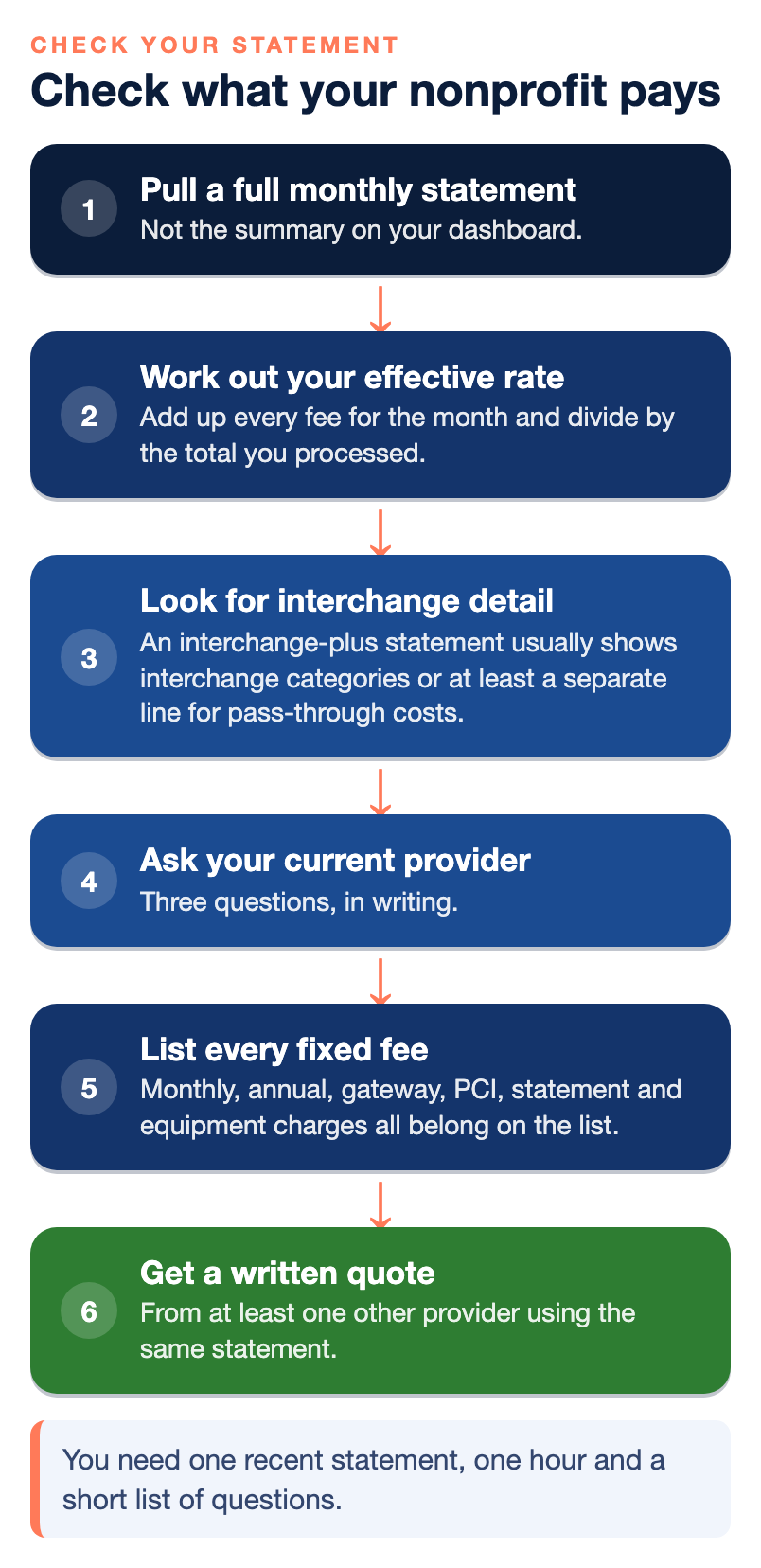
Finance staff and board treasurers often find that this exercise answers the question in the title on its own. Either the statement shows charity interchange and a modest markup, in which case you are already being treated fairly, or it shows a flat rate with no detail, in which case you have a real question to ask.
Other ways nonprofits lower the cost of taking gifts
The charity category is one lever. A few others often matter just as much, and they work alongside it.
Offer bank transfers for larger and recurring gifts
ACH, the system banks use to move money directly between accounts, usually costs far less than a card payment, and it does not depend on card-network categories at all. For monthly donors, major gifts, pledge payments and grants from donor-advised funds, offering ACH next to cards can cut costs noticeably. Some donors also prefer it, because a bank account does not expire the way a card does. We go into the details in our ACH optimization guide.
Let donors choose to cover the fee
Many donation forms include an optional box that lets a donor add a small amount to cover processing. Because the donor chooses it, it works differently from a surcharge added at checkout, and many givers are happy to tick it. If you add one, keep it optional, keep the wording plain and confirm with your processor and your accountant how it should be set up and recorded. If you are considering anything that adds a mandatory fee to card payments, that is a separate question with its own card-network and state rules, so read our guide on how to reduce card fees without being fined first.
Consolidate your tools
Nonprofits often collect money through four or five different tools, one for the website, one for events, one for recurring gifts and another for invoices to sponsors. Each one may carry its own fees and its own reporting. Bringing them onto fewer platforms tends to reduce fixed fees and makes reconciliation easier for whoever keeps the books.
Where NPS fits, and where it does not
We work with organizations that want to see exactly what they pay and why. For a nonprofit, that usually means a look at how the account is categorized, a quote that separates interchange from our markup, and a plan for each way you collect money, whether that is card, ACH, invoicing, payment links or recurring billing. Our all-in-one platform, NPSONE, supports card and ACH payments, smart invoicing, payment links, recurring payments, hosted payment pages and QuickBooks integrations, which helps organizations that have outgrown a patchwork of tools. Every account still goes through underwriting, and we review each organization individually rather than publishing one rate for everyone.
We are probably not the right fit if your organization takes only a handful of gifts a year, wants an instant self-service sign-up with no documents, or is choosing purely on the lowest advertised flat rate. A simple donation app can be the sensible choice in those cases, as long as you go in knowing how flat-rate pricing treats the charity categories. If you want a broader view of the market before you decide, our comparison of the best payment processing providers explains what each type of provider does well.
What to have ready before you ask for a quote
- Two or three recent monthly processing statements from your current provider.
- Your nonprofit documentation, such as the IRS letter confirming your tax-exempt status, and your organizing documents.
- A rough split of how money arrives: in person, online, recurring, events, and anything you sell.
- A list of the tools you use to collect money today, including your donation platform and accounting software.
- Your average gift size and your busiest months, such as a year-end campaign or an annual gala.
With those in hand, any provider can give you a quote that reflects your real activity instead of a guess, and you can compare quotes on the same footing.
Bottom line
Nonprofits do not automatically pay less to accept cards, but they can. The card networks have done their part by publishing charity categories. Whether those categories reach your organization depends on three things you control: the code your account is set up under, the pricing model you agreed to, and the fees stacked on top. If your statement shows a single flat percentage and no detail, you are probably paying close to what a for-profit store pays, and an hour with your statement will tell you how much that is costing your mission. If you would like a second pair of eyes on it, contact us for a statement review, or browse the rest of our payments guides.
Frequently asked questions
Do nonprofits get lower credit card processing rates?
They can, at the interchange level. Visa and Mastercard both publish charity categories that can lower the base cost of a qualifying donation. The processor’s own markup is not reduced by any rule, so the total depends on your contract and how your account is set up.
What is a charity interchange rate?
It is a category in the card networks’ published fee schedules for transactions taken by merchants set up as charitable organizations. It sets the base cost paid to the donor’s card-issuing bank. Whether a donation qualifies depends on your account’s category code, the card type and how the payment is taken.
Why does my nonprofit pay the same rate as a store?
The most common reasons are an account coded as the wrong kind of business, a flat-rate price that hides interchange, online gifts sent without the expected data, or extra fees that cancel out the savings. A recent statement and a few written questions to your provider will usually show which one applies.
Is flat-rate pricing bad for nonprofits?
Not always, but it usually keeps the charity savings with the provider. You pay one percentage whatever the card or category, so a lower base cost underneath does not come back to you. Very small organizations may still prefer it for its simplicity, as long as they choose it knowingly.
What documents do nonprofits need to qualify for charity rates?
Expect to provide nonprofit documentation, such as the IRS letter confirming your tax-exempt status, along with your organizing documents and recent processing statements. The processor uses these to set your account under a category code that accurately describes your organization. A code cannot be chosen just because it is cheaper.
Do charity rates apply to online and recurring donations?
They can, but the conditions vary by how the payment is taken and sent. A donation form or gateway that is not set up correctly can push qualifying gifts into a more expensive category. Ask your provider to confirm in writing that online and recurring gifts are being sent so they can qualify.
Can a nonprofit pass card fees on to donors?
Many donation forms offer an optional box that lets donors choose to cover the processing cost, and many givers are glad to use it. A mandatory fee added to card payments is a different matter with its own card-network and state rules. Check with your processor and your accountant before you change how you charge.