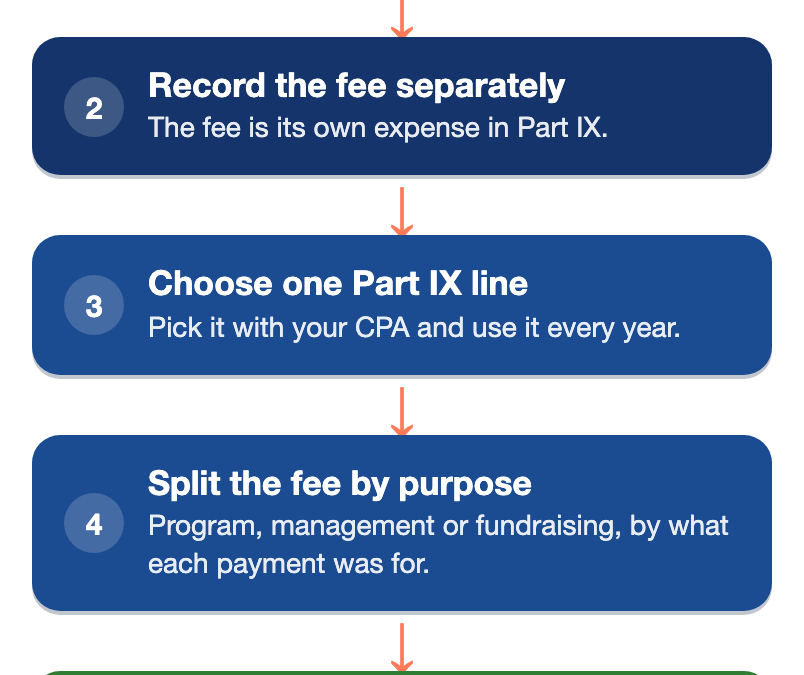
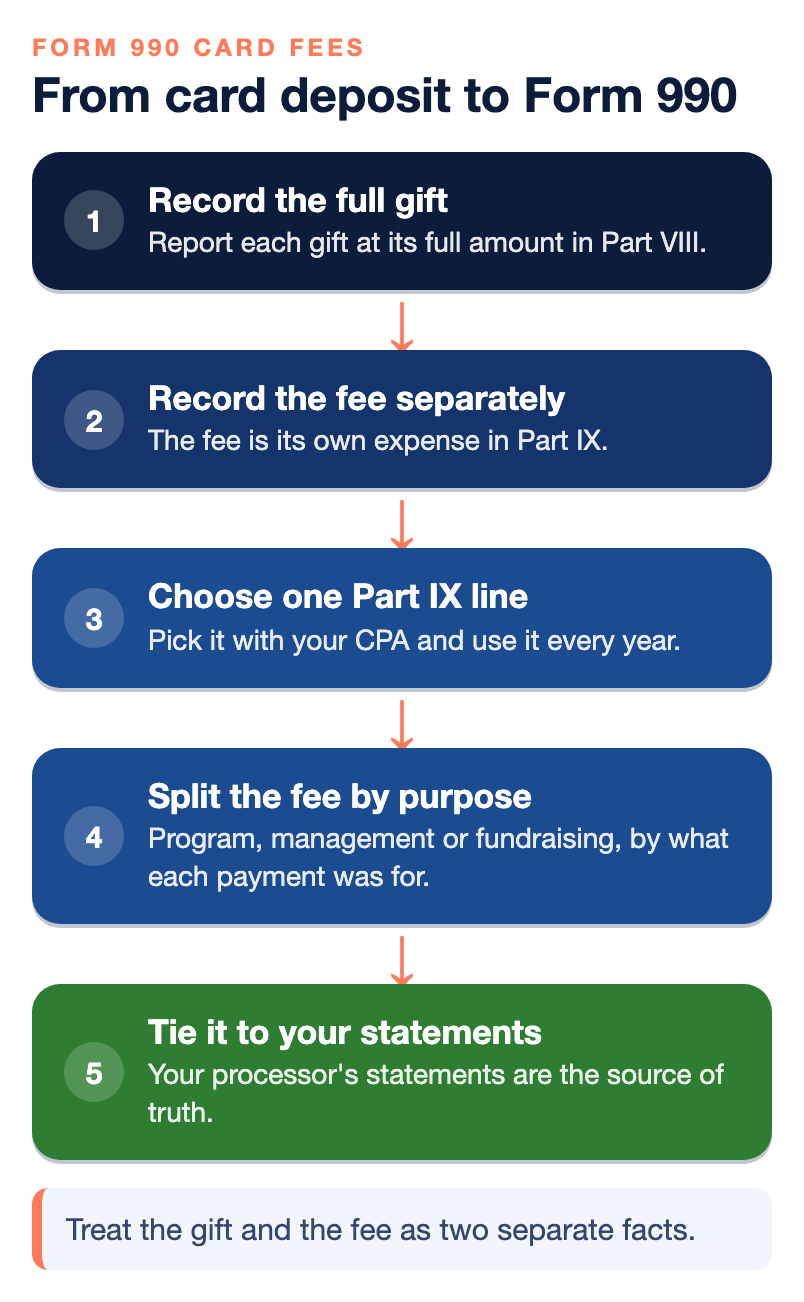
Report every gift at its full amount on Form 990, then report the card processing fees separately as an expense, because the IRS tells nonprofits not to net related items and says an organization that reports contributions net of fundraising expenses can face a penalty. The fees themselves go in Part IX, the Statement of Functional Expenses, on whichever line your preparer chooses for them, and they get split between program, management and fundraising columns according to what each payment was for. This guide walks through each of those decisions in plain words, shows where the numbers come from, and explains how to set up your books so the return almost writes itself next year.
The short answer
- Revenue goes in gross. A donation that reached your bank account after the processor kept its fee is still reported at the full amount the donor gave.
- The fee is its own expense. It belongs in Part IX, not subtracted from revenue in Part VIII.
- The IRS instructions do not name card processing fees on any single line. The closest named item is “bank fees,” which the instructions list under line 13, Office expenses. Some preparers use line 24, Other expenses, with a clear label instead. Pick one with your CPA and use it every year.
- Split the fee by purpose. Fees on donations usually sit with fundraising, fees on program revenue such as tuition or class fees sit with program services, and general fees sit with management and general.
- Your processor’s statements are the source of truth. Pull all twelve months, add up the fees, and make sure your books match before your preparer starts.
Who wrote this, and what it is not
Nationwide Payment Systems (NPS) publishes this guide. We are a payment processor based in South Florida and we have been in business since 2001, so we see the deposit side of this question every day, the statements, the batches and the fees. We are not your tax preparer. Everything here is drawn from the IRS Instructions for Form 990 for tax year 2025, read in October 2026, and it describes the rules in general terms.
This is not tax advice. Line choices and functional allocations are judgment calls that depend on your organization, your accounting method and your state’s own reporting rules, which the IRS itself warns can differ from federal ones. Confirm every choice with your CPA or the preparer who signs your return, and use the current year’s instructions when you file.
Why processing fees cause trouble on a 990 in the first place
The problem starts at the bank. When a donor gives online or taps a card at your gala, most processors keep their fee before the money lands, so what shows up in your account is a little less than what the donor actually gave. As our own guide to whether credit card processing fees are tax deductible puts it for businesses, the processor deducts fees before deposits hit, and the same thing happens to a nonprofit’s gifts. Other processors take the whole month’s fees in a single debit at the start of the next month, which creates a different mismatch, because the deposits look complete while one large withdrawal sits on its own line in the bank statement.
Either way, a bookkeeper who records only what the bank shows will end up with revenue that is too low, an expense that is missing, or both. That is how a nonprofit ends up filing a return that quietly shows contributions net of fees, which is exactly the shape of mistake the IRS describes in its penalty section. It is also how the numbers on your 990 stop matching the gross figures your processor reports elsewhere. If your processor sends you a Form 1099-K, the IRS explains that the gross payment amount in Box 1a is not adjusted for fees, so it will not tie to deposits that already had fees taken out.
None of this is hard once you see it. It just needs to be set up on purpose, and the earlier in the year you do it, the less reconstruction you face in the spring.
Rule one: report the gift at its full amount
Contributions go in Part VIII, Statement of Revenue, starting at line 1. The general instructions for Form 990 say to report revenue and expenses separately and not to net related items unless a specific instruction says otherwise. The penalty section goes further and gives a direct example: an organization that reports contributions net of related fundraising expenses can be subject to the penalty for filing an incorrect return. A card fee charged on a donation is a cost of collecting that donation, so the safe reading is simple. The donor’s full gift is the revenue, and the fee is an expense reported somewhere else.
In practice, that means your books need to see the gross amount of every gift as well as the deposit. A good donation platform or processor report shows each transaction with its gross amount, its fee and its net amount, which gives your bookkeeper all three numbers without guesswork. If your current reports only show net deposits, that is worth fixing before the year closes, because rebuilding twelve months of gross figures from bank statements alone is slow and error-prone.
The same logic applies to program revenue. Tuition, class fees, memberships that are payments for services, and event tickets each have their own lines in Part VIII, and each should be reported at the full amount the payer was charged, with the processing fee pulled out and reported as an expense.
Rule two: put the fee on one Part IX line and keep it there
Part IX lists expenses on lines 1 through 24, and the instructions tell you to report each expense on the line that describes it and to use line 24 only for expenses that do not fit lines 1 through 23. Card processing fees are not named anywhere in that list, which is why preparers do not all agree on where they belong. These are the lines that come up, and what the instructions actually say about each one.
- Line 13, Office expenses. The instructions list supplies, telephone, postage, shipping materials, equipment rental, bank fees and other similar costs. Many preparers treat merchant card fees as a kind of bank fee and report them here. It is the only line whose description names a fee charged for handling the organization’s money.
- Line 24, Other expenses. For expenses not reported on lines 1 through 23. You enter the four largest items by type on lines 24a through 24d and the rest on line 24e, and the instructions say not to use a vague label such as “miscellaneous expenses” on lines 24a through 24d. If card fees are one of your bigger costs, a line such as “merchant card processing fees” on line 24a, 24b, 24c or 24d is clear and easy for a reader to understand. If line 24e is more than 10% of your total expenses on line 25, you also list its contents on Schedule O.
- Line 11g, Other fees for services. This line is for services provided by independent contractors that are not covered by lines 11a through 11f. Per-transaction processing fees are usually a weaker fit here, but some preparers place a platform’s bundled service fees on this line. If line 11g is more than 10% of line 25, it also needs a breakdown on Schedule O.
- Line 14, Information technology. Hardware, software and support services, including website operations. A monthly subscription for donation or invoicing software is usually a closer match for this line than for the fee lines above, even when the subscription arrives on the same statement as the card fees.
Our view is that consistency matters more than the line you choose. A reader comparing your returns across years, or a state regulator reviewing your filings, will notice if fees jump from one line to another. Decide with your preparer, write the decision down, and set up your chart of accounts so that card fees, software subscriptions and bank charges land in separate accounts. Then each one can be mapped to its Part IX line without anyone sorting through statements by hand.
Rule three: split the fee by what each payment was for
Section 501(c)(3) and 501(c)(4) organizations complete all four columns of Part IX. Column A is the total, and columns B, C and D divide it into program services, management and general, and fundraising. Other exempt organizations must complete column A and may complete the rest. The instructions allow any reasonable method of allocation when your accounting system does not already allocate expenses, as long as you report amounts accurately and document the method in your records.
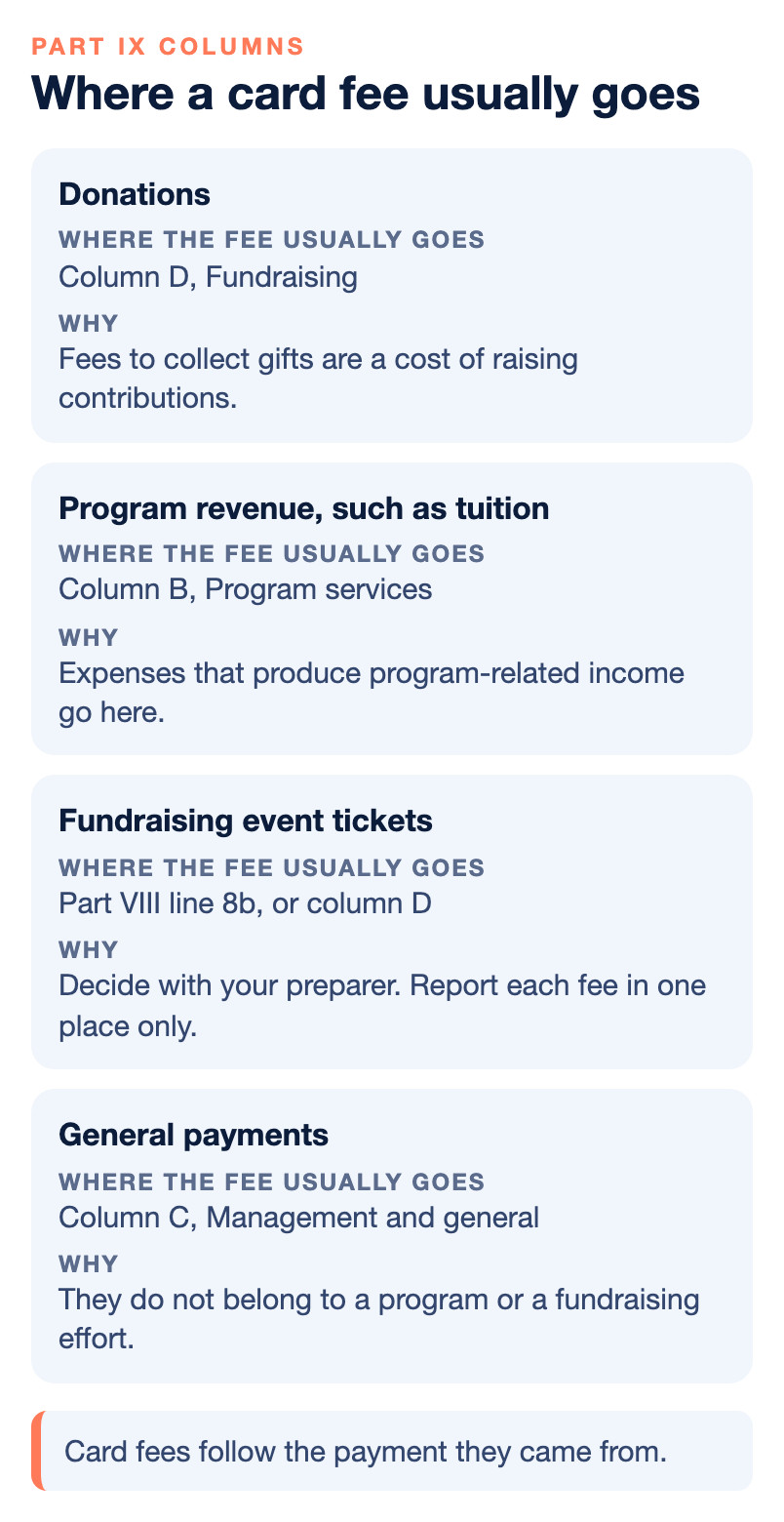
Card fees follow the payment they came from, which makes them easier to allocate than most shared costs.
- Fees on donations. The instructions define fundraising expenses as those incurred in soliciting contributions, including expenses of preparing to solicit or receive contributions. Fees charged to collect gifts generally sit with column D, Fundraising.
- Fees on program revenue. Tuition, class registrations, camp fees and similar payments for services that further your mission produce program revenue, and the instructions put expenses related to the production of program-related income in column B, Program services.
- Fees on fundraising events. This is the one that needs a careful conversation. Direct expenses of fundraising events are reported on Part VIII, line 8b, rather than in Part IX, and indirect expenses of those events go in column D of Part IX. Whether card fees on ticket sales count as a direct expense of the event is a question to settle with your preparer. Whichever way you go, do not report the same fee in both places.
- Everything else. Fees on payments that do not belong to a program or a fundraising effort, such as a refund of an overpayment or a general administrative charge, fit column C, Management and general.
If your payments platform tags each transaction with a campaign, a fund or a program, this split is a report you run, not a project. If it does not, the fallback is a reasonable allocation based on how your revenue divides between gifts, programs and events, written down and applied the same way every year.
When a donor chooses to cover the fee
Many donation forms now ask donors whether they would like to add a little extra so the organization receives the full amount of the gift. When a donor says yes, that extra amount is part of what they gave voluntarily, without receiving goods or services in return, which matches how the instructions describe a contribution. The usual treatment is to report the whole amount the donor paid as the contribution and the full fee as an expense, rather than letting the two cancel each other out.
The same rule, do not net related items, applies here. It is tempting to say the donor covered the fee so there is nothing to report, but the processor still charged a fee, and the donor still gave more than the base amount. Your donor’s receipt should show what they actually paid, and your books should show both sides. Ask your preparer to confirm this treatment for your organization, especially if you also run events where part of a payment buys a meal or a ticket and part is a gift.
Recurring gifts, refunds and chargebacks
Monthly giving programs create twelve small fee entries per donor per year, which is fine as long as the processor’s monthly statement rolls them up for you. The bigger risk with recurring giving is a card that expires or is replaced, so the gift fails quietly and the donor lapses without anyone noticing. That is a fundraising problem more than a tax one, and our guide to recurring payments covers the billing side.
Refunds and chargebacks need their own entries. When a gift is refunded, the contribution was not really received, and your preparer will want to see the refund recorded rather than buried inside a smaller deposit. Chargebacks often carry their own fee on top of the reversed amount. Keep those fees in the same account as your other card fees, or in a clearly named account beside it, so that the yearly total your preparer reports is complete. If chargebacks are frequent, treat that as a signal to look at your donation forms and receipts, since unclear descriptors and surprise recurring charges are common causes.
Set up your books so the 990 is easy next year
Most of the pain in reporting processing fees comes from trying to reconstruct a year of transactions in March. A few habits during the year remove almost all of it.
- Download every monthly processing statement and keep them with your accounting records. Our guide on how to read your merchant statement shows where the total sales and total fees appear, and those two numbers are what your bookkeeper needs each month.
- Record deposits at gross with the fee as a separate line. In most accounting systems this is a deposit entry with the full amount credited to revenue and the fee debited to an expense account. If your payments platform syncs to your accounting software, check that the sync records fees this way instead of posting net deposits.
- Use separate expense accounts for card processing fees, payment software subscriptions and ordinary bank charges, so each can be mapped to its Part IX line.
- Tag transactions by fund or campaign wherever your tools allow it, which makes the program, management and fundraising split a matter of running a report.
- Reconcile once a quarter, not once a year. Compare the processor’s gross totals, your recorded revenue and your recorded fees, and chase any gap while the details are fresh.
It also helps to understand how your fees are built in the first place. Flat-rate, tiered and interchange-plus pricing all show up differently on a statement, and our guide to merchant account pricing models explains the difference in plain words. Knowing which model you are on makes it much easier to spot a statement that does not add up.
Where NPS fits, and where it does not
NPS works with nonprofits alongside the businesses we serve, and our NPS One platform includes a donation flow built for this kind of record keeping. Nonprofits can create separate donation pages for a general fund, a specific campaign or an event, each with its own QR code, and because each campaign has its own link, you can see how much each effort raised. Donation receipts are generated and sent automatically with the language used for tax-deductible contributions, and donors can optionally be asked to cover the processing fee. NPS One also connects to QuickBooks Online with a two-way, near-real-time sync, which we describe in our guide to the NPS One and QuickBooks integration.
On cost, some nonprofits may qualify for special pricing, and eligibility depends on factors such as the merchant category code, card type and how transactions are processed. We price each account individually rather than publishing one universal rate, so the honest answer to “what will it cost” is to ask for an itemized quote in writing and compare it on total fees, not on a single headline percentage. If you are still choosing, our overview of the best payment processing providers for businesses sets out how the main types of provider differ.
We are probably not the right fit if your organization processes very little by card, wants an instant self-service donation button with no application, or would rather not provide underwriting documents. A small volunteer group that files Form 990-N, which the instructions describe as the electronic notice for organizations whose gross receipts are normally $50,000 or less, may be well served by a simple donation tool. We are built for organizations that want a payment partner with support, integrations, ACH and reporting, rather than a bare donation button.
Questions to ask your processor before year end
- Can I export every transaction for the year with gross amount, fee and net amount on each line?
- Are fees taken out of each deposit or charged in one monthly debit?
- Will I receive a Form 1099-K, and what gross total will it show?
- Can transactions be tagged by fund, campaign or program?
- Does the sync to my accounting software record fees as a separate expense?
- Are software subscriptions and equipment charges listed separately from per-transaction fees?
- How are refunds, chargebacks and chargeback fees shown on the statement?
If any answer is no, you can still file correctly, it just takes more work. That extra work is worth knowing about before you sign with a processor, and worth raising now if you already have one.
Bottom line
Treat the gift and the fee as two separate facts, because that is how Form 990 wants to see them. Report the full gift in Part VIII, report the fee in Part IX on one line your preparer picks and keeps, and split it by what each payment was for. The organizations that find this easy are the ones whose processor gives them gross, fee and net on every transaction and whose books record fees on their own account from the first deposit of the year. If yours does not, fix that before the year closes, then let your CPA make the final calls on lines and columns. If you want to see whether your current reports give your preparer what they need, talk to our team, and you can find more plain-language guides in our payments guides.
Frequently asked questions
Do nonprofits report donations gross or net of credit card fees on Form 990?
Gross. The Form 990 instructions say to report revenue and expenses separately and not to net related items unless an instruction says otherwise. They also say an organization that reports contributions net of related fundraising expenses can be subject to a penalty. Report the full gift as revenue and the fee as an expense.
Which line of Form 990 Part IX do credit card processing fees go on?
The instructions do not name card processing fees on any line. Line 13, Office expenses, lists bank fees, and many preparers report card fees there, while others use line 24, Other expenses, with a clear label. Choose one with your CPA and use it consistently every year.
Are processing fees on donations a fundraising expense?
Generally, yes. The instructions define fundraising expenses as those incurred in soliciting contributions, including preparing to solicit or receive them, so fees on gifts usually go in column D. Fees on program revenue such as tuition usually go in column B, and general fees in column C.
How do I handle fees when a donor chooses to cover them?
The usual treatment is to report the full amount the donor paid as the contribution and the full fee as an expense. The extra amount was given voluntarily, which fits how the instructions describe a contribution. Confirm the treatment with your preparer.
Where do card fees on fundraising event tickets go?
Direct expenses of fundraising events go on Part VIII, line 8b, and indirect event expenses go in column D of Part IX. Whether card fees on ticket sales are a direct event expense is a decision to make with your preparer. Report each fee in one place only.
Why does my 1099-K not match my bank deposits?
The IRS explains that the gross payment amount on Form 1099-K is not adjusted for fees, while many processors take fees out before the money reaches your bank. The difference is usually your processing fees, plus any refunds or chargebacks. Your processor’s statements show the full breakdown.
Does a small nonprofit need to worry about this?
Yes, if it files Form 990 or 990-EZ, because both report revenue and expenses. The instructions describe Form 990-N as the electronic notice for organizations whose gross receipts are normally $50,000 or less, and it asks for far less detail. Good records still help if you grow into a fuller return.
Is this tax advice?
No. This guide explains the IRS Form 990 instructions in general terms from a payment processor’s point of view. Line choices and allocations depend on your organization and your state rules, so confirm every decision with your CPA or tax preparer.