CBD chargebacks are different from ordinary e-commerce chargebacks because they cluster around a few predictable triggers: recurring orders customers forget they signed up for, billing descriptors nobody recognizes, shipments that stall or never arrive, and buyers who expected something the label never promised. Each of those can be designed out of the business before the first dispute arrives. The harder truth is that a CBD merchant has far less room for error than a T-shirt shop, because the bank that approved the account was already cautious, so a dispute rate that would be shrugged off elsewhere can lead to reserves, reviews or a closed account. This guide explains the pattern, the controls that actually change it, and the ones that only look like they do.
The bottom line
- Most CBD disputes start before the sale, in the offer, the checkout and the descriptor, not in the dispute response. Fix those first.
- Recurring and trial offers are the biggest single risk. If you sell auto-ship, make the terms impossible to miss, remind customers before they are billed and make canceling easy.
- A charge the customer recognizes is a charge they rarely dispute. Use a billing descriptor that matches your store name and includes a way to reach you.
- Refunding early is cheaper than fighting late. Dispute alert tools let you refund a transaction before it becomes a chargeback, which protects the ratio your bank watches.
- Never solve a chargeback problem by hiding what you sell. A vague business description or a second account to spread out disputes turns a fixable problem into a terminated one.
Who wrote this, and what we will not claim
Nationwide Payment Systems (NPS) publishes this guide. We are a payment processing company in South Florida, in business since 2001, and we work with CBD and hemp businesses every week, so we have a stake in where CBD merchants process. We do not quote dispute percentages, fees or reserve amounts here, because those depend on your bank, your products, your sales channels and your history, and anyone who quotes you one number for every CBD merchant is guessing. Card-network rules change, so treat the network details below as general guidance and confirm the current version with your processor.
Why CBD disputes do not look like general e-commerce disputes
A typical online store sees a spread of disputes: some stolen cards, a few packages that went missing, the occasional customer who forgot what they bought. A CBD store sees all of that, but the mix leans hard toward a handful of causes, and those causes are tied to how CBD is usually sold. That is good news, because a pattern you can name is a pattern you can control.
Three things set the category apart. First, a large share of CBD revenue comes from repeat purchases, subscriptions and auto-ship programs, and recurring billing has always produced more disputes than one-time sales. Second, the category is heavily watched. Our guide to getting approved for a CBD merchant account describes how many agencies keep an eye on CBD sellers, and federal regulators have gone after companies for advertising health claims they could not support. Marketing that oversells creates customers who feel misled, and customers who feel misled file disputes. Third, CBD merchants are underwritten as high risk from the start. The acquiring bank priced in more exposure than it would for a general retailer, so it reacts sooner when disputes rise.
Put those together and you get a business that generates more of the disputes banks dislike most, on an account the bank was already watching closely. That is why the controls matter more here than almost anywhere else.
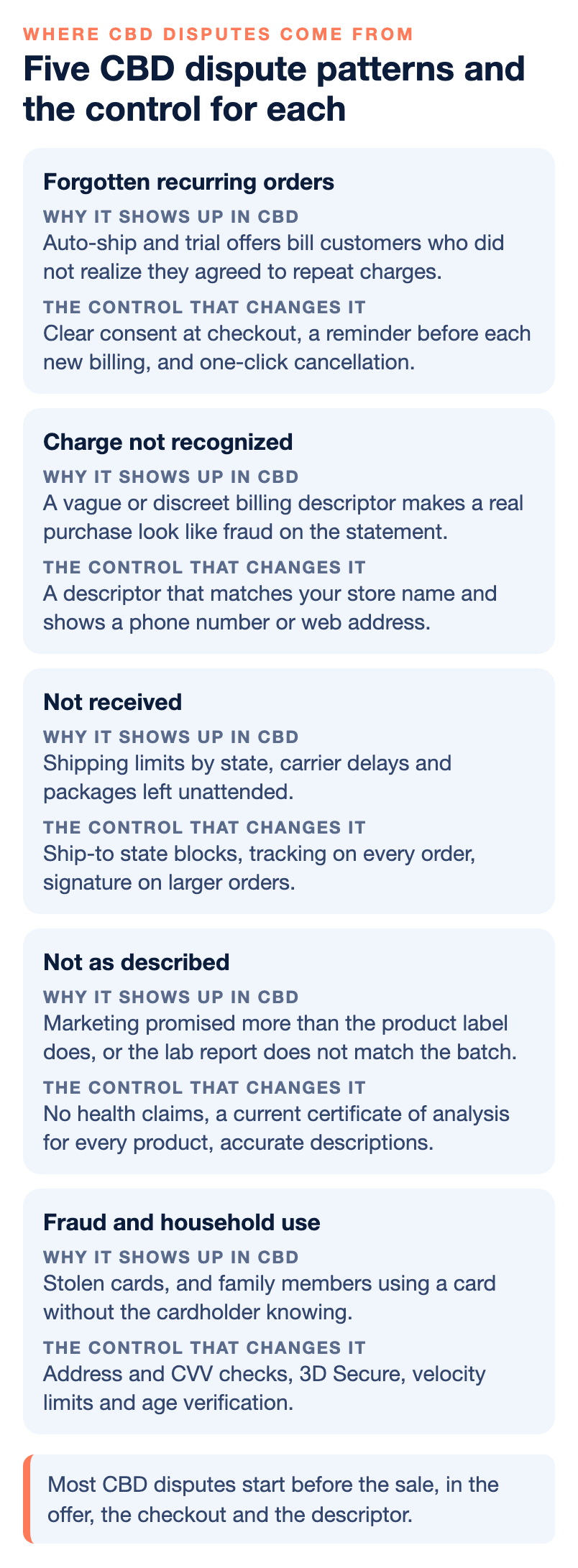
The five dispute patterns that drive CBD chargebacks
When we review a CBD merchant’s disputes, they almost always sort into the same few groups. Seeing which group dominates tells you where to put your effort.
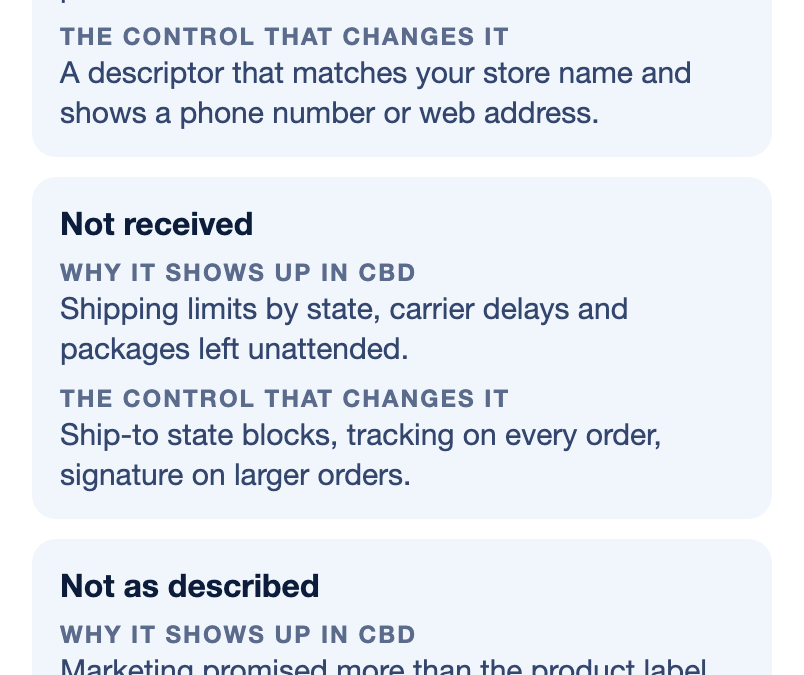
| Pattern | Why it shows up in CBD | The control that changes it |
|---|---|---|
| Forgotten or unwanted recurring orders | Auto-ship and trial offers bill customers who did not realize they agreed to repeat charges. | Clear consent at checkout, a reminder before each new billing, and one-click cancellation. |
| “I don’t recognize this charge” | A vague or discreet billing descriptor makes a real purchase look like fraud on the statement. | A descriptor that matches your store name and shows a phone number or web address. |
| Not received | Shipping limits by state, carrier delays and packages left unattended. | Ship-to state blocks, tracking on every order, signature on larger orders. |
| Not as described | Marketing promised more than the product label does, or the lab report does not match the batch. | No health claims, a current certificate of analysis for every product, accurate descriptions. |
| True fraud and household use | Stolen cards, and family members using a card without the cardholder knowing. | Address and CVV checks, 3D Secure, velocity limits and age verification. |
1. Recurring orders the customer forgot about
Subscriptions are the backbone of a lot of CBD businesses, and they are also the single most reliable source of disputes. The problem is rarely the subscription itself. It is the customer who checked a box months ago, never thought about it again, and then saw a charge they did not expect. To that customer it feels like they were billed without permission, and the fastest way to get the money back is to call the bank rather than the store. Free-trial offers that roll into a full-price subscription are worse, because the customer believed they were getting something for free.
The card networks have tightened their rules for exactly this kind of offer. In general, a merchant that converts a trial or introductory offer into recurring billing is expected to get the customer’s clear agreement to the terms, confirm them after the sale, remind the customer before the first full-price charge and make canceling simple. The details vary by network and change over time, so ask your processor which rules apply to your offer before you launch it.
2. Charges the customer does not recognize
Some CBD sellers choose a discreet descriptor, on the theory that customers would rather not see “CBD” on a card statement. It sounds considerate, and it backfires. When a customer cannot match a charge to a purchase, the natural assumption is fraud, and the dispute goes in under a fraud reason code, which is the kind banks weigh most heavily. A descriptor that matches the store name the customer saw at checkout, plus a phone number or web address, stops a surprising share of these before they start. It also matters for compliance: the descriptor should reflect the business your bank approved, not a different one.
3. Orders that never arrive
Not every state treats hemp and CBD products the same way, and rules have been changing at both the state and federal level. A CBD store that ships everywhere without checking where it can lawfully send its products risks packages that are held, returned or refused, and every one of those is a likely “not received” dispute. Our CBD approval guide makes the point plainly: if there is a state you cannot ship to, block it at checkout. Beyond that, the ordinary e-commerce discipline applies. Use tracking on every order, keep the confirmation, and require a signature on larger orders so you have proof that holds up.
4. Products that were not what the customer expected
This is the pattern most tied to the category’s marketing. When a product page or an influencer post suggests a product will do something specific for the buyer’s body or mind, a customer who does not get that result has a reason to say the product was not as described. That is a dispute you are unlikely to win, and the marketing that caused it can also draw attention from regulators. Describe what is in the product, the amount, the ingredients and how to use it. Leave out what it will do for someone’s health.
The lab report is the other half of this. A current certificate of analysis for each product, matched to the batch you are shipping and linked from the product page, gives the customer confidence before they buy and gives you evidence if they dispute later. A report that is out of date, or that shows something different from the label, works against you.
5. Stolen cards and household purchases
True fraud hits CBD merchants the same way it hits any online store, through stolen card numbers tested on low-value orders and then used for bigger ones. CBD adds a household wrinkle: a family member, sometimes a younger one, uses a parent’s card, and the cardholder disputes a charge they did not make. Address verification, CVV checks, 3D Secure on online orders, limits on how many orders one card or address can place in a short window, and age verification at checkout all reduce both kinds. None of them is perfect, and each one adds a little friction, so tune them to your own fraud history rather than switching everything to maximum.
Why a CBD account has less room for error
Every merchant account is watched for its dispute ratio, the share of transactions that turn into chargebacks, and the card networks run monitoring programs that act when a merchant’s ratio stays above their thresholds. Our guide to high-risk chargebacks, RDR and VAMP explains how those programs work and what happens at each stage, from an early warning to fines and possible termination.
For a CBD merchant, two things make that pressure sharper. The acquiring bank often watches more closely than the networks require, and it may set its own internal limits well before a network program would ever apply. And the consequences of losing an account are bigger, because fewer banks underwrite CBD, so a termination is harder to replace. Some payment platforms have stopped supporting CBD and hemp entirely, as we explain in our article on a major platform dropping CBD merchants. A closure for excessive chargebacks can also lead the bank to add the business to MATCH, the list acquiring banks check on new applications, which is why we wrote about the 14 reasons merchants end up on the MATCH list.
The practical takeaway is to watch your own ratio monthly, by card brand, and to act on a rising trend long before anyone sends you a warning.
The controls that actually work
None of these is exotic. What separates the CBD merchants who keep their accounts from the ones who lose them is usually not a secret tool. It is doing the ordinary things completely and early.
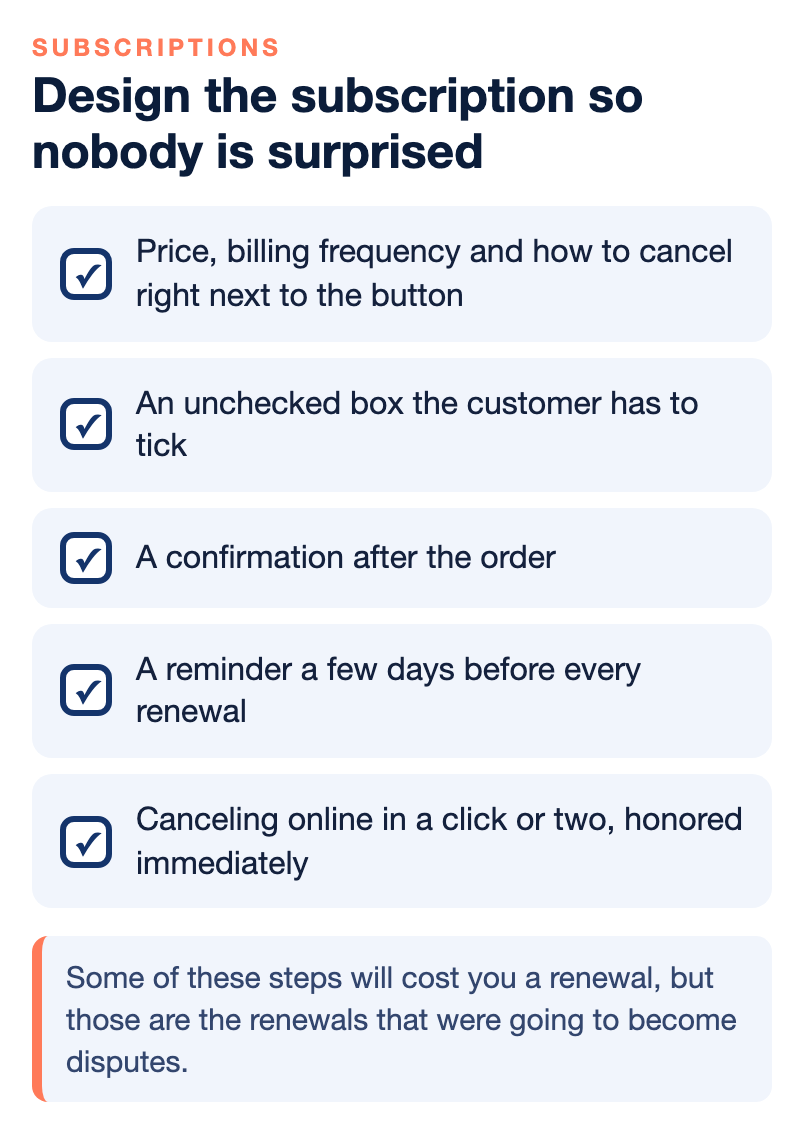
Design the subscription so nobody is surprised
Show the price, the billing frequency and how to cancel right next to the button that starts the subscription, not in the terms page. Use an unchecked box the customer has to tick. Send a confirmation after the order and a reminder a few days before every renewal. Make canceling possible online in a click or two, and honor it immediately. Each of these steps feels like it might cost you a renewal, and some of them will. The renewals you lose this way are the ones that were going to become disputes.
Make every charge recognizable
Ask your processor what your billing descriptor shows today, then change it if a customer would not connect it to your store. Put your store name first and add a phone number or web address. Send an order confirmation email from the same name, and mention in it how the charge will appear on the statement.
Refund before the dispute becomes a chargeback
Dispute alert programs let a merchant see that a cardholder has contacted their bank and, in many cases, refund the transaction before it becomes a formal chargeback. Visa’s Rapid Dispute Resolution can do this automatically under rules you set, and a refunded case does not count against your chargeback ratio. For a CBD merchant with recurring orders, this is often the single most effective tool, because it turns a compliance event into an ordinary refund. Set the rules carefully: refunding every small-dollar alert automatically is usually sensible, while larger orders may deserve a closer look.
Answer customers faster than their bank does
A customer who cannot reach you calls the number on the back of their card. Put a phone number and email on every page, answer within a business day, and give your team the authority to issue a refund without a long approval chain. A quick refund costs you the sale. A chargeback costs you the sale, a fee and a mark against your ratio.
Keep an evidence file for every order
When you do fight a dispute, the issuing bank decides, and it decides on the evidence you send. Our Chargeback Rescue program is built around this. For CBD, a strong file includes the order details, IP address and device information, address and CVV results, 3D Secure authentication where used, the subscription consent and the reminder emails, tracking and delivery confirmation, the certificate of analysis for the batch shipped, and every message with the customer. Build the file at the moment of sale, not after the dispute arrives, because response windows are short.
Keep the website in order
Underwriters and issuing banks both read your website. Show your real business name, a way to reach you, accurate product descriptions and prices, a clear refund and cancellation policy, your shipping limits, age verification, and certificates of analysis. Remove health claims and before-and-after promises. A website that matches what the bank approved is one of the strongest pieces of evidence you have.
The controls that only look like they work
Some common fixes make the problem worse, and a few can end the account outright.
- A discreet descriptor. It produces exactly the “I don’t recognize this” disputes it was meant to avoid.
- Describing the business as something more generic. Calling a CBD store a wellness shop or general retail might get an account opened, but the mismatch usually comes out, and the result is worse than the original problem.
- Spreading sales across several accounts to keep each ratio low. Banks and card networks treat this as a way of hiding risk, and it can lead to every account being closed together.
- Fighting every dispute on principle. Representment takes time and still leaves the chargeback on your record if you lose. Prevent and refund where you can, and fight the ones your evidence can actually win.
- A stronger refund-policy page alone. A policy helps, but a customer who has already decided to call the bank rarely reads it first. The controls that work act before that moment.
Where NPS fits, and where it does not
We place CBD and hemp businesses with acquiring banks that underwrite the category on purpose, and before we submit an application we review the website, the product pages, the certificates of analysis, the shipping rules and the subscription setup, because most of the chargeback risk lives there. Once an account is open, we monitor dispute activity, help set up dispute alerts and RDR where they fit, provide chargeback alert tools, help merchants respond to disputes through Chargeback Rescue, and connect higher-volume online merchants with dedicated chargeback management firms. Accounts come with live, U.S.-based support and a dedicated account manager. You can read more about our high-risk merchant services.
We are specific about the line in this category. We work with cannabis-related businesses that do not touch the plant, such as CBD and hemp products, pipes and smoking accessories, medical card services and companies that sell to cannabis businesses. We do not process for dispensaries, growers or any business that touches the plant.
We may also not be the right choice if:
- You want an instant, self-service account. We underwrite every CBD account, and that takes documents and a review.
- You would rather keep the health claims. We will ask you to remove them, because they drive disputes and regulatory attention.
- You do not want to change a confusing subscription or descriptor. Those are the first things we will ask about.
- Your products cannot be sold lawfully where you ship them. No processor can fix that, and a good one will tell you so.
- You sell very little and only occasionally. We may not be the best fit for hobby sellers with very low volume.
Wondering how close your own numbers are to a warning? Our guide to the chargeback ratio at which card networks start threatening an account walks through how the ratio is counted and what happens at each stage.
Next step
A CBD chargeback problem is almost never solved in the dispute response. It is solved in the offer, the checkout, the descriptor, the shipping rules and the speed of your customer service, and the merchants who fix those early tend to keep their accounts. If you want a second set of eyes on your dispute history, your subscription setup or a warning from your processor, you can talk with our team. More guides on processing, chargebacks and high-risk accounts are in our payments guides.
Frequently asked questions
Why do CBD merchants get more chargebacks than other online stores?
CBD sales lean heavily on subscriptions and auto-ship, which produce more disputes than one-time sales. Vague billing descriptors, shipping limits by state and marketing that oversells add to it. Each of those causes can be controlled, which is why two CBD stores of the same size can have very different dispute rates.
What is the most common reason for a CBD chargeback?
Recurring orders the customer forgot about or did not understand are usually the biggest group. Charges the customer does not recognize on a statement come close behind. Clear subscription terms, renewal reminders and a recognizable descriptor reduce both.
Should a CBD store use a discreet billing descriptor?
Usually not. A descriptor the customer cannot connect to a purchase tends to be disputed as fraud. Use your store name and add a phone number or web address so the customer can reach you instead of the bank.
Does RDR help CBD merchants?
Often, yes. Rapid Dispute Resolution can refund a Visa transaction before it becomes a formal chargeback, and that case does not count against your chargeback ratio. Ask your processor whether it is available on your account and how to set the refund rules.
Can a CBD merchant win a chargeback?
Yes, when the evidence is strong and the dispute is one the evidence can answer. Order details, address and CVV results, 3D Secure, subscription consent, tracking, the certificate of analysis and customer messages all help. Disputes about a product not doing what marketing promised are much harder to win, which is one more reason to leave health claims out.
What happens if a CBD account has too many chargebacks?
The bank may add a reserve, limit processing, review the account or close it, and card-network monitoring programs can add fines. A closure for excessive chargebacks can also lead to a MATCH listing. Watching your ratio monthly and acting early is far easier than replacing a CBD account.
Can I open a second merchant account to spread out my chargebacks?
No. Using several accounts to keep each one’s ratio low is treated as hiding risk, and it can lead to all of them being closed. Fix the causes of the disputes and tell your processor what you are doing about them.
Does NPS work with CBD dispensaries?
No. We work with cannabis-related businesses that do not touch the plant, such as CBD and hemp products, smoking accessories and companies that sell to cannabis businesses. We do not process for dispensaries, growers or any business that touches the plant.