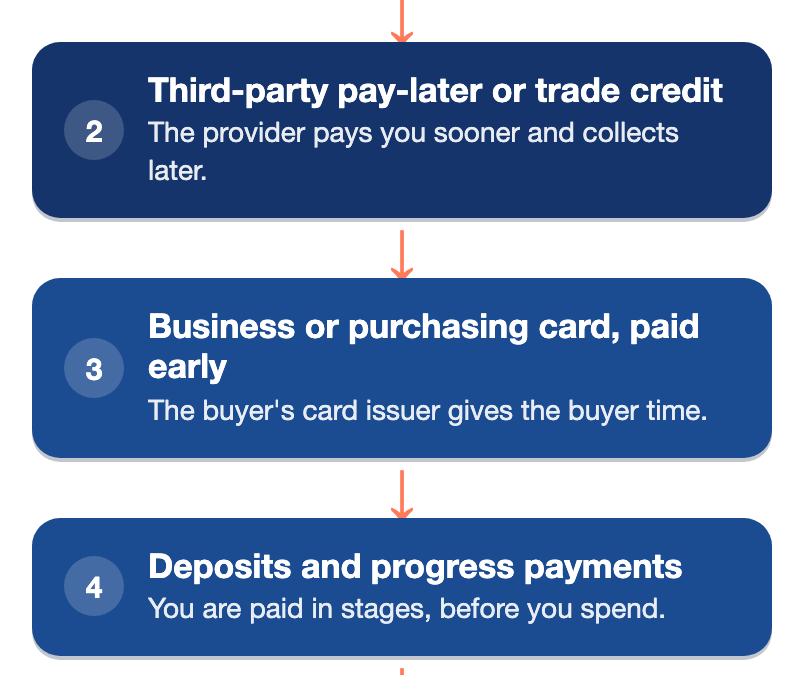
A B2B merchant has five realistic ways to let a business buyer pay later: net terms you carry yourself, a third-party pay-later or trade-credit provider that pays you up front, the buyer’s own business or purchasing card, deposits and progress payments, and lender-based financing or leasing for big equipment. The right one depends less on the buzzword and more on a single question, which is who carries the wait and the risk between the day you ship and the day the money lands. This guide walks through each option in plain words, compares them side by side, says honestly where Nationwide Payment Systems (NPS) fits and where it does not, and gives you the questions to ask before you sign anything.
The short answer
- If your buyers already pay on time and you have the cash to wait: structured net terms, with clear rules and electronic invoices, are often enough. The trick is the rules, not the terms.
- If you are losing orders because buyers want more time than you can afford to give: a third-party B2B pay-later or trade-credit provider can pay you sooner and carry the buyer’s credit risk, in exchange for a fee. Read who carries the loss if the buyer never pays.
- If your buyers carry corporate or purchasing cards: let them pay by card early, inside a short window, so their card issuer gives them the float instead of you.
- If you build to order or run long projects: deposits and progress payments protect you before you spend money on materials and labor.
- If the purchase is large equipment the buyer will use for years: lender-based equipment financing or leasing usually fits better than any pay-later button.
- Whatever you choose, write a payment policy first. A pay-later option without a policy just moves the late payments somewhere else.
Who wrote this, and what we will not claim
Nationwide Payment Systems publishes this guide. We are a payment processing company based in South Florida and have worked with merchants since 2001. We help businesses accept cards and ACH, send electronic invoices and offer customer financing, so we have a point of view, and we will tell you where it ends. We quote nobody’s rates or fees in this article, because those depend on your industry, your buyers and the terms you pick, and any number we printed here would be wrong for someone. Ask every provider, including us, for its pricing in writing.
Nothing here is legal, tax or lending advice. Business financing rules vary by state and by product, and some states require specific disclosures for commercial financing. If you are offering credit to your customers or signing with a lender, have your accountant or attorney read the agreement.
What “buy now, pay later” means when the buyer is a business
Most people hear “buy now, pay later” and picture a shopper splitting a purchase into a few payments at an online checkout. That is the consumer version, and it is built around one person, one card or bank account and a quick credit check. Business purchasing works differently, and the differences decide which options make sense for you.
A business buyer rarely pays the moment it decides to buy. A purchase order goes out, the goods ship or the service starts, an invoice arrives, accounts payable enters it, someone approves it and only then does a payment go out. On our own B2B payment gateway guide we describe that chain as a lot of steps, and every one of them adds delay. A typical supplier may be juggling large invoices, commercial and purchasing cards, purchase orders, several contacts at one customer and Net-30 or Net-60 terms all at the same time.
So in B2B, “pay later” usually means one of two things. Either the seller gives the buyer time and waits for the money, or someone else steps in, pays the seller and collects from the buyer later. Everything below is a variation on those two ideas. The useful question is never “should we offer BNPL?” but “who is going to be the bank in this sale, and what does that cost?”
Five ways to let a business buyer pay later
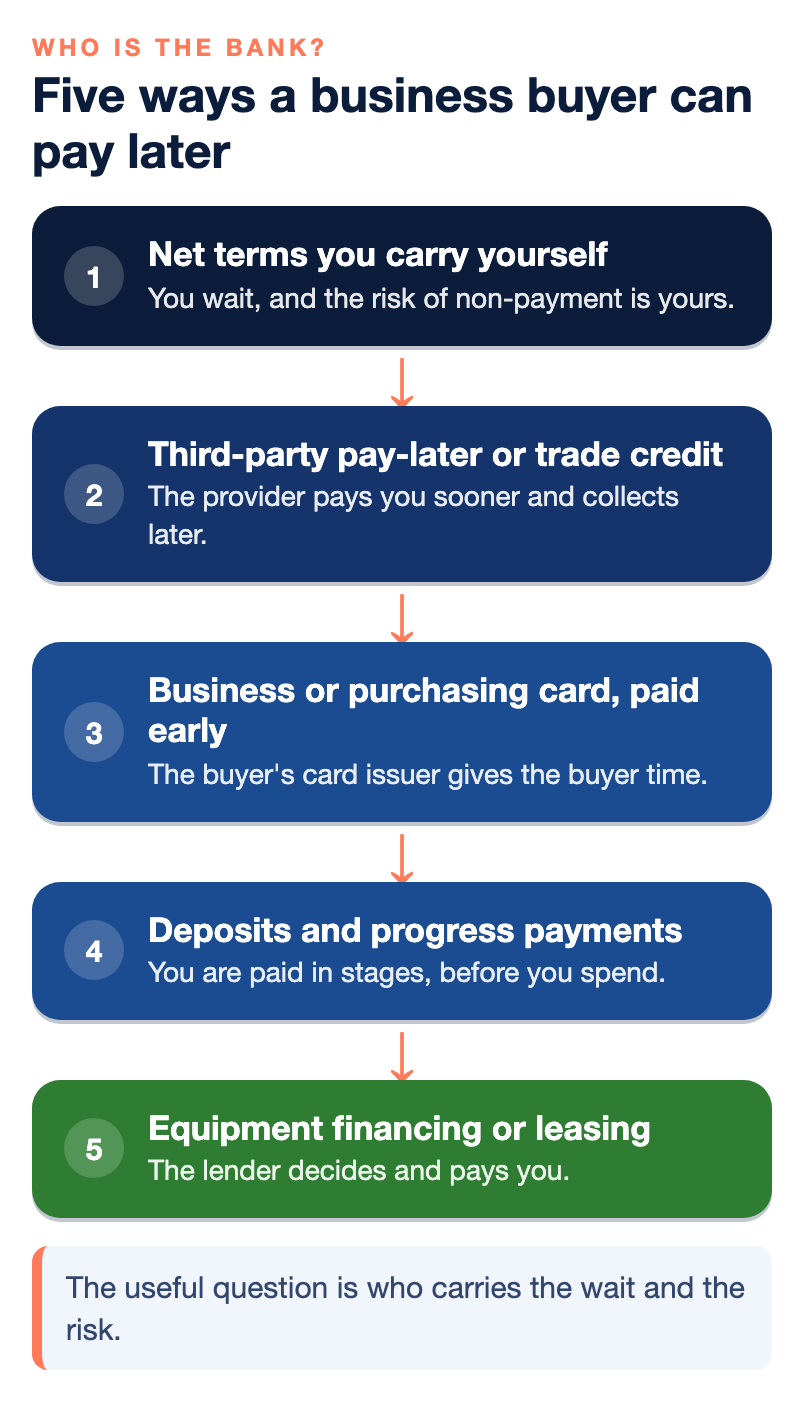
1. Net terms you carry yourself
Net terms are the oldest pay-later option in B2B. You ship, you invoice and the buyer agrees to pay within a set number of days. It costs you nothing per transaction, and your customers already understand it, which is why so many suppliers default to it.
The cost is hidden in the wait. Every unpaid invoice is money you have already earned but cannot use for payroll, inventory, freight or rent, and the risk that the buyer pays late, or never pays, sits entirely with you. In a B2B Vault podcast episode on not being your customer’s bank, we talked about a pattern that hurts suppliers twice: the buyer gets Net-30 terms, pays at day 45 or 60, and then pays by card, so the supplier finances the receivable for two months and still pays the card cost at the end.
Net terms work best when you know your buyers, your margins can absorb the wait and you have rules that are actually enforced. They work worst when you are growing fast, selling to new customers you have not vetted or already short on cash.
2. A third-party B2B pay-later or trade-credit provider
This is the option most people mean when they say “B2B BNPL.” A specialized provider reviews your buyer, offers the buyer terms or installments and pays you, usually much sooner than the buyer would have. The provider then collects from the buyer on the agreed schedule. In effect, you hand the waiting and the credit decision to someone whose business is lending.
The appeal is easy to see. You can say yes to a buyer who wants time without tying up your own cash, and your sales team gets another way to close an order without discounting. The trade-off is a fee to you, which often grows with the length of the terms, plus a set of rules you no longer control. The provider decides which of your buyers qualify, how much credit each one gets and what happens when an invoice is disputed.
The most important line in any of these agreements is recourse. In a non-recourse arrangement, the provider generally absorbs the loss if an approved buyer does not pay. In a recourse arrangement, the loss can come back to you, which means you are still carrying the risk and paying a fee on top. Ask for this in writing before anything else, together with how returns, partial shipments and disputed invoices are handled.
3. The buyer’s own business or purchasing card
Many business buyers already have a pay-later tool in their wallet: a corporate card, a purchasing card or a virtual card issued by their bank. When they pay you by card, their card issuer gives them time to pay, and you get your money on your normal funding schedule. Their bank becomes the bank, which is exactly where that job belongs.
The catch is timing. If a buyer pays by card on day 60, you have already financed the order for two months and then you pay the card cost on top. The smarter policy, which we discussed on the podcast and support in NPSONE Smart Invoicing, is rules-based acceptance: card payments are allowed inside an early window, and after that window the card option goes away and ACH stays available. The buyer still gets flexibility from its issuer, and you get paid while the money is still worth something to you.
If a meaningful share of your buyers pay with commercial or purchasing cards, ask your processor about Level 2 and Level 3 data. Sending details such as tax amounts, purchase order numbers and line items can help eligible commercial card transactions qualify for lower interchange categories. The savings depend on the card and the data, so ask for an itemized review rather than a promise.
4. Deposits, progress payments and partial payments
Not every order should be paid all at once, and not every “pay later” problem needs a lender. If you build to order, run multi-stage projects or ship large custom jobs, splitting the payment into stages lets the buyer spread the cost while you are paid before you spend money on materials and labor. A common structure is a deposit before production, another payment before shipment and the balance on delivery, though the percentages are yours to set.
This is often the cheapest pay-later option you can offer, because no third party takes a cut beyond your normal payment costs. NPSONE Smart Invoicing supports deposits, partial payments and scheduled payments, with electronic invoices sent by email, text, payment link or QR code, so the buyer can pay each stage by card or ACH without a phone call. The limit is that you still carry the risk on the final payment, so keep the last stage small enough that you can live with a delay.
5. Lender-based equipment financing or leasing
When the purchase is a large piece of equipment the buyer will use for years, the right pay-later option is usually a loan or a lease from a lender that specializes in that kind of asset. The buyer applies, the lender decides and you are paid by the lender. Because the equipment itself can secure the deal, these programs can handle amounts and terms that a checkout button cannot.
The downside is speed and paperwork. Approval can take longer than a card swipe, and the buyer has to qualify on its own credit. If you sell equipment regularly, it is worth having a relationship with a lender in place before the next big quote goes out, so financing is part of the proposal instead of a scramble after the buyer hesitates.
A note on consumer financing
Consumer financing and consumer buy now, pay later programs are built for individuals, not companies. NPS offers customer financing for businesses such as healthcare practices, home services, auto repair and retail, and our consumer program describes options such as 4 to 12 payments for smaller purchases and terms up to 36 months for larger ones. Those programs are a good fit when your customer is a person paying for their own care, repair or home project. They are usually the wrong tool when the buyer is a company paying an invoice through accounts payable.
There is one useful middle ground. Some sellers, such as coaches, consultants and training programs, sell to business owners who are deciding as individuals and would rather spread the cost than spend working capital all at once. For that group, NPS offers coaching program financing, where an approved client gets monthly payment options and the seller avoids creating its own long-term receivable.
The options side by side
| Option | Who carries the wait | Who carries the risk of non-payment | What it costs you | Best for |
|---|---|---|---|---|
| Net terms you carry | You | You | No per-sale fee, but the cost of waiting and collecting | Known buyers, healthy cash, enforced rules |
| Third-party B2B pay-later or trade credit | The provider | The provider if non-recourse, you if recourse | A fee per invoice, often tied to the length of terms | Growing sellers whose buyers want more time than the seller can fund |
| Buyer’s business or purchasing card, paid early | The buyer’s card issuer | The card issuer, subject to card-network dispute rules | Your normal card processing cost | Buyers with corporate, purchasing or virtual cards |
| Deposits and progress payments | Shared by stage | You, on the unpaid stages | Your normal card or ACH cost | Custom orders, projects, manufacturing |
| Equipment financing or leasing | The lender | The lender, after approval | Depends on the program, often paid by the buyer | Large equipment with a long useful life |
Read the table as a starting point, not a verdict. Every provider writes its own contract, and two programs with the same name can put the risk in very different places.
What a pay-later provider looks at before it says yes
If you apply to a third-party B2B pay-later or trade-credit program, expect to be reviewed twice: once as a seller and again, buyer by buyer, every time someone wants terms. As a seller, providers typically want to understand your industry, your average order size, how often orders are returned or disputed and how you prove delivery. A seller with clear invoices, proof of shipment and a low dispute rate is easier to support than one whose orders are often changed after the fact.
For each buyer, the provider decides whether to extend credit and how much. That means some of your customers may be approved for the terms you want to offer and others will not be. Ask in advance what the buyer experience looks like when someone is declined, because a clumsy decline at checkout can cost you a customer you would have happily invoiced on your own terms.
Finally, look at how the program fits the way you already bill. If your team invoices from accounting software, quotes by email and takes some payments by phone, a pay-later option that only works at a web checkout may cover a small slice of your orders. The best program for you is the one that shows up where your buyers actually pay.
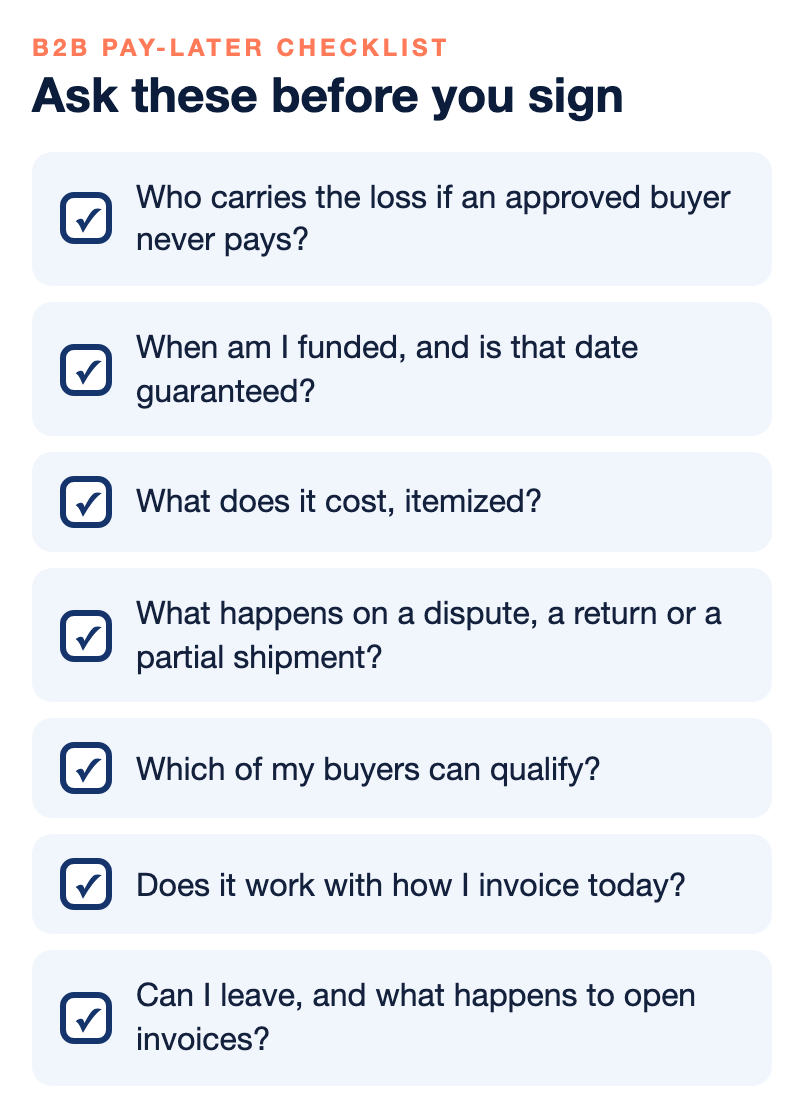
Questions to ask before you sign
- Who carries the loss if an approved buyer never pays? Get the recourse terms in writing.
- When am I funded, and is that date guaranteed? Ask what can delay it.
- What does it cost, itemized? Ask for every fee, how it changes with the length of terms and whether the buyer pays anything.
- What happens on a dispute, a return or a partial shipment? Ask who decides and how money moves back.
- Which of my buyers can qualify, and what happens when one is declined?
- Does it work with how I invoice today? Email invoices, accounting software, phone orders and ACH all count.
- Can I leave, and what happens to open invoices if I do?
Write the payment policy before you add a pay-later option
The most common reason B2B sellers end up acting as their customers’ bank is not a lack of financing options. It is the lack of a written payment policy. Without one, buyers do whatever is easiest for them, and a new pay-later option becomes one more way to pay late.
A good policy answers a short list of questions in writing. When is payment due? Which payment methods are accepted, and until when? When is a card accepted and when is ACH required? What happens when an invoice goes past due, and are new orders paused until it is paid? Which customers are placed on automatic payments? Once those answers exist, the tools can enforce them. Electronic invoices with payment links shorten the time between “invoice sent” and “money received,” and a card window that closes on schedule keeps the cost of card acceptance from landing on top of a 60-day wait.
With the policy in place, you can decide where outside financing earns its fee. Many sellers find they need it for a smaller group of buyers than they expected, such as new customers, very large orders or buyers who need longer terms than the seller can fund.
Common mistakes to avoid
- Treating the advertised fee as the whole cost. The real cost includes recourse, delayed funding, declined buyers and the time your team spends on exceptions.
- Offering long terms to every buyer by default. Terms are a sales tool. Give them deliberately, and tie them to credit you have checked.
- Taking card payments at day 60. If you accept cards, accept them early, and move late payers to ACH.
- Using a consumer program for company purchases. Consumer financing is built for people paying their own bills, not for accounts payable.
- Skipping deposits on custom work. A deposit is the cheapest protection you have before you buy materials.
Where NPS fits, and where it does not
NPS is a good fit if you want the payment side of B2B pay-later done well: card and ACH acceptance, NPSONE Smart Invoicing with deposits, partial payments, scheduled and recurring payments, payment links and rules that close the card window when you decide, plus Level 2 and Level 3 support for eligible commercial card transactions. We also offer consumer financing and coaching program financing when your buyer is an individual or a business owner paying for a program.
We are not the right fit if what you need is a lender that extends trade credit to your business customers at checkout. We do not present NPS as a B2B trade-credit provider, and we would rather tell you that up front than sell you something that does not match your buyers. In that case, choose a specialized provider using the questions above (our guide to choosing a payment processing provider covers the payment side), and keep your invoicing and payment acceptance on a platform that fits how you bill.
Next step
If you are not sure which mix fits, start with your last few months of invoices: how long buyers actually took to pay, how many paid by card and how many orders stalled because a buyer wanted more time. Those answers usually point to the right option faster than any sales pitch. If you would like a second set of eyes on your invoices, payment mix or financing options, contact our team and ask for a written review. You can also browse more plain-language articles in our payments guides.
The bottom line
For most B2B merchants, the best pay-later setup is not a single product. It is a written payment policy, electronic invoices that make paying easy, early card acceptance for buyers with business cards, deposits on custom work and a third-party pay-later or lender program for the buyers who need more time than you can fund. Pick the outside financing last, and pick it by who carries the risk, not by the name on the button.
Frequently asked questions
What is B2B buy now, pay later?
It is a way for a business buyer to receive goods or services now and pay over time, while a third-party provider pays the seller sooner and collects from the buyer later. The provider usually reviews each buyer before offering terms and charges the seller a fee. It differs from consumer buy now, pay later because it is built around invoices, purchase orders and company credit.
Is B2B buy now, pay later the same as net terms?
No. With net terms you carry yourself, you wait for the money and you carry the risk if the buyer does not pay. With a third-party pay-later or trade-credit provider, the provider pays you and collects from the buyer, and depending on the contract it may also carry the risk of non-payment.
What does B2B buy now, pay later cost the merchant?
It depends on the provider, your industry and the length of the terms you offer. Fees are usually charged to the seller and often grow as terms get longer. Ask every provider for an itemized fee schedule in writing, including any recourse terms and what happens on disputes and returns.
What does recourse mean in B2B financing?
Recourse decides who absorbs the loss when an approved buyer does not pay. In a non-recourse program the provider generally takes that loss, and in a recourse program it can come back to you. Read this clause before you compare fees, because it changes what you are really paying for.
Can my business customers just pay with a credit card instead?
Often, yes. Corporate, purchasing and virtual cards already give business buyers time to pay through their card issuer. The key is to accept card payments early, inside a set window, so you are not financing the invoice for weeks and then paying the card cost on top.
Does Nationwide Payment Systems offer B2B buy now, pay later?
We do not present NPS as a B2B trade-credit lender. We help B2B merchants with the payment side, including card and ACH acceptance, NPSONE Smart Invoicing with deposits and partial payments, and Level 2 and Level 3 support for eligible commercial card transactions. We also offer consumer financing and coaching program financing for individual buyers.
Should I offer consumer financing to business buyers?
Usually not. Consumer financing is built for individuals paying their own bills, not for companies paying through accounts payable. One exception is a seller such as a coach or consultant whose buyer is a business owner deciding as an individual.
How do I start offering pay-later options to business buyers?
Start with a written payment policy that sets due dates, accepted payment methods and what happens when an invoice is late. Then add electronic invoices, deposits for custom work and early card acceptance. Choose an outside pay-later or lender program last, for the buyers who need more time than you can fund.