Offering buy now, pay later usually raises the average order value of the customers who choose it, but that is not the same as raising the average order value of your business, and the gap between those two numbers is where most owners get misled. In practice, the change comes from a few specific places: some customers trade up to a bigger purchase, some add one more item, and some people buy who would not have bought at all. Whether your overall average goes up, and whether the extra revenue is worth the cost, depends on what you sell and on the terms you sign. This guide explains where the change really comes from, how to measure it on your own sales instead of trusting someone else’s headline, and what it costs you.
The bottom line
- Financed orders will almost always look bigger than your other orders. That comparison flatters the option, because the customers who reach for a payment plan were already looking at the larger purchases.
- The number that matters is your average across every order, along with your conversion rate and your revenue per visitor or per quote, measured before and after you add the option.
- The lift is strongest on bigger, considered purchases such as repairs, equipment, furniture, home projects and treatment plans, and weakest on small everyday sales where nobody needs to spread the cost.
- Every financed sale costs you something, usually a merchant fee that can be higher than your card rate, so count the profit on orders that would have happened anyway, not only the new ones.
- Get the program terms in writing before you switch it on: what you pay, who carries the risk if the customer stops paying, how refunds work and when you are funded.
Who wrote this, and what we will not claim
Nationwide Payment Systems (NPS) publishes this guide. We are a payment processing company, and we offer customer financing and buy now, pay later programs to the businesses we work with, so we have a reason to want you to say yes. That is exactly why this guide does not quote an average order value increase. Any single percentage you read is someone else’s result, measured on someone else’s customers, and it tells you very little about yours. What we can do is show you how the change happens and how to measure it honestly, so the decision rests on your own numbers. Program terms change, so treat anything here as a starting point and confirm the details with whoever provides your program.
Where the change in order value actually comes from
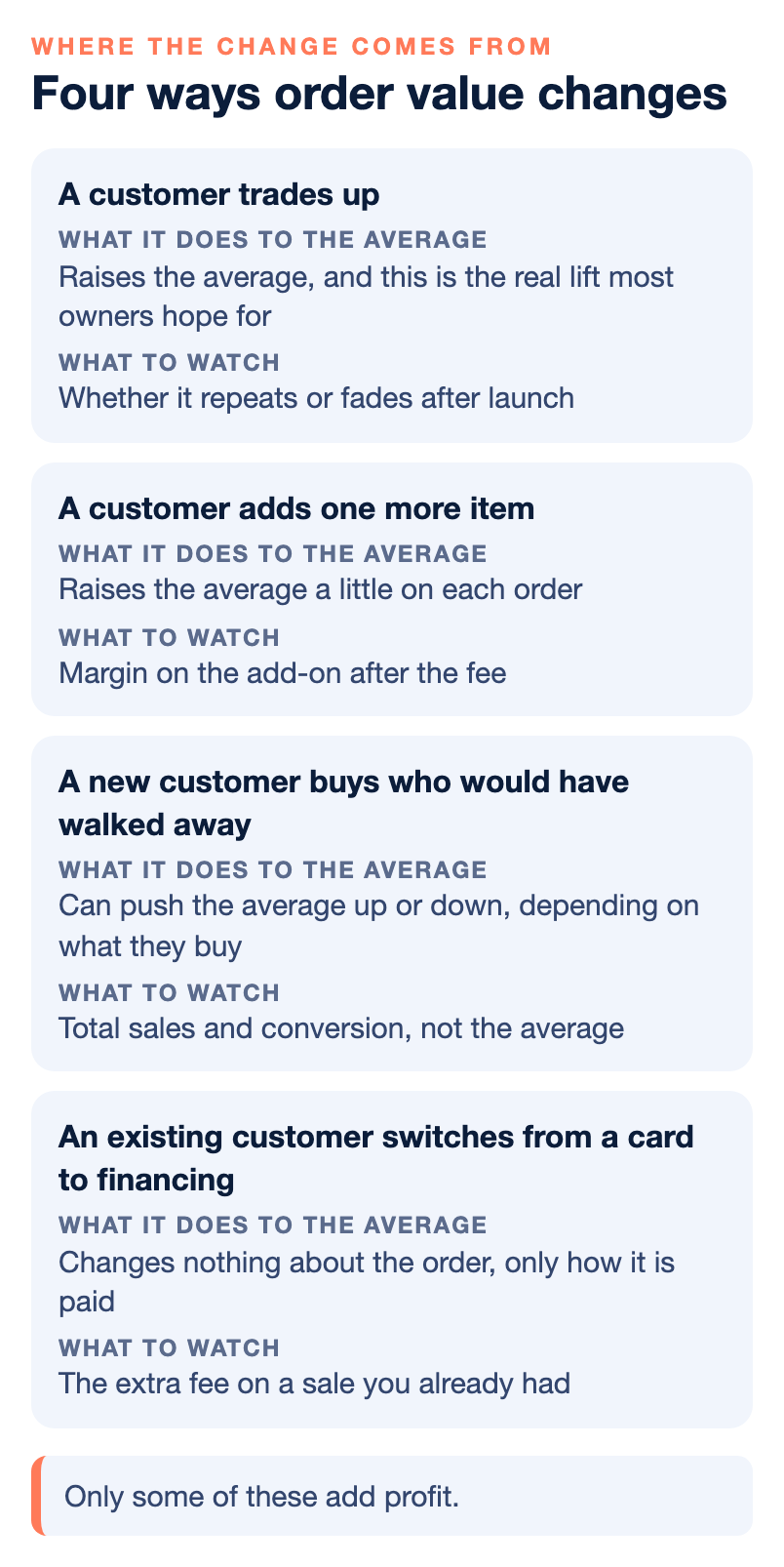
When an owner says buy now, pay later raised their order value, it helps to ask which of four different things actually happened, because they behave very differently once you look at the totals. Each one has a different effect on the average, and only some of them add profit.
| What happens | What it does to the average | What to watch |
|---|---|---|
| A customer trades up to the better model, the bigger job or the full treatment plan | Raises the average, and this is the real lift most owners hope for | Whether it repeats month after month or fades after launch |
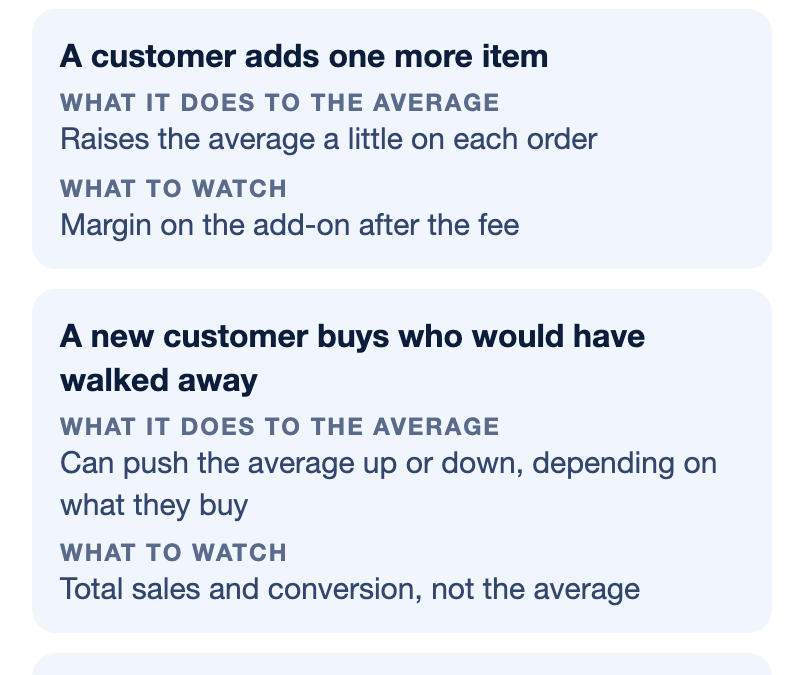
| A customer adds one more item to a purchase they were already making | Raises the average a little on each order | Margin on the add-on after the financing fee |
| A new customer buys who would have walked away without a payment plan | Can push the average up or down, depending on what they buy | Total sales and conversion, not the average alone |
| An existing customer switches from a card to the financing option for the same purchase | Changes nothing about the order, only how it is paid | The extra fee you now pay on a sale you already had |
Trading up is the lift you are hoping for
The most valuable effect is the customer who was going to buy anyway and buys more because the monthly figure feels manageable. A homeowner who was about to approve the cheaper repair chooses the full fix. A shopper picks the better mattress, the bigger set of tires or the complete package instead of the starter one. This is the version of the story that sales pitches tell, and it does happen, mostly where the gap between the basic option and the better one is large enough that paying it all at once is the real obstacle.
Adding one more item is smaller but steadier
On a mid-size purchase, a payment plan can make it easier to say yes to the extra piece, the accessory, the maintenance plan or the second unit. Each of these nudges the order value up a little. It is a quieter effect than trading up, and it is easy to wipe out if the add-on carries a thin margin and the financing fee comes out of the whole order.
New buyers can push the average either way
Some customers who would have walked away will now buy. That is good for revenue, but it can move your average order value in a direction you did not expect. If the new buyers are people who finally say yes to your biggest ticket, the average rises. If the option mainly brings in people buying a smaller item they could not have paid for in one go, your average can stay flat or even fall while your total sales go up. That is why average order value should never be the only number you watch. A flat average with more orders can still be a very good month.
Switching is where the cost hides
The fourth effect is the one owners tend to overlook. Some of the people who choose to pay over time were going to buy the same thing, at the same price, with a card or cash. For those orders nothing about the sale changes, except that you may now pay a higher fee to accept it. The more of your financed orders fall into this group, the less the program earns you, and no dashboard will label these orders for you. You find them by measuring carefully, which is what the next section is about.
Why financed orders always look bigger than they are
Most reports from a financing program compare the orders that used the plan with the orders that did not, and the financed orders come out larger. That comparison is real, but it does not prove the plan made anyone spend more. Customers who choose to pay over time are, almost by definition, the ones looking at the bigger purchases. Someone buying a small item has little reason to split it into payments. So the financed group starts out larger before the option has changed anyone’s mind.
Think of it like comparing the bill of diners who order dessert with the bill of diners who do not. The dessert table will always spend more, partly because of the dessert and partly because people who order dessert tend to be the ones settling in for a long meal. You cannot tell from that comparison alone how much the dessert menu raised your sales. To learn that, you would compare whole evenings with and without the menu. The same idea applies here. The honest test compares your whole business with the option and without it, not one group of orders with the other.
How to measure it on your own sales
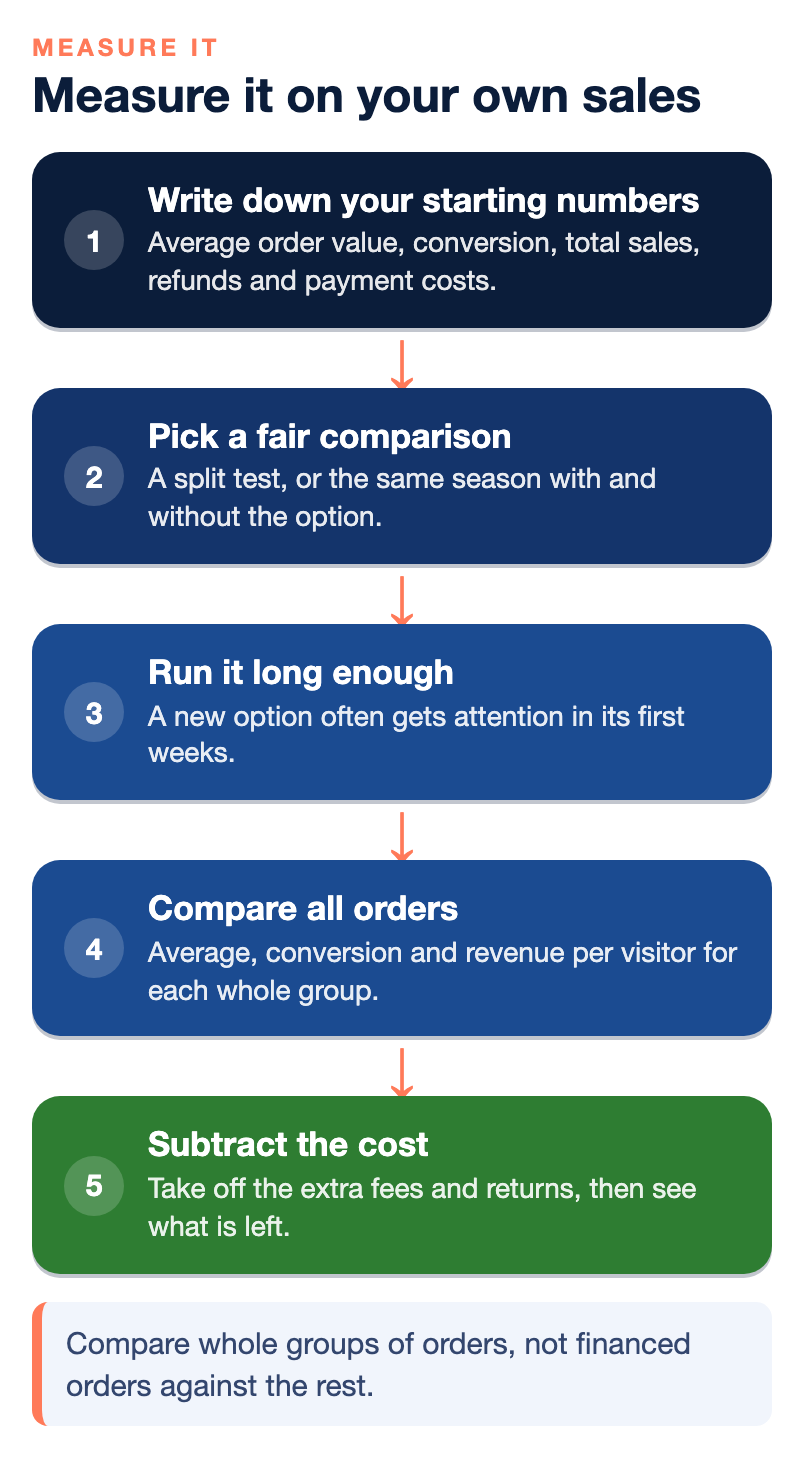
You do not need a data team to answer this question well. You need a clean starting point, a fair comparison and enough orders to trust the result. Here is the order we suggest.
- Write down your starting numbers before you switch anything on. Record your average order value across all orders, your conversion rate or quote close rate, your total sales, your refund rate and what you pay to accept payments, for a recent period long enough to smooth out a slow week.
- Pick a fair comparison. The cleanest is a split test, where half your website visitors see the payment plan option and half do not, or where you alternate weeks in a store or on quotes. If you cannot split, compare the same season with and without the option, since a holiday month against a quiet month tells you nothing.
- Run it long enough to see past the launch. A new option often gets attention in its first weeks. Wait until the novelty has worn off and you have a meaningful number of orders on both sides before you decide.
- Compare all orders, not just financed ones. Look at the average order value, conversion rate and revenue per visitor or per quote for each whole group. That is your real lift.
- Subtract the cost. Take the extra fees you paid on financed orders, including the ones that would have happened anyway, and the cost of any extra returns, then see what is left.
If you sell through quotes or estimates rather than a checkout page, the same method works with a slightly different set of numbers. Track how many quotes are accepted, the average value of an accepted quote and how often customers pick the larger option you offered. Mention the payment plan on every second quote for a few months, or on every quote for one period and none for the next, and keep notes on which ones were offered financing. A service business usually has fewer transactions than a store, so give the test more time before you read too much into it.
The numbers that tell you the most
Average order value is the headline, but on its own it can mislead you. The numbers that, taken together, give you a fair picture are these:
- Average order value across every order, compared between the group with the option and the group without it.
- Conversion rate or quote acceptance rate, because a plan that brings in more buyers can be worth it even if the average stays flat.
- Revenue per visitor or per quote, which combines the two into one number and is often the best single measure.
- Share of orders that use the plan, which tells you how much the fee will cost you over a full year.
- Refund and return rate on financed orders, compared with your other orders.
- Profit after payment costs, because more revenue at a lower margin is a trade, not a win by default.
What offering it really costs
A payment plan program has to be paid for by someone, and in most cases the merchant pays at least part of it. How much depends on the program, the length of the plan and whether the customer pays interest. We will not quote a figure here, because programs differ and the terms change, but these are the costs to ask about and to put in your math.
The merchant fee
Most programs charge the business a fee on each financed sale, and on interest-free plans that fee is often higher than what you pay to accept a card. The fee is easy to accept on a sale you would not otherwise have made. It is harder to justify on a sale you were going to make anyway, which is why measuring the switching effect matters. If you are not sure what you pay today to accept cards, our guide on how to read your merchant statement shows where to find it, so you have a fair number to compare against.
Who carries the risk if the customer stops paying
In most third-party programs the financing provider approves the customer and takes on the repayment, and the business is paid for the sale. That is the main difference between offering a program and running your own informal payment plan, where you deliver the work and then chase the balance. Our article on faster customer financing for high-ticket sales explains why becoming your customer’s bank is a trap many owners fall into with good intentions. Still, read the agreement. Some arrangements can charge back to the merchant in particular situations, and you want to know which ones before you sign.
Refunds, returns and disputes
When a financed order is returned, the refund usually has to run back through the financing provider, and the provider’s rules decide whether you get your fee back. A customer who pays over time is also still paying when something goes wrong, so a complaint can turn into a dispute weeks after the sale. Keep your return policy clear and your delivery records tidy, the same habits that help with card disputes, which we cover in our guide on how to win chargeback disputes.
When you get paid
Ask how quickly you are funded after a financed sale, and whether funding waits for anything, such as the customer confirming delivery or the job being completed. A slow payout can strain your cash flow even when the sale itself is healthy.
Businesses where it tends to help, and where it does not
The pattern is fairly consistent. A payment plan helps most where the purchase is large enough that paying in full is a genuine hurdle, and where the customer wants or needs the item but hesitates at the price. That describes auto repair, home services and improvement, healthcare and dental treatment, furniture, equipment and other higher-ticket retail. Our article on why offering buy now, pay later can boost business describes the kinds of businesses that come to us for it.
It tends to help least where orders are small and frequent, where customers rarely hesitate over price, and where your margins are already thin. A coffee shop or a convenience store has little to gain from letting customers split a small purchase, and a fee on every financed order would eat into profit quickly. If your business sits somewhere in between, that is exactly the case for running a measured test instead of guessing.
How to present the option so it actually works
The same program can produce very different results depending on where and how customers see it. A plan that only appears at the last step of checkout mostly catches people who had already decided to buy, which leans toward the switching effect. A plan mentioned earlier, on the product page, next to the price, or in the first conversation about a quote, has a better chance of changing what the customer chooses to buy, which is where trading up comes from.
Keep the wording plain and accurate. Show the monthly figure only if your provider gives you the exact terms to display, and never promise approval, since the provider decides who qualifies. Train your staff to offer the plan as a normal choice, the way you would mention paying by card, rather than as a favor for customers who seem short of money. Customers respond better to a matter-of-fact option than to one that sounds like a judgment about them.
Questions to ask before you sign
Before you add any payment plan program, ask the provider for written answers to these questions. A provider who will not put them in writing is telling you something.
- What fee do we pay on each financed sale, and does it change with the plan length or the interest rate the customer pays?
- Who carries the loss if a customer stops paying, and are there any situations where it comes back to us?
- How do refunds and returns work, and do we get our fee back on a returned order?
- How quickly are we funded, and does funding depend on anything after the sale?
- What are the minimum and maximum purchase amounts, and which plan lengths can customers choose?
- What exactly are we allowed to say about the plan in our advertising and at the register?
- Does the program work with our current checkout, point of sale or invoicing, or does it need a separate system?
Where NPS fits, and where it does not
We offer customer financing and buy now, pay later programs alongside card processing, ACH and other payment options, so a business can add a payment plan without juggling a separate set of relationships. We are glad to walk through the terms with you, help you set up a fair before-and-after comparison and look at your current processing costs so the math is honest from the start. If you are still deciding which payment setup fits your business, our comparison of payment processing providers by business type is a useful place to begin.
Here is where we may not be the right choice:
- Your orders are small and frequent. A payment plan rarely pays for itself on everyday low-ticket sales, and we will tell you so.
- You want a guaranteed lift. Nobody can promise one. We can help you measure it, not invent it.
- You would rather not track the results. Without the before-and-after numbers, you will not know whether the fee is worth paying.
- You only want the cheapest possible fee. We would rather match a program to your business than chase one headline rate.
Next step
Buy now, pay later can raise what your customers spend, especially on bigger purchases, but the only number worth trusting is the one you measure on your own sales after the cost is taken out. Write down your starting numbers, run a fair comparison and decide on profit, not on how large the financed orders look.
If you want help setting up that test or reading a financing agreement, you can talk with our team. For more on payments, fees and processing, browse our payments guides.
Frequently asked questions
Does buy now, pay later increase average order value?
It often raises the value of the orders that use it, mostly on bigger purchases where customers trade up or add an item. Whether it raises your average across all orders depends on what you sell and who the option brings in. Measure your whole business before and after rather than trusting a general figure.
Why do financed orders look so much bigger than other orders?
Customers who choose a payment plan are usually the ones already looking at larger purchases. So the financed group starts out bigger before the option has changed anyone’s decision. Compare all orders with the option against all orders without it to see the real effect.
How do I measure the effect of buy now, pay later on my own sales?
Record your average order value, conversion rate, total sales and refund rate before you start. Then run a split test or compare the same season with and without the option, long enough to get past the launch weeks. Compare whole groups of orders and subtract the financing fees before you decide.
What does it cost a merchant to offer buy now, pay later?
Most programs charge the business a fee on each financed sale, and on interest-free plans it is often higher than a card fee. Ask about refunds, funding speed and who carries the loss if a customer stops paying. Get every term in writing before you sign.
Who carries the risk if a customer does not pay back a payment plan?
In most third-party programs the financing provider approves the customer and takes on the repayment, and the business is paid for the sale. Some agreements can still come back to the merchant in certain situations. Read that part of the agreement closely and ask the provider to explain it in writing.
Can buy now, pay later lower my average order value?
It can, if the option mainly brings in new customers buying smaller items they could not pay for in one go. Your total sales may still rise even when the average stays flat or dips. That is why conversion rate and revenue per visitor matter as much as the average.
Which businesses benefit most from offering payment plans?
Businesses with larger, considered purchases tend to see the most benefit, such as auto repair, home services, healthcare and dental care, furniture and equipment. Businesses with small, frequent sales and thin margins usually gain little. If you sit in between, run a measured test.
How long should I test buy now, pay later before deciding?
Long enough to get past the first weeks, when a new option draws extra attention, and to collect a meaningful number of orders on both sides. Service businesses with fewer sales usually need longer than online stores. Compare the same season so a busy month does not distort the result.