
NCR Counterpoint vs. Lightspeed Retail: Which POS Fits Your Store in 2026?
Our verdict: NCR Counterpoint wins for the store with a deep, complicated catalog, many employees or several locations and a need for custom work, and Lightspeed Retail wins for the store that wants a cloud system it can try on its own, run on an iPad and pay for as a subscription. Both handle inventory, multiple stores and ecommerce, so the real difference is how you buy the system, who sets it up, how it is licensed and who processes your cards. We sell and support Counterpoint, so read this as one dealer’s honest comparison: below we lay the two side by side, say which stores each one fits, say where we are not the right choice, and give you the questions to ask before you sign.
The bottom line
- Best for an inventory-heavy specialty retailer (lawn and garden, feed, sporting goods, firearms, liquor, grocery with scales, apparel): NCR Counterpoint, installed and supported by a dealer that knows it well.
- Best for a store that wants to start on its own, this week, on an iPad: Lightspeed Retail, which offers a free trial and sells its plans as a monthly or annual subscription.
- Best for a business with many cashiers, shifts and departments: look hard at how each system charges for users and registers, because that line grows with your staff.
- Best for a small store with a simple catalog: you may not need either one. A smaller retail POS can be enough, and we will say so.
- Whatever you choose, compare the full cost of owning the system for the same number of years, and get a written answer about who you call when something breaks.
Who wrote this, and what we will not claim
Nationwide Payment Systems (NPS) publishes this comparison. We are a payment processor based in South Florida, in business since 2001, and a certified partner of NCR. We sell, install, program and support NCR Counterpoint, and we do not sell Lightspeed. That makes us a seller in this comparison, so we have kept a few rules. Everything we say about Lightspeed Retail comes from Lightspeed’s own public pages as they read in October 2026, we quote nobody’s prices or rates, and we name the stores Counterpoint is wrong for. Features and plans change, so check any claim here on the vendor’s current page before you sign.
Two different ways to buy a POS
The fastest way to understand this comparison is to see that these are two different kinds of purchase, even though both end with a register on your counter.
NCR Counterpoint is a specialty retail management platform that a dealer installs, configures and supports for you. It combines point of sale, inventory, purchasing, customer management, pricing, loyalty, reporting and multi-location control in one system, and much of its value comes from how well the dealer fits it to the way your store already works. When we install it, our team is at your location in person for two to three business days, setting up, testing and training you, your managers and your staff.
Lightspeed Retail is a cloud-based POS sold as a subscription. Lightspeed describes it as an advanced cloud-based platform, and its pricing page sells plans billed monthly or annually, with a base plan cost and a charge for additional registers. You can start a 14-day trial with no credit card, and Lightspeed offers one-on-one onboarding, help moving your data and a dedicated account manager. It runs on iPads as well as countertop stations, and its payments are built in through Lightspeed Payments.
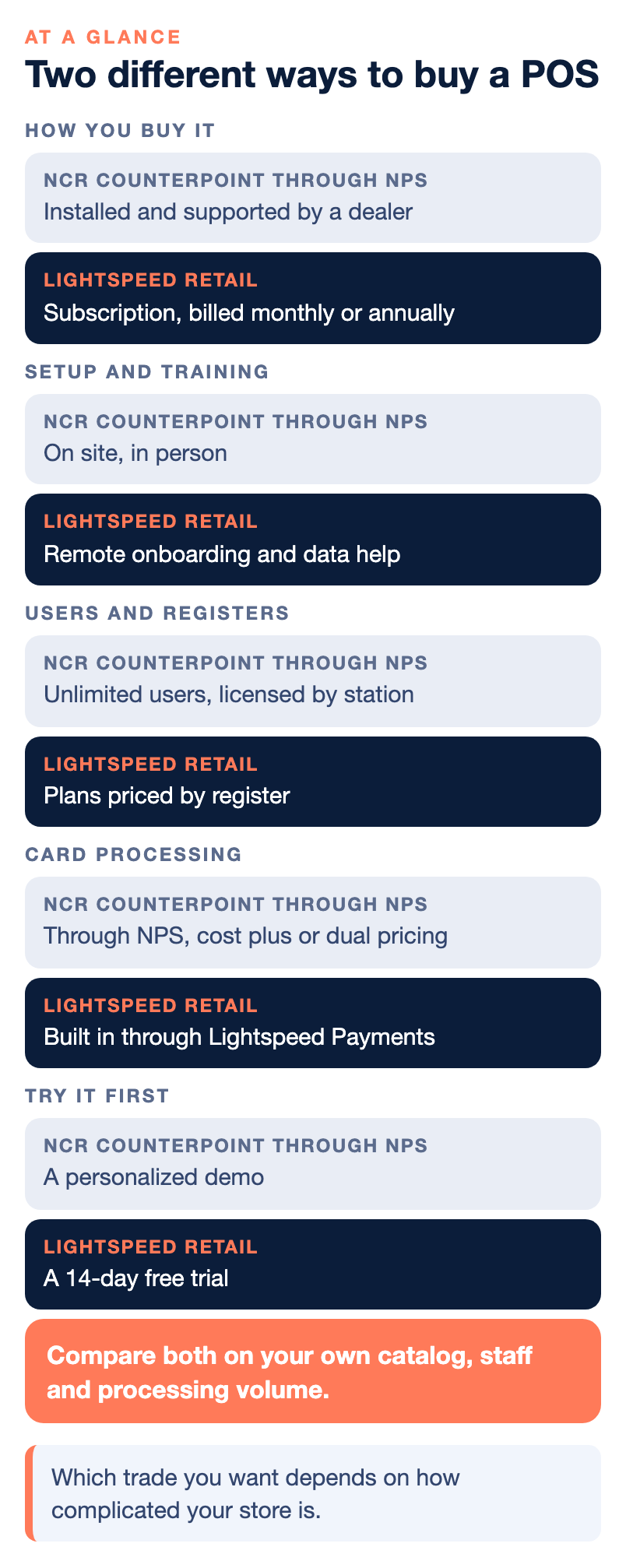
Neither approach is better in the abstract. A dealer-installed system asks more of you up front and gives you a team that bends the software to your store. A subscription system lets you get going quickly and asks you to work the way the platform works. Which trade you want depends on how complicated your store is.
Side by side
Here is how the two compare on the points that usually decide the choice. The Counterpoint column describes Counterpoint as we sell and support it. The Lightspeed column describes what Lightspeed’s own pages say.
| Question | NCR Counterpoint through NPS | Lightspeed Retail |
|---|---|---|
| How you buy it | Installed and supported by a dealer | A subscription plan, billed monthly or annually |
| Setup and training | On-site setup and training | Remote onboarding and help moving your data |
| Users and registers | Unlimited users, licensed by station | Plans priced with additional registers extra |
| Catalog size | No SKU limits | Ask about limits on your plan |
| Card processing | Through NPS, with cost plus or dual pricing | Built in through Lightspeed Payments |
| Custom work | Custom programming by our Counterpoint team | An open API and third-party integrations |
| Try it first | A personalized demo built around your store | A 14-day free trial |
Inventory and catalog depth
Inventory is where most stores feel the difference first, and where we think Counterpoint earns its place. Counterpoint has no SKU limits, tracks inventory in real time, handles serialized products, moves stock between locations and gives you one view across every store and the warehouse. Purchasing, vendor management and reorder points are built in. Pricing is unusually flexible: our Counterpoint setups support up to six pricing levels per item, along with customer-specific and promotional pricing, which matters to a store that sells the same bag of feed to a walk-in customer, a contractor and a wholesale account at three different prices.
Lightspeed is not a light inventory tool either, and it would be unfair to say so. Its own pages describe product variants, unique serial numbers, purchase orders, stock transfers between locations, demand forecasting and wholesale ordering through its NuORDER connection. Lightspeed also lets you import items through a CSV tool that handles up to 10,000 items at a time, with onboarding help if you want them to move your data for you.
So the question is not whether each system tracks stock. It is how complicated your catalog really is. If you carry tens of thousands of items, sell by weight on a scale, track serial numbers on regulated goods, price differently by customer type and need reports nobody has built yet, a dealer who can program the system around you is worth a lot. If your catalog is a few thousand clean items with sizes and colors, a cloud subscription may do everything you need. Lightspeed’s own buyer advice says the same thing in its own words: profile your business first, including your store count and how many SKUs you carry.
Users, registers and licensing
This line on the quote is easy to skip and expensive to ignore. Many systems charge for every user or every register, and the total climbs every time you hire, add a shift or open a lane.
With our Counterpoint setup, you can have unlimited users. Licensing is based on the devices or stations you run, not on each employee who logs in, so a store with 25 cashiers, a handful of managers, inventory staff, bookkeepers and owners does not buy a license for every person. For a business with seasonal staff or several departments, that difference can be real.
Lightspeed’s pricing page builds its plans around registers, with a base plan cost and a separate line for additional registers, and it offers a discount for paying annually. That is a simple model, and for a single store with one or two registers it may be all you ever pay for. Before you choose, count the registers you will need in two years, not just today, and ask each vendor to price that number.
Payments and what processing costs you
For most stores, card processing costs more over the life of the system than the software does, so give the processing side as much attention as the register.
With Counterpoint, we integrate payment processing directly into the system. That covers credit and debit cards, tap-to-pay, Apple Pay, Google Wallet, EBT, ACH, accounts receivable payments and online payment links. We do not force one pricing model on everyone. Depending on your business, we can quote cost plus, where the card network costs are passed through and our markup is shown separately, or a dual pricing program, where eligible stores show a cash price and a card price. Our guide to merchant account pricing models explains how each model works, and our guide to dual pricing versus surcharging explains why those two are not the same thing. Card-brand rules and state law govern both, so confirm what is allowed where you operate before you turn either on.
Lightspeed builds its payments in. Its payments page says payments are built right in and built for the POS, and it presents one provider for the point of sale, payments, hardware and support as the advantage. That is a fair benefit: one company to call and fewer moving parts. The trade is that your processing and your software come from the same place, so ask Lightspeed directly whether you can bring your own processor, what pricing you will be quoted on your real volume, and what changes if you ever want to move your processing elsewhere.
One more thing to know about our side. If you already run Counterpoint and want us to take over your support, your payment processing must also move to us. We combine the two on purpose, so that when a payment fails at the register there is one company responsible instead of a dealer blaming a processor and a processor blaming the dealer. If you want to keep your current processor no matter what, that is a reason to look elsewhere for support.
Setup, training and support
Support is where retailers tell us they are most unhappy with their current POS, so it is worth asking about in detail.
Our Counterpoint team works only on Counterpoint. The same people install it, configure it, program it, migrate stores onto it and troubleshoot it. Routine ongoing support runs on a support fee rather than an hourly meter, so you can call with a question without wondering what it will add to your invoice, and we include Counterpoint updates at no extra charge. Every account has a dedicated account manager. Our office is open from about 9 or 10 a.m. to 6 p.m., and merchants can reach 24/7 support through the help desk for their product. Installation and training can be done in person or remotely, depending on the project.
Lightspeed offers 24/7 support from retail specialists, one-on-one onboarding and a dedicated account manager, according to its retail page. Onboarding packages can include migrating your inventory and customer data, training staff and moving gift card balances. For a store that is comfortable learning software remotely, that can be plenty.
The useful question for either vendor is the same. When something breaks on a busy Saturday, who answers, how fast, and are they an expert in your system or a general help desk? Ask for that in writing.
Ecommerce, accounting and integrations
Both systems connect your store to the rest of your business, but they get there differently.
Counterpoint integrates with ecommerce platforms including Shopify, WooCommerce, WordPress, Magento and BigCommerce, so online and in-store inventory, pricing and orders can stay in sync. It also integrates with QuickBooks workflows, which cuts down on manual accounting. For firearms retailers we support integrations with TRCG Bound Book and FastBound, and Counterpoint’s Service Point functionality handles appointments, estimates and repairs for stores that sell service as well as products. Mobile POS, smart alerts by text or email, loyalty, gift cards and customer email marketing are available too. When a store needs something that does not exist yet, our programmers can build it, and if we have already built something similar for another business we can reuse that work instead of starting from scratch.
Lightspeed connects its retail POS to its own ecommerce product, so online and store inventory are managed from one platform. It integrates with accounting software, ERP systems and marketing tools, and it offers an open API for stores that want to build their own workflows. If your needs fit the integrations that already exist, that is a clean way to work. If you need something custom, ask who will build it and who will maintain it after it is built.
Hardware
Replacing a POS does not always mean replacing every device in the building. With Counterpoint, existing hardware may be reusable, depending on compatibility, and we evaluate it during discovery. We set up Counterpoint stations with customer-facing screens, kiosks, self-checkout, mobile POS, scales, label printers and scanners.
Lightspeed sells hardware that includes countertop stations, wireless scanners and iPads, and its iPad stand turns an iPad into a full retail register. Lightspeed’s payments page says its hardware is sold separately, and that you cannot use existing payment terminals you already own with Lightspeed Payments. If you have recently bought terminals, factor that into the cost.
What each one costs to own
We will not quote prices here, and we suggest you ignore anyone’s headline number until you have a written quote built on your own store. What we can tell you is what goes into the total, so you compare like with like.
For Counterpoint through NPS, the total includes the software licensed by station, any new hardware you need, installation and on-site training, the ongoing support fee, any custom programming, and card processing on cost plus or dual pricing. For Lightspeed, the total includes the subscription plan, additional registers, hardware sold separately, any onboarding package, and card processing through Lightspeed Payments. Lay both over the same number of years, include processing on your real monthly volume, and the comparison becomes honest. Our comparison of payment processors by business type can help you judge the processing half on its own.
Who should choose which
Choose NCR Counterpoint if
- You run a specialty store with a large or complicated catalog, such as lawn and garden, feed and pet, sporting goods, hunting and fishing, firearms, liquor, independent grocery with scales, apparel and shoes, automotive aftermarket, or an attraction or museum gift shop.
- You have several locations, or plan to, and want central control of inventory, pricing, purchasing and staff access.
- You have many employees and do not want to pay for every user.
- You need reports, workflows or integrations that have to be built for you.
- You already run Counterpoint and are unhappy with your current dealer’s support.
Choose Lightspeed Retail if
- You want a cloud system you can try on your own before you talk to anyone.
- You want to run your registers on iPads.
- Your catalog is moderate and your workflows fit the features that already exist.
- You like the idea of one company for software, payments and hardware, and you are comfortable with remote onboarding.
Where NPS is not the right choice
We would rather lose a sale than install the wrong system. Counterpoint through us is probably not right for you if:
- You want to sign up online and be selling tomorrow. We start with discovery and a demo, then install and train. That takes longer than a self-service trial.
- You run one small store with a simple catalog. Counterpoint can be more system than you need. Our own smaller retail POS, described as suited to stores with up to about 8,000 products, may fit better, and so may a cloud subscription.
- You want our Counterpoint support but must keep your current processor. We only take over Counterpoint support when processing moves to us too.
- You want to choose on the lowest advertised monthly price alone. We price each business individually, so there is no single number to compare.
If one of those describes you, our retail POS for smaller stores is worth a look, or you may simply be better served by a system like Lightspeed.
Counterpoint alternatives worth comparing
People who search for Counterpoint alternatives usually fall into one of three groups, and each has a different answer.
If your system is old and you are shopping for a replacement, Lightspeed Retail is a reasonable cloud alternative to put next to Counterpoint, and this page should help you compare them fairly. If your store is small and Counterpoint feels like too much, a simpler retail POS sold with a merchant account may cover what you need at a lower level of complexity. And if you like Counterpoint but dislike your dealer, the alternative may not be a new system at all. Long ticket waits, hourly bills for every call and customizations nobody will touch are support problems, and you can change dealers without changing software. Our complete guide to NCR Counterpoint in 2026 covers what a support takeover involves, and our NCR Counterpoint page lists the hardware and features we set up.
Questions to ask before you choose
Ask both vendors the same questions, including us. The answers tell you more than a feature list.
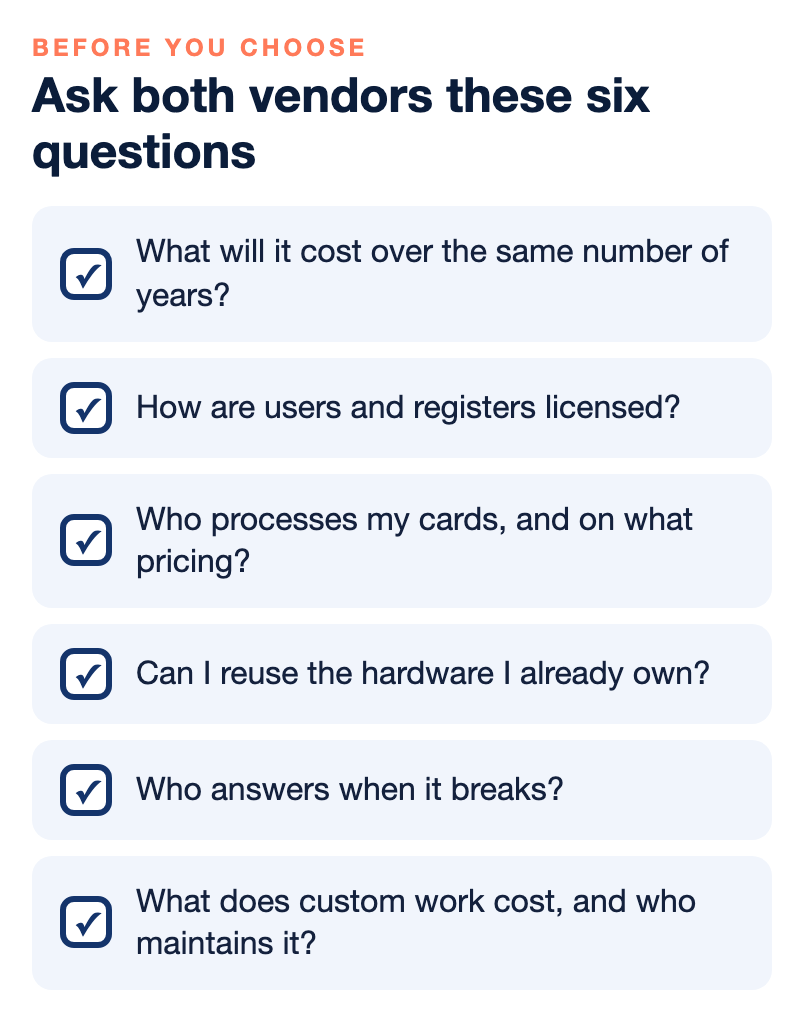
- What will it cost over the same number of years? Ask for software, hardware, setup, support and processing on your real volume, all in writing.
- How are users and registers licensed? Price the number of registers and staff you expect to have in two years.
- Who processes my cards, and on what pricing? Ask whether you can choose your processor and whether cost plus or dual pricing is available.
- Can I reuse the hardware I already own? Bring a list of your stations, scanners, scales, printers and terminals.
- Who answers when it breaks? Ask about hours, response times, and whether the person who answers knows your system.
- What does custom work cost, and who maintains it? Bring one report or workflow you need and ask them to show you how they would build it.
Then ask for a demo that runs your own store, not a slideshow. Show the vendor how you sell, receive inventory, price items, transfer stock and run your reports, and watch them do it in the system. If a vendor will not answer one of these plainly, treat that as an answer.
Next step
The right POS is the one that fits how your store actually runs, not the one with the longest feature list or the lowest monthly number. For a complicated specialty store, that is often Counterpoint with a dealer who knows it. For a simpler store that wants a cloud system it can run on its own, Lightspeed may be the better fit.
If you want a demo of Counterpoint built around your store, or a second opinion on your current setup and processing statement, you can talk with our team. If your store is a better fit for something else, we will tell you.
Frequently asked questions
Is NCR Counterpoint better than Lightspeed Retail?
It depends on your store. Counterpoint tends to fit inventory-heavy specialty retailers with many employees, several locations or a need for custom programming. Lightspeed Retail tends to fit stores that want a cloud subscription they can try on their own and run on iPads. Compare both on your own catalog, staff and processing volume.
How much does NCR Counterpoint cost?
There is no single price, because the total depends on how many stations you run, the hardware you need, installation and training, ongoing support and your card processing. Through NPS, Counterpoint is licensed by station with unlimited users, and routine support runs on a support fee rather than hourly billing. Ask for a written quote built on your own store.
Is Lightspeed Retail cloud-based?
Yes. Lightspeed describes Lightspeed Retail as a cloud-based platform sold as a subscription, billed monthly or annually. It runs on iPads as well as countertop stations, and its payments are built in through Lightspeed Payments. Check Lightspeed’s current pages for plan details.
What are the best NCR Counterpoint alternatives?
For a cloud alternative, Lightspeed Retail is a common one to compare. For a smaller store, a simpler retail POS sold with a merchant account may be enough. If you like Counterpoint but not your dealer, changing support providers can solve the problem without changing systems.
Can NPS take over my Counterpoint support if I keep my current processor?
No. If NPS takes over support for an existing Counterpoint installation, your payment processing must also move to NPS. We combine the two so one company is responsible for both the POS and the payments.
Does NCR Counterpoint integrate with Shopify and QuickBooks?
Yes. Through NPS, Counterpoint integrates with ecommerce platforms including Shopify, WooCommerce, Magento and BigCommerce, and with QuickBooks workflows. Ask which integrations your store needs during the demo so they are planned into the setup.
Can I use dual pricing with Counterpoint?
Yes, for eligible businesses. NPS offers both cost plus and dual pricing with Counterpoint. Card-brand rules and state law govern dual pricing, so confirm what is allowed where you operate before you turn it on.