Nationwide Payment Systems
Mobile Payment Processing for Small Businesses
Learn how mobile payment processing for small businesses works, including mobile POS systems, tap-to-pay, card readers, payment links, ACH, and secure payment tools.
Presented by Allen Kopelman, CEO — Nationwide Payment Systems-Host of B2B Vault: The Biz2Biz Podcast
AI OVERVIEW
sponsored by

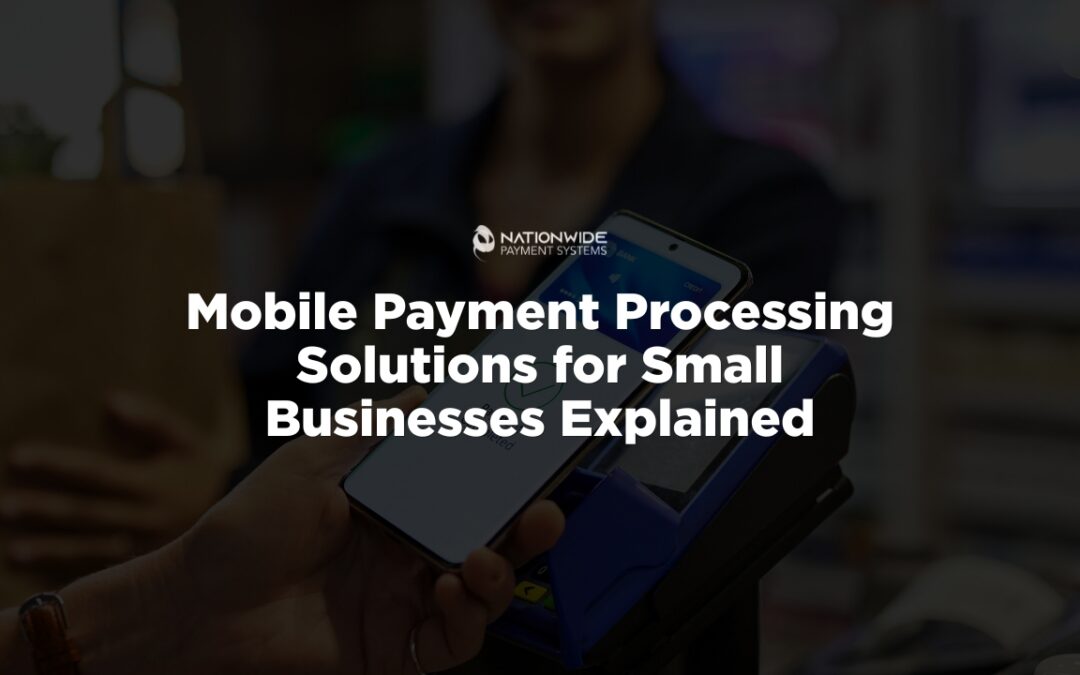
Mobile Payment Processing for Small Businesses: Solutions Explained
Small businesses are not always paid at a front counter.
Many businesses collect payments in the field, at customer locations, at events, over the phone, by invoice, through a mobile device, or after a service is completed.
That is why mobile payment processing for small businesses has become so important.
A contractor may need to collect a deposit at the job site.
A plumber may need to take payment after a repair.
A food truck may need a mobile POS system.
A vendor may need to accept cards at an event.
A medical office may need a payment link for a patient balance.
A consultant may need to send an invoice from a phone.
A delivery business may need mobile card acceptance.
The old way was simple but slow:
Send an invoice.
Wait for a check.
Call the customer.
Take a card number manually.
Follow up again.
Hope payment comes in.
Mobile payment tools help businesses get paid faster, reduce friction, and make it easier for customers to pay wherever the sale or service happens.
This guide explains how mobile payment processing works, which tools small businesses should consider, and how Nationwide Payment Systems can help businesses choose the right mobile payment setup.
What Is Mobile Payment Processing for Small Businesses?
Mobile payment processing for small businesses allows merchants to accept payments away from a traditional fixed checkout counter.
This can include mobile card readers, wireless terminals, mobile POS systems, tap-to-pay tools, payment links, virtual terminals, invoice payments, ACH payments, and mobile-friendly checkout pages.
In simple terms, mobile payment processing lets your business get paid wherever the customer is.
That may be:
At a job site
At a customer’s home
At an event
At a trade show
At a food truck
At a delivery location
At a mobile service appointment
Inside an office
Through a phone or tablet
By email or text payment link
Through an online invoice
For small businesses, mobile payment processing can be a major upgrade because it removes the need to wait until the customer is at a counter or sends a check later.
When the job is done, the business can request payment immediately.
Why Do Small Businesses Need Mobile Payment Processing?
Mobile payment processing for small businesses matters because customers expect fast, flexible, and convenient ways to pay.
If a business cannot accept payment when the customer is ready, it may create delays, missed sales, and extra collection work.
Mobile payment processing helps businesses:
Collect payment faster
Accept cards in the field
Send payment links
Take deposits
Reduce unpaid invoices
Improve cash flow
Offer customer convenience
Support mobile staff
Process payments at events
Accept payments outside the office
Reduce manual card handling
Look more professional
For many businesses, payment delays are not caused by customers refusing to pay.
They are caused by payment friction.
The customer is ready, but the business does not have an easy way to collect.
Mobile payment tools solve that problem.
How Does Mobile Payment Processing Work?
Mobile payment processing works by using a mobile device, card reader, wireless terminal, POS system, payment link, or virtual terminal to securely send payment information for authorization.
The process depends on the tool being used.
For example, a business may:
Use a mobile card reader connected to a phone
Use a wireless terminal at a customer location
Use a tablet-based mobile POS system
Use tap-to-pay on a compatible device
Send a payment link by text or email
Enter payment details into a virtual terminal
Send an invoice through NPSONE Smart Invoicing
Accept ACH for larger payments
Once the payment is submitted, the transaction is authorized, processed, settled, and deposited based on the provider’s funding schedule.
From the customer’s point of view, the payment can be quick and simple.
From the business’s point of view, mobile payments can reduce delays and improve collections.
What Is a Mobile POS System?
A mobile POS system is a portable point-of-sale system that allows a business to ring up sales, accept payments, view transactions, and sometimes manage inventory, customers, employees, tips, and reporting from a mobile device or wireless setup.
A mobile POS can be useful for businesses that need more than a basic card reader.
A mobile POS may support:
Card payments
Tap-to-pay
Mobile wallet payments
Cash tracking
Receipts
Tips
Product menus
Inventory
Employee logins
Customer records
Discounts
Tax settings
Refunds
Reporting
Event sales
Mobile checkout
Mobile POS systems are especially useful for:
Food trucks
Pop-up shops
Retail vendors
Event sellers
Mobile service businesses
Restaurants with pay-at-table
Delivery businesses
Field sales teams
Trade show vendors
A business that only needs to collect an occasional card payment may not need a full mobile POS.
But a business that sells products, tracks items, manages staff, or needs reporting may benefit from one.
What Is the Difference Between a Mobile Card Reader and a Mobile POS?
A mobile card reader is mainly used to accept card payments, while a mobile POS can include payment acceptance plus sales, inventory, reporting, staff, and customer management features.
A mobile card reader is usually simpler.
It may connect to a phone or tablet and allow the business to accept card payments.
A mobile POS is more complete.
It can help manage the sale, not just the payment.
For example:
A handyman may only need a mobile card reader or payment link.
A food truck may need a mobile POS with menu items and sales reporting.
A retail vendor may need a mobile POS with inventory.
A service business may need mobile invoicing and payment links.
A restaurant may need pay-at-table tools.
The best solution depends on the business.
Do not buy a complex system if you only need simple payment acceptance.
Do not rely on a basic card reader if your business needs reporting, inventory, or staff controls.
What Is Tap-to-Pay for Small Businesses?
Tap-to-pay allows customers to make contactless payments using a contactless card, smartphone, or mobile wallet.
Tap-to-pay is popular because it is fast, familiar, and convenient.
Customers may tap with:
Contactless credit cards
Contactless debit cards
Apple Pay
Google Pay
Samsung Pay
Other mobile wallets
For small businesses, tap-to-pay can speed up checkout and reduce friction.
It can be useful for:
Retail stores
Food trucks
Event vendors
Coffee shops
Quick-service restaurants
Mobile service providers
Medical offices
Delivery businesses
Pop-up shops
Tap-to-pay can also reduce the need to handle cards physically.
The right terminal, mobile reader, or POS system should support modern contactless payments whenever possible.
What Are Payment Links?
Payment links are secure links that allow customers to pay online without the business needing a full e-commerce website.
A business can send a payment link by text, email, invoice, or message.
The customer clicks the link, enters payment information, and completes the payment.
Payment links are one of the easiest mobile payment tools for small businesses because they do not always require hardware.
They can be used for:
Deposits
Invoices
One-time payments
Service balances
Quotes
Event payments
Donations
Remote orders
Membership dues
Customer follow-ups
B2B payments
Mobile service payments
Payment links are especially useful when the customer is not physically present or when the business wants to avoid taking card numbers over the phone.
With NPSONE Smart Invoicing, businesses can create payment links and send invoices so customers can pay by card or ACH.
What Is a Virtual Terminal for Mobile Payments?
A virtual terminal is a secure online tool that allows a business to manually enter payment information and process a transaction from a computer, tablet, or mobile device.
Virtual terminals are useful when a business needs to accept payments without a physical card reader.
A virtual terminal may support:
Keyed card payments
ACH payments
Customer lookup
Saved customer profiles
Recurring billing
Invoice payments
Receipts
Reporting
User permissions
Transaction history
A virtual terminal can be useful for:
Office staff
Phone orders
Service businesses
Medical offices
Professional services
B2B companies
Customer service teams
Remote sales teams
Nonprofits
Contractors
Businesses should use virtual terminals carefully because manually entered payments may carry different risk and cost considerations than chip, tap, or swipe payments.
A payment consultant can help a business decide when to use a virtual terminal, payment link, mobile reader, or POS system.
How Can Mobile Payments Help Contractors and Home Service Businesses?
Mobile payments help contractors and home service businesses collect deposits, final payments, service fees, and recurring payments without waiting for checks or manual follow-up.
Contractors and home service businesses often work away from an office.
That makes mobile payment tools valuable.
They can help:
Collect deposits before work starts
Collect final payment after completion
Send payment links from the field
Accept cards at the job site
Offer ACH for larger invoices
Set up recurring service plans
Send professional invoices
Reduce unpaid balances
Improve cash flow
Avoid chasing checks
This can help businesses such as:
HVAC companies
Plumbers
Electricians
Roofers
Landscapers
Pest control companies
Cleaning companies
Pool service companies
Handymen
Home repair businesses
General contractors
NPSONE Smart Invoicing can be especially useful for these businesses because it supports invoice payments, ACH, card payments, payment links, deposits, and recurring billing.
How Can Mobile Payments Help Food Trucks and Event Vendors?
Mobile payments help food trucks and event vendors accept cards, mobile wallets, and tap-to-pay payments wherever they are selling.
Food trucks and event vendors need fast checkout.
Long lines can cost sales.
Mobile payment tools can help by supporting:
Mobile POS systems
Tap-to-pay
Card readers
Wireless terminals
Digital receipts
Menu items
Sales reporting
Tips
Event sales tracking
Mobile wallet payments
A food truck may need a mobile POS.
A craft vendor may need a card reader.
A pop-up seller may need tap-to-pay.
An event business may need multiple users or devices.
The key is reliability.
Mobile businesses need payment tools that can work in real-world environments, not just at a fixed counter.
How Can Mobile Payments Help Medical Offices and Professional Services?
Mobile payments help medical offices and professional services collect balances, send payment links, accept card or ACH payments, and reduce manual billing follow-up.
Not every mobile payment situation happens in the field.
Sometimes “mobile” means giving customers a convenient digital way to pay without standing at the front desk.
Medical offices, consultants, attorneys, accountants, and other professional services may use:
Payment links
Online invoices
Virtual terminals
ACH payments
Recurring billing
Card-on-file
Patient or client payment pages
Hosted checkout
Secure payment portals
This can help collect:
Co-pays
Patient balances
Consulting invoices
Retainers
Service fees
Payment plans
Membership dues
Recurring charges
For these businesses, mobile payment processing is really about convenience and collections.
If a customer can pay from their phone, the business has a better chance of getting paid faster.
How Can Mobile Payments Help B2B Companies?
Mobile payments help B2B companies by allowing them to send invoice links, accept ACH, accept card payments, support virtual card payments, and reduce accounts receivable delays.
B2B payments can be slow when the business relies only on paper invoices and checks.
Mobile-friendly payment tools can help B2B companies offer customers better options.
That may include:
Invoice payment links
ACH payments
Card payments
Virtual card acceptance
Recurring billing
Deposits
Partial payments
Customer payment pages
Payment confirmations
QuickBooks workflow support
Level 2 and Level 3 data where applicable
A B2B customer may receive an invoice and forward a payment link to accounts payable.
Another customer may pay by ACH.
Another may pay with a corporate card or virtual card.
The more payment options the business supports, the easier it becomes for customers to pay.
NPSONE Smart Invoicing is built for this kind of payment flexibility.
Are Mobile Payments Secure?
Mobile payments can be secure when businesses use trusted payment tools, encrypted transactions, tokenization, secure gateways, EMV-enabled devices, and proper PCI compliance practices.
Security matters because mobile payment tools still handle sensitive payment information.
Small businesses should avoid risky habits such as:
Writing down card numbers
Texting card information
Emailing card numbers
Storing card data in spreadsheets
Using unsecured devices
Sharing passwords
Using outdated terminals
Allowing too many users access
Skipping PCI compliance
Better options include:
Using secure payment links
Using EMV and tap-enabled terminals
Using hosted checkout pages
Using tokenization
Using user permissions
Keeping devices updated
Using secure Wi-Fi or cellular connections
Completing PCI compliance
Using trusted gateways and payment systems
Mobile payment processing should make payment easier without making security weaker.
What Should Businesses Know About PCI Compliance for Mobile Payments?
Businesses using mobile payments still need to understand PCI compliance because accepting card payments creates payment security responsibilities.
PCI compliance applies to businesses that accept, process, store, or transmit cardholder data.
Using mobile tools does not remove that responsibility.
However, the right tools can help reduce exposure.
For example, sending a secure payment link may be safer than asking a customer to text a card number.
Using an EMV-enabled mobile terminal may be safer than manually entering card data.
Using tokenization may reduce the need to store raw card information.
Small businesses should complete required PCI validation steps and ask their provider for guidance.
They should also review whether they are being charged PCI non-compliance fees.
A little attention to PCI compliance can help reduce risk and avoid unnecessary fees.
What Fees Are Connected to Mobile Payment Processing?
Mobile payment processing fees may include processing rates, transaction fees, mobile reader costs, terminal costs, gateway fees, monthly fees, PCI fees, chargeback fees, and software fees.
The cost depends on the provider and setup.
Possible fees include:
Percentage processing rate
Per-transaction fee
Monthly service fee
Mobile POS software fee
Gateway fee
Virtual terminal fee
PCI compliance fee
PCI non-compliance fee
Chargeback fee
Equipment cost
Wireless terminal fee
Data plan fee
Batch fee
Statement fee
Early termination fee
A simple mobile card reader may have one cost structure.
A full mobile POS system may have another.
A payment link or smart invoicing setup may include gateway or platform fees.
A wireless terminal may have equipment or data costs.
Business owners should ask for a clear explanation of all costs before choosing a mobile payment solution.
Should a Business Choose a Mobile Reader, Wireless Terminal, Payment Link, or POS System?
When choosing mobile payment processing for small businesses, owners should match the tool to how and where they get paid and how much functionality they need.
Here is a simple way to think about it:
A mobile reader may work if the business only needs simple card acceptance.
A wireless terminal may work if the business needs a dedicated payment device.
A payment link may work if customers pay remotely or by invoice.
A virtual terminal may work if staff take payments by phone or from an office.
A mobile POS may work if the business needs sales tracking, products, tips, staff, or reporting.
NPSONE Smart Invoicing may work if the business sends invoices, needs ACH, creates payment links, collects deposits, or manages recurring billing.
The best setup may include more than one tool.
For example, a contractor may use mobile payments in the field and NPSONE Smart Invoicing for invoices.
A food truck may use a mobile POS and payment links for catering deposits.
A B2B company may use ACH, payment links, and virtual terminal tools.
The right setup depends on the workflow.
How Can NPSONE Smart Invoicing Support Mobile Payments?
NPSONE Smart Invoicing can support mobile payments by allowing businesses to send invoices, create payment links, accept card and ACH payments, collect deposits, and set up recurring billing from a more flexible payment workflow.
This is useful because many mobile businesses do not need customers to swipe a card in person every time.
Sometimes the better workflow is:
Send the invoice.
Send a payment link.
Let the customer pay by card or ACH.
Receive confirmation.
Reduce manual follow-up.
NPSONE Smart Invoicing can help businesses that need:
Mobile invoice payments
ACH payments
Card payments
One-time payment links
Recurring billing
Deposits
Partial payments
B2B collections
Service business payments
Customer-friendly checkout
Improved cash flow
For many small businesses, mobile payment processing is not only about hardware.
It is about making it easier for customers to pay from anywhere.
How Can the NPS POS System Support Mobile and In-Person Payments?
The NPS POS System can support small businesses that need in-person checkout, payment acceptance, reporting, and operational tools beyond a simple mobile card reader.
Some businesses outgrow basic mobile payment tools.
They need a real POS system.
The NPS POS System may help businesses:
Accept payments
Manage checkout
View sales reports
Support staff permissions
Improve daily operations
Handle refunds
Support customer receipts
Create a more professional payment experience
Use a system that fits the business better than oversized alternatives
Nationwide Payment Systems offers the NPS POS System for as low as $199, which can be a strong option for businesses that want more than a simple card reader without overpaying for a complicated system.
Some businesses may also qualify for a free credit card terminal if they only need basic card acceptance.
The key is choosing the right tool for the job.
Can a Business Get a Free Credit Card Terminal for Mobile or In-Person Payments?
Yes, qualifying businesses may be able to get a free credit card terminal through Nationwide Payment Systems.
A free terminal may be a good fit for businesses that need simple, reliable card acceptance without a full POS system.
This may work for:
Small retail shops
Service businesses
Medical offices
Professional offices
Mobile businesses
Simple checkout environments
Businesses that do not need inventory or advanced POS tools
A terminal may support chip cards, tap-to-pay, swipe, and mobile wallet payments depending on the equipment.
For businesses that need more features, the NPS POS System or NPSONE Smart Invoicing may be a better fit.
The right solution depends on whether the business needs hardware, invoicing, ACH, recurring billing, e-commerce, or POS features.
How Do You Choose a Mobile Payment Processing Provider?
You choose a mobile payment processing provider by comparing tools, pricing, support, security, PCI guidance, equipment options, mobile POS features, payment links, ACH, and whether the provider understands your business.
Important questions include:
Can I accept payments in the field?
Can I send payment links?
Can I accept ACH?
Can I use tap-to-pay?
Can I use a mobile POS?
Can I use a wireless terminal?
Can I send invoices?
Can I set up recurring billing?
Can I accept deposits?
Can I get support by phone?
Can someone explain my fees?
Can someone help with PCI compliance?
Can the solution grow with my business?
Can the provider support my industry?
The best mobile payment provider is not always the company with the most famous app.
It is the provider that fits how your business actually collects money.
How Can Nationwide Payment Systems Help With Mobile Payment Processing?
Nationwide Payment Systems can help small businesses choose mobile payment processing solutions such as mobile terminals, mobile POS systems, payment links, ACH, NPSONE Smart Invoicing, virtual terminals, and free credit card terminal options for qualifying merchants.
NPS works with many businesses that need flexible payment tools, including:
Contractors
Home services
Medical offices
Professional services
B2B companies
Food trucks
Event vendors
Retail shops
Delivery businesses
Nonprofits
Mobile service providers
E-commerce businesses
High-risk and specialized merchants
Nationwide Payment Systems can help review:
How customers pay
Where payments happen
Whether mobile hardware is needed
Whether payment links would work better
Whether ACH should be offered
Whether NPSONE Smart Invoicing fits the business
Whether a POS system is needed
Whether a free terminal is available
Whether PCI compliance has been completed
Whether current fees are too high
The goal is not to sell every business the same mobile payment tool.
The goal is to match the tool to the business.
The Bottom Line
Mobile payment processing helps small businesses get paid wherever the customer is.
That may mean accepting cards in the field, using a mobile POS system, sending payment links, accepting ACH, using a virtual terminal, or sending smart invoices.
The right mobile payment solution can improve cash flow, reduce unpaid invoices, create a better customer experience, and make the business look more professional.
But not every business needs the same setup.
Some businesses need a mobile card reader.
Some need a wireless terminal.
Some need payment links.
Some need NPSONE Smart Invoicing.
Some need ACH.
Some need the NPS POS System.
Some may qualify for a free credit card terminal.
Nationwide Payment Systems helps small businesses choose mobile payment solutions that fit how they actually get paid.
Because if your business is mobile, your payments should be mobile too.
Call to Action
Need a better way to accept payments on the go?
Nationwide Payment Systems can help your business accept mobile payments, send payment links, use NPSONE Smart Invoicing, accept ACH, set up a mobile POS, or choose the right credit card terminal.
Ask about free credit card terminal options for qualifying businesses and the NPS POS System available for as low as $199.
Schedule a consultation today and find out how NPS can help your business get paid faster from anywhere.