Growth Is Not the Same Thing as Building a Valuable Business
Most business owners want more customers.
More customers should mean more revenue.
But what happens if your company suddenly doubles its sales?
That was one of the first questions Stuart Webb raised during his conversation with Allen Kopelman:
If your business doubled tomorrow, what would break first?
It is an important question because growth can expose weaknesses that are easy to ignore when a company is smaller.
Your sales department might be able to generate twice as much business, but can operations handle it?
Can customer service?
Can accounting?
Can your inventory system?
Can your billing process?
Can you collect the money fast enough?
Can management handle twice as many customers without the owner becoming the bottleneck?
Businesses that are designed only for today's volume may discover that growth actually makes their problems worse.
The goal should not simply be to build a bigger business.
The goal should be to build a scalable business.
Find the Leaks Before You Step on the Gas
Stuart describes business owners as needing to identify the areas where value is leaking out of the organization.
Those leaks might include:
Manual administrative work
Inefficient billing
Slow collections
Poor customer follow-up
Unnecessary repetitive tasks
Founder dependency
Customer-service bottlenecks
Lack of documented processes
Inefficient sales processes
Poor use of technology
Adding more customers to a company with these problems does not necessarily fix anything.
It can magnify them.
Think of it like putting a much more powerful engine into a car whose brakes, suspension, and chassis were never designed for the additional horsepower.
The car may go faster.
That does not mean it will perform better.
The same thing can happen with a business.
AI Cannot Fix a Broken Business Process
Artificial intelligence came up several times during the B2B Vault conversation.
Businesses are racing to implement AI for marketing, sales, customer service, accounting, and operations.
But there is an important distinction between automating a good process and automating a bad process.
If your workflow is already inefficient, AI may simply allow your company to perform the inefficient process faster.
Before implementing automation, ask:
What exactly are we trying to automate?
Why does this process exist?
Could the process be eliminated completely?
Where does the customer experience friction?
Where are employees wasting time?
Technology works best when it removes friction rather than adding another layer of complexity.
Your Business Needs to Know Its “Magic”
Another concept Stuart discusses is what he calls the company's magic.
Every successful business needs to understand why customers choose it instead of the alternatives.
That advantage might be:
Customer service.
Expertise.
Technology.
Speed.
Convenience.
Industry knowledge.
Product quality.
Pricing.
Relationships.
Specialization.
Or a combination of several of these.
But if the business owner cannot clearly explain the company's advantage, employees and customers probably cannot explain it either.
Stuart's advice is to codify your magic.
Identify it.
Document it.
Build processes around it.
Protect it.
Then make sure growth does not destroy the exact characteristics that made customers choose your business in the first place.
More Sales Without More Profit Is Not Success
Allen brought up another problem that frequently occurs with growing companies.
A company announces:
“We're growing like crazy.”
Sales are up.
The company hires more employees.
Marketing spending increases.
Commissions increase.
Inventory increases.
Operating expenses are increasing.
But there is one problem.
Profit did not increase.
Growth without margin can create the illusion of success while increasing financial pressure on the business.
Business owners need to understand where the money is going.
That means monitoring:
Revenue.
Gross margin.
Labor.
Commissions.
Cost of goods.
Customer acquisition costs.
Accounts receivable.
Payment costs.
Inventory.
Cash flow.
And profitability.
Revenue is important.
But revenue alone does not determine the health of a business.
Cash Flow Is King
One of the strongest parts of the conversation centered around cash flow.
A profitable business can still run into serious trouble if money is not coming in fast enough.
You have payroll.
Inventory.
Rent.
Marketing.
Insurance.
Taxes.
Equipment.
Technology.
Suppliers.
Employees.
All of those expenses continue whether your customers have paid you yet or not.
That is why businesses should constantly evaluate how quickly they are converting an invoice into usable cash.
Stop Being the Bank for Your Customers
One of the recurring ideas we discuss at Nationwide Payment Systems is simple:
Your customer already has a bank.
Your customer may also have:
Credit cards
Business credit
Lines of credit
Working-capital facilities
Corporate cards
Bank accounts
Why should your company become their bank?
If you deliver a product or service today and voluntarily wait another 30, 45, 60, or 90 days to collect the money, you are financing your customer's business with your money.
Meanwhile, you may be borrowing money yourself to cover payroll, replenish inventory, advertise, or expand.
That has a cost.
Businesses sometimes focus exclusively on the processing cost associated with accepting a credit card.
But the better question is:
What is the cost of not having the money?
Receiving money sooner may allow the business to:
Purchase additional inventory.
Take advantage of supplier discounts.
Invest in marketing.
Hire another employee.
Pay down a credit line.
Fund another project.
Or simply operate with less financial stress.
The time value of money matters.
Make It Easy for Customers to Pay You
During the episode, Allen described receiving a bill from a company that required him to call the business, provide a credit card over the phone, or request information before initiating an ACH payment.
In 2026, that creates unnecessary friction.
Businesses should be asking:
Why are we making it difficult for customers to give us money?
A modern payment workflow can allow businesses to offer options such as:
Pay-by-link
Email invoices
Text-message payment links
ACH
Credit cards
Debit cards
Digital wallets
Recurring payments
Scheduled payments
Automatic reminders
Every additional unnecessary step gives the customer another opportunity to say:
“I'll do it later.”
And “later” is exactly how accounts receivable grows.
Automating Accounts Receivable Can Help a Business Scale
This is where payment automation becomes part of business strategy rather than simply another piece of accounting software.
NPSONE and Smart Invoicing from Nationwide Payment Systems are designed to help businesses modernize the way they bill and collect payments.
Businesses can use Smart Invoicing as part of their accounts-receivable workflow and connect payment collection with systems such as:
QuickBooks Online
Xero
Sage Intacct
Businesses can also provide customers with electronic payment options including ACH and credit cards while using tools such as payment links, recurring billing, scheduled payments, reminders, APIs, and webhooks.
Instead of assigning employees to repeatedly:
Create invoices.
Email invoices.
Check whether invoices were paid.
Call customers.
Send reminders.
Take card information over the telephone.
Post payments.
Reconcile transactions.
Businesses can automate significant portions of that workflow.
That is exactly the type of repetitive operational task a growing business should examine.
Recurring Revenue Can Increase Business Value
Allen and Stuart also discussed the continued growth of subscription and recurring-revenue business models.
Recurring revenue is no longer limited to software companies.
Consider an HVAC contractor.
Instead of waiting for customers to remember that they need maintenance twice a year, the contractor can create an annual maintenance program.
Pest-control companies can offer recurring service plans.
Professional-service companies can offer retainers.
Equipment companies can offer maintenance agreements.
Retailers can offer memberships.
Consultants can offer ongoing advisory programs.
The concept is simple:
Instead of constantly trying to sell the same customer again, create an ongoing relationship that provides continuing value.
Recurring revenue can help improve:
Revenue predictability.
Customer retention.
Cash-flow forecasting.
Customer lifetime value.
Scheduling.
Business valuation.
It can also reduce the constant pressure to replace customers who disappear.
Customer Retention Is Often Quiet
Something interesting happens when customers become unhappy.
They do not always complain.
Sometimes they simply disappear.
They stop ordering.
They stop responding.
They stop renewing.
They find another provider.
Business owners therefore need to look beyond complaints.
Ask:
Why did the customer leave?
Why did they stop ordering?
Why did they stop responding?
Why did that happen?
And then ask why again.
Stuart discussed using the Five Whys technique to dig beneath the surface-level problem until the business identifies the actual cause.
Treating symptoms does not fix the underlying leak.
Do Not Make It Hard to Do Business With You
One of the simplest lessons from the episode may also be one of the most important.
Make it easy for people to do business with you.
That applies to:
Finding your company.
Contacting your company.
Getting a quote.
Placing an order.
Receiving service.
Getting support.
Receiving an invoice.
Making a payment.
Buying again.
Customers have choices.
Every unnecessary obstacle creates an opportunity for them to choose someone else.
Search Is Changing: SEO, AEO, and AI Discovery
Traditional SEO remains part of digital marketing, but businesses now also need to think about how information is discovered through AI-powered search and answer engines.
That means websites should contain useful content that directly answers the questions customers are actually asking.
For example:
What does this company do?
Who does it serve?
How does its product work?
What problems does it solve?
What does it cost?
What industries does it work with?
How can someone contact the company?
Structured data and schema can also help search engines and machines better understand the relationship between a company, its products, its people, its articles, its podcast episodes, and the questions those pages answer.
The objective is not simply to rank for keywords.
The objective is to become a useful, understandable, and authoritative source that search engines and AI systems can interpret.
Robotics May Be the Next Major Business Transformation
Stuart also identified robotics as an area business owners should watch.
Automation is moving beyond software.
Robots are already being tested and deployed for:
Food preparation.
Warehouse operations.
Transportation.
Delivery.
Manufacturing.
Customer service.
Cleaning.
And other repetitive tasks.
As robotics advances, businesses will have to decide which tasks should remain human and which tasks can be automated.
The opportunity is not simply eliminating labor.
It frees people from repetitive work so they can spend more time doing things humans are especially good at:
Building relationships.
Solving unusual problems.
Creating.
Selling.
Leading.
Advising customers.
And delivering better experiences.
The Founder Cannot Be the Bottleneck Forever
Toward the end of the conversation, Stuart offered business owners an interesting exercise.
Every few weeks, examine how you spend your time.
Divide your work into two categories:
Work only I can do
and
Work a system or another person can do
If the founder is personally handling tasks that can be automated, delegated, documented, or systematized, the founder may have become the company's biggest scalability problem.
A business that cannot operate without the owner constantly intervening is difficult to scale.
And it can also be difficult to sell.
Ask Yourself This Question Tomorrow Morning
Look at your company and imagine that tomorrow you suddenly have twice as many customers.
Then ask:
What breaks first?
Sales?
Customer service?
Billing?
Collections?
Inventory?
Fulfillment?
Accounting?
Management?
Technology?
Cash flow?
Whatever answer immediately comes to mind may be exactly where your next business improvement needs to begin.
Growth is exciting.
But sustainable growth requires systems.
The businesses that create long-term value are not simply the companies capable of generating more sales.
They are the companies capable of handling those sales efficiently, profitably, and without making it harder for customers to do business with them.
About Stuart Webb
Stuart Webb is the founder of The Unicorn Mentor and works with founders and business owners on building more scalable and valuable companies.
His approach focuses on identifying value leakage, improving business architecture, removing unnecessary work, protecting a company's competitive advantage, and reducing founder dependency.
He also publishes The Leak, where he discusses business growth, leadership, scalability, and value creation.
About B2B Vault: The Biz to Biz Podcast
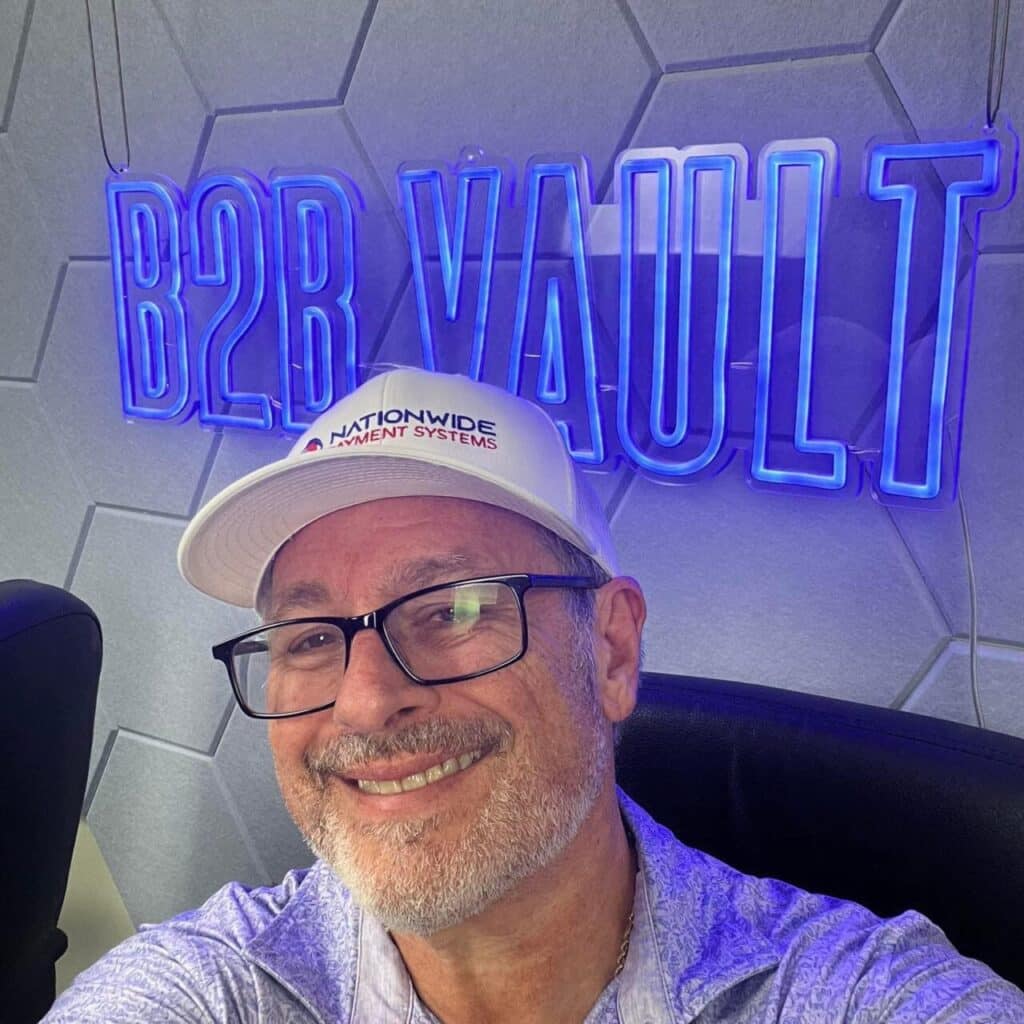
B2B Vault: The Biz to Biz Podcast is hosted by Allen Kopelman, CEO and co-founder of Nationwide Payment Systems.
The show features conversations with entrepreneurs, founders, executives, fintech leaders, technology companies, sales and marketing professionals, payment experts, and other business leaders.
Topics include entrepreneurship, payments, fintech, artificial intelligence, sales, marketing, fraud, compliance, technology, business growth, and the constantly changing world of commerce.
B2B Vault is sponsored by Nationwide Payment Systems.
Improve Cash Flow With Nationwide Payment Systems
Nationwide Payment Systems helps businesses build modern payment workflows around the way they actually operate.
Solutions include:
Credit and debit card processing
ACH payments
NPSONE payment gateway
Smart Invoicing
Payment links
Recurring billing
Scheduled payments
Accounting integrations
B2B payment optimization
Level 2 and Level 3 processing
APIs and webhooks
POS systems
E-commerce payments
Enterprise payment solutions
If your business is growing but your payment and accounts-receivable processes are still manual, it may be time to ask the same question Stuart asked:
If your business doubled tomorrow, will your payment process be ready?