
Smoke Shop Credit Card Processing and Merchant Accounts: What to Know

CEO – Nationwide Payment Systems
A smoke shop needs a merchant account from a processor that underwrites tobacco, vape and smoking accessories on purpose, approves every product you actually sell in writing, and keeps processing them after the first review. A cheap instant-approval app that shuts you down later is the most expensive choice you can make. Nationwide Payment Systems (NPS) has processed for smoke shops, vape shops, cigar retailers and other regulated businesses for years, and smoke shops are one of our core industries. This guide covers the processing side: what a smoke shop merchant account covers, why banks call smoke shops high risk, what to look for in a processor, how pricing is built, the Tobacco Scan Data Program, the documents you need and how to apply.
For the register and inventory side, see our guide to the best POS systems for tobacco and smoke shops. That page compares the point of sale itself. This one is about the account that moves your money.
The short version
- Smoke shops are high risk to banks because the products are age-restricted, the rules on vape keep changing, and disputes run higher than in ordinary retail. The label is about the category, not about how well you run your store.
- Pick the processor before the hardware. Ask for written approval for tobacco, vape, cigars, hookah, accessories, CBD and hemp products, whatever you sell, before you buy a single terminal.
- Tell the processor about every sales channel. Online tobacco and vape sales bring extra Visa and Mastercard rules, and an account approved for the counter is not automatically approved for a website.
- Ask about scan data. Tobacco manufacturers pay participating retailers for scan data, and the Tobacco Scan Data Program can help cover the cost of your reporting.
- Ask for the whole cost structure in writing, not one rate on a flyer, and ask what happens to your deposits if the account is ever reviewed.
Smoke shop and tobacco payment processing, explained
Every card sale at your counter runs through the same chain, whether the customer is buying a lighter or a box of premium cigars. The customer taps, dips or swipes a card. Your terminal or point of sale sends the transaction to your processor, the processor asks the bank that issued the card to approve it, and the approval comes back to your screen in a couple of seconds. At the end of the day the approved sales are settled in a batch, and the money is deposited to your business bank account, minus the processing costs.
Behind that chain sits an acquiring bank, the bank that agrees to sponsor your merchant account and takes on the financial exposure for the sales you run. Visa and Mastercard write the rules every bank and every merchant has to follow, including the rules on which businesses need special registration and monitoring. Your processor is the company that connects you to that bank, sets up your account, supplies or supports your equipment and handles your service. When people say a processor “does not accept smoke shops”, what they usually mean is that none of the banks behind that processor want the category.
That is the whole reason smoke shop processing is its own topic. The mechanics of a tobacco sale are no different from a grocery sale. The difference is who is willing to sponsor the account, what they ask to see first and what they watch once you are live. A processor that works with smoke shops every day knows which banks want the business, what those banks need from you, and how to set the account up so the sales you make next year are covered as well as the sales you make this week.
Smoke shop and tobacco merchant accounts: what payment processing actually covers
A merchant account is the agreement that lets your business accept card payments and receive the money. If you want the plain definition first, our page on what a merchant account is walks through it. For a smoke shop, the account should cover every way your customers actually pay and every way you actually sell, because a gap between what was approved and what you do is how accounts get closed.
Ways your customers pay
Through NPS, a smoke shop can accept credit cards, debit cards, mobile wallets, contactless tap payments, chip cards, ACH and eCheck payments, and online payment links. EMV chip technology authenticates each card-present transaction, which makes counterfeit cards very hard to use at your counter. Smart invoicing and payment links help a shop that takes phone orders, special orders or deliveries collect the money without handling card numbers by hand.
Where you sell
In the store, you can run a point of sale built for smoke shops, with ID scanning, inventory management and compliance tools, or a traditional credit card terminal if you prefer a simple setup. Online, NPS supplies secure gateways for smoke shops that sell products on a website, along with high-risk fraud tools to protect your revenue and keep chargebacks down. Many shops do both, and the account should be built for both from the start rather than stretched later.
Retail and wholesale
We serve smoke shops that sell at retail and businesses that sell at wholesale to other shops. Wholesale accounts often run larger tickets and more invoiced or card-not-present sales, so the application should say plainly which kind of business you are, and the account should be priced and monitored for the way you really sell.
What is payment processing for a single-location smoke shop?
For a single-location smoke shop, payment processing usually means one or two checkout stations at the counter, a merchant account approved for the products on your shelves, a daily batch deposit to your business bank account, and reports that tell you what sold, what was taxed and what you owe. It is the most common setup we see, and it is also where an owner is most tempted to grab whatever app came with a tablet.
The trouble is that a single store has the least room to absorb a frozen account. A chain can shift sales to another location for a few days. A one-store owner who has deposits held over a weekend feels it in payroll and inventory immediately. So the single-location shop gets the most from a careful setup: an account underwritten for tobacco and vape before the first sale, equipment that handles age checks at the register, and someone to call who knows the account.
A single store also benefits more than people expect from good reporting. Taxes broken down by category, tobacco reporting for the manufacturer programs and simple sales analytics save hours every month, and a shop with one owner doing the books feels those hours. Cigar retailers get the same setup. NPS handles both the retail store transactions and the ecommerce transactions of cigar and tobacco businesses, with ID scanning offered as part of our point of sale.
Why banks label smoke shops high risk, in plain words
Banks sort businesses by how likely they are to produce losses, disputes or regulatory trouble. Smoke shops land in the high risk group for three ordinary reasons, and none of them say anything bad about your store.
The products are age-restricted
Tobacco, vape and related items require strict ID checks. Federal law prohibits selling tobacco products to anyone younger than 21, and retailers must check photo identification for anyone under 30 who tries to buy covered tobacco products. State and local laws can add more. A bank sponsoring your account wants to know you have a reliable way to meet those rules at every sale, including the shifts when the most careful employee is off.
The rules keep changing
Local and federal laws around vaping and alternative tobacco products change often. Which vape products can lawfully be marketed in the United States is decided by the FDA, and a product being carried by your distributor does not make it legal for you to sell. When a processor or bank discovers products that are not permitted under its program, the account can be restricted, reserved or closed. We cover those rules in detail on our smoke shop and vape processing rules page.
Disputes run higher
Many banks see tobacco and vape transactions as more likely to end in chargebacks, which happen when a cardholder disputes a charge and asks for the money back. Every chargeback costs the bank time and money, and a high chargeback rate is one of the fastest ways for any merchant to lose an account.
Put those together and you can see why many mainstream processors decline smoke shop applications, or approve them automatically and shut the account down without warning once a review catches up. Our guide to high risk merchant services explains the label in full, including what underwriters look at and how strategic bank matching works. The short lesson for a smoke shop is that the approval you want is the one that lasts.
Pipes, accessories, CBD and hemp: who we can and cannot serve
Smoke shops sell pipes, papers, grinders, vaporizers and other smoking accessories, and many also carry CBD and hemp products. NPS serves these cannabis-related businesses, and we want to be clear about the line. We work with cannabis-related, non-plant-touching businesses only: smoke shops and stores selling pipes and smoking accessories, CBD and hemp products, and companies that sell products or services to cannabis businesses. We do not serve dispensaries, growers or any business that touches the plant. If your store sells only accessories, CBD and hemp, you are in the category we serve. If your business touches the plant, we are not the right fit.
For CBD and hemp products, expect the bank to ask for certificates of analysis, supplier details and product labels, and to read your website for health claims. Having those ready before you apply saves time and keeps your file clean.
Vape and online sales: where the rules get stricter
A sale across the counter and a sale on a website are treated very differently by the card networks. When a customer walks in, presents a card and walks out with the product, you can check the ID face to face. When the order comes through your website, a mobile app, a phone order or a payment link, the sale is card-not-present, and online tobacco sales bring additional compliance and payment-network requirements.
Mastercard defines a non-face-to-face tobacco transaction as a card-not-present sale of tobacco products, including cigarettes, cigars, loose tobacco and electronic nicotine delivery systems such as e-cigarettes. Visa places certain card-absent tobacco activity in its high-integrity-risk framework and requires the acquiring bank to complete enhanced due diligence and registration. In practice that means an online smoke shop should never connect an ordinary gateway and assume it is covered. The account has to be registered and monitored for that channel, with age verification and shipping rules in place.
The safest habit is simple. Tell your processor about every product and every channel before you start selling it, including a new vape line, a website, a delivery service or a wholesale arm. Our vape rules page covers the FDA authorized list, the age rules and the card-network rules in more depth.
What to look for in a smoke shop processor
Most processors will tell you they are fast, cheap and friendly. The questions below are how you find out whether a processor is built for a smoke shop or only willing to take the application.
Underwriting that knows your category
A processor that specializes in high risk merchant accounts is far more likely to approve a smoke shop and keep it approved, because it submits your file to banks that want the category instead of running it through the same automated rules as a coffee shop. Ask which products the approval covers, and get the answer in writing.
Pricing that reflects the risk without gouging
Smoke shop processing usually costs more than low risk retail because the bank takes on more risk. It should still be transparent, with no hidden fees. Ask for every line of the cost structure before you sign, which we cover in the pricing section below.
Reliable funding
Quick, predictable access to your deposits is vital for a store that buys inventory every week. Ask when batches settle, when deposits land and under what conditions funds could ever be held.
Support from people who know the account
Dedicated support that understands smoke shops matters most on the day something goes wrong. Ask who you call, when they answer and whether they can see your account history.
Security and compliance
The processor should meet industry security standards such as PCI DSS to protect your customers’ card data, and should give you fraud tools such as address verification (AVS) and card verification value (CVV) checks for any card-not-present sales.
Room for retail and wholesale
If you sell at retail and at wholesale, or in the store and online, the processor should be able to support all of it under one relationship rather than sending you to three different companies.
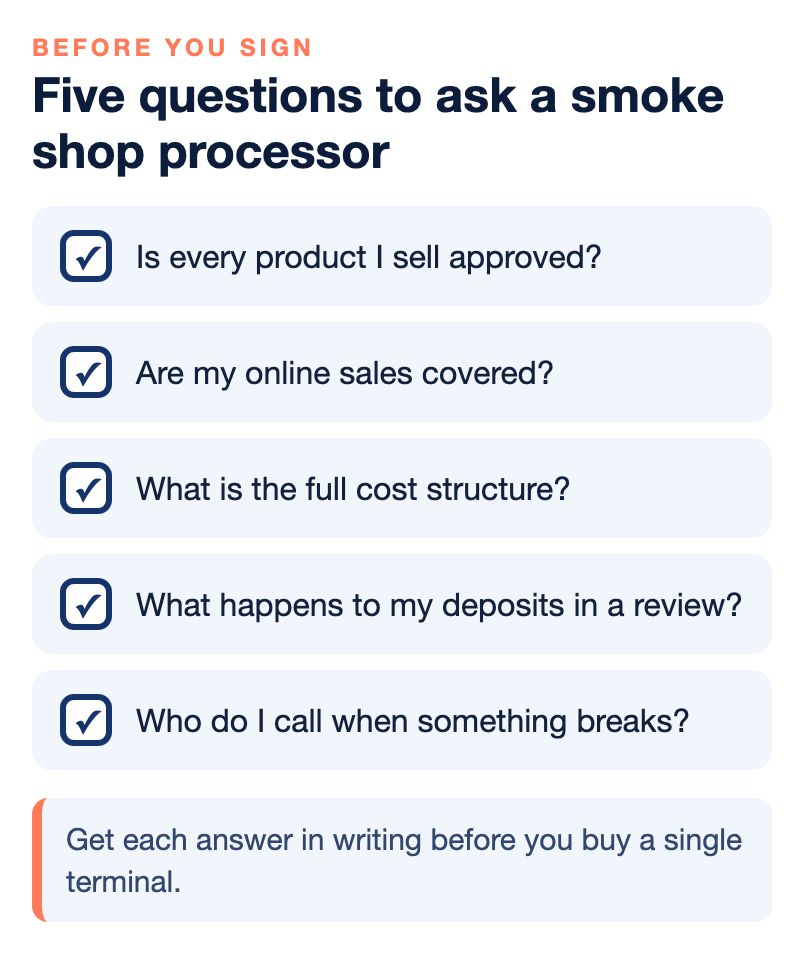
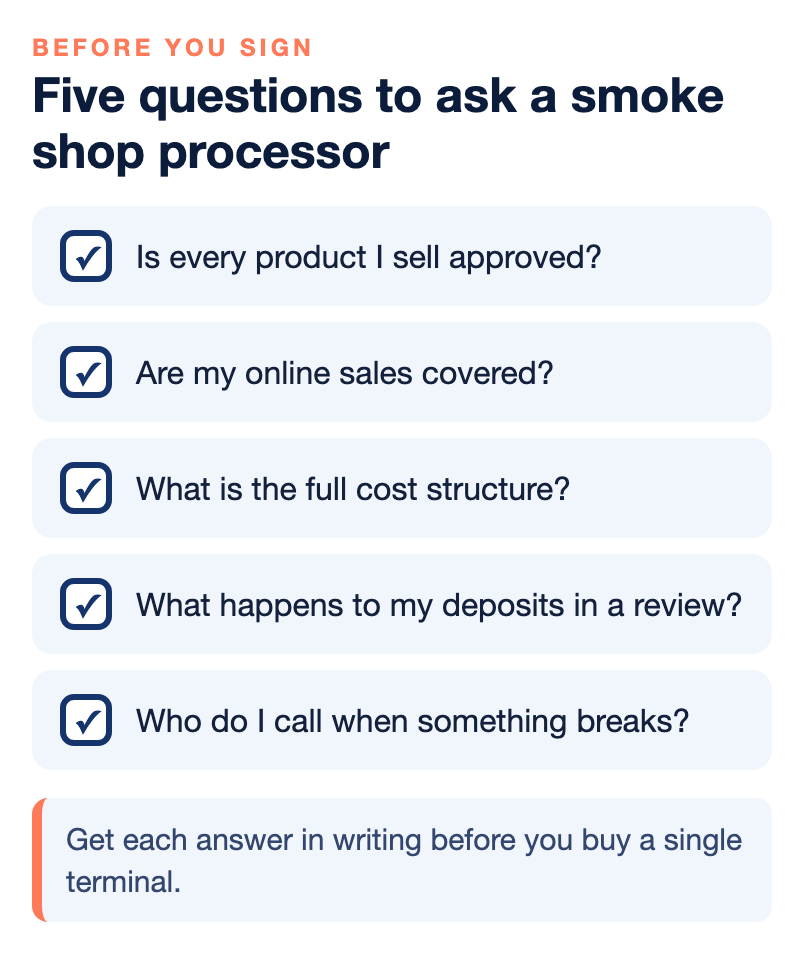
The table below turns those points into questions you can take into any sales conversation.
| Ask this | Why it matters | A good answer |
|---|---|---|
| Is every product I sell approved? | Unapproved products are a common reason smoke shop accounts close | A written list that matches your shelves |
| Are my online sales covered? | Card-not-present tobacco brings extra Visa and Mastercard rules | Registration and monitoring set up for the website |
| What is the full cost structure? | One rate on a flyer hides the monthly and per-item fees | Every fee listed in writing before you sign |
| What happens to my deposits in a review? | A held account hurts a single store fastest | A plain explanation of holds, reserves and timing |
| Who do I call when something breaks? | A terminal down on a Friday night costs real sales | Named office hours plus a 24/7 help desk |
How smoke shop processing is priced
We do not publish one rate for every smoke shop, because the right price depends on your volume, your average ticket, your mix of card-present and online sales and your history. What we can tell you is how the programs are built, so you can compare offers on the same terms.
NPS offers several pricing models to smoke shops. A flat rate program keeps the math simple for a newer store. A cost plus program passes through the card brands’ actual costs plus a set markup, and you qualify for it by submitting your current processing statements so we can see your real volume and mix. A dual pricing program shows a cash price and a card price at the register, and a cash discount program offers customers a discount for paying cash. Both of those programs have to follow card-brand rules and state law, and our guide on whether your cash discount or dual pricing is compliant explains what a compliant setup looks like before you turn it on. Shops that take EBT can add it to the same setup.
When you compare offers from any processor, ask for the entire cost structure in writing: the processing markup, per-transaction fees, monthly fees, gateway fees for online sales, chargeback fees, PCI fees, any reserve, early termination terms and equipment costs. A low rate with a long contract and heavy monthly fees can cost far more than a fair rate with clear terms. A clean processing history and a low chargeback ratio work in your favor over time, so a shop that starts on one program can often move to a better one later.
The Tobacco Scan Data Program and buydowns
Large chains have long received buydowns and promotional money from tobacco manufacturers. The Tobacco Scan Data Program gives an independent smoke shop the same kind of opportunity. NPS submits your point of sale scan data, and you get paid monthly by participating tobacco manufacturers for your tobacco sales. You do nothing beyond ringing up the sale, and you become eligible for buydown promotions.
The plan includes:
- Scan reporting to participating tobacco manufacturers
- Multi-pack and loyalty program reporting
- License ID scanning, included with no additional scanner required
- Automatic manufacturer promotions sent through the system
- Access to additional manufacturer coupons through a companion app
Depending on your sales volume, you can also earn money back per carton, which helps cover your scan data processing fee. Because the reporting runs from the point of sale, it also takes the manual paperwork out of tobacco reporting and helps you stay compliant with the manufacturer programs. Ask us for current pricing for the program, since it depends on your setup. Our post on automated tobacco scan data reporting explains how the reporting works day to day.
Reporting, taxes and the tipping feature
A merchant account through NPS comes with reporting that helps you run the store as well as reconcile deposits. Detailed sales reports help you see trends and decide what to reorder. Integrated inventory tracking helps you keep the right stock on the shelf. Customer insights help you plan promotions and loyalty offers. Tobacco reporting for the manufacturer programs runs from the same system, and taxes are broken down by category, such as sales tax, tobacco tax and liquor tax, which makes filing much quicker for shops that sell more than one regulated product.
NPS also offers a tipping feature. It lets customers leave a gratuity during the payment, which suits service-oriented transactions and helps staff collect gratuities, and it is easy to set up and use for both employees and customers.
If you are also choosing the register, our retail POS system for convenience stores, smoke shops and small retailers covers the NPS POS bundle built for stores like yours.
How to get a smoke shop merchant account: documents and steps
Getting a smoke shop merchant account is a straightforward process when the file is complete. Most of the delay in high risk approvals comes from missing documents and back-and-forth, so the best thing you can do is gather everything before you apply.
Documents to gather
- Proof of your business’s legal identity, such as your business license or articles of incorporation
- Proof of your business’s physical address, such as a utility bill or lease agreement
- Identification for the owners
- A voided business check or a letter from your bank
- Recent processing statements, if you already accept cards
- Any tobacco or retail licenses your state and city require
- A list of the products you sell, with supplier details and certificates of analysis for CBD and hemp products
- If you sell online, your website with clear refund, shipping, privacy and age-verification policies
Our high risk merchant services guide has the complete document and policy checklist that banks use for regulated businesses.
The steps
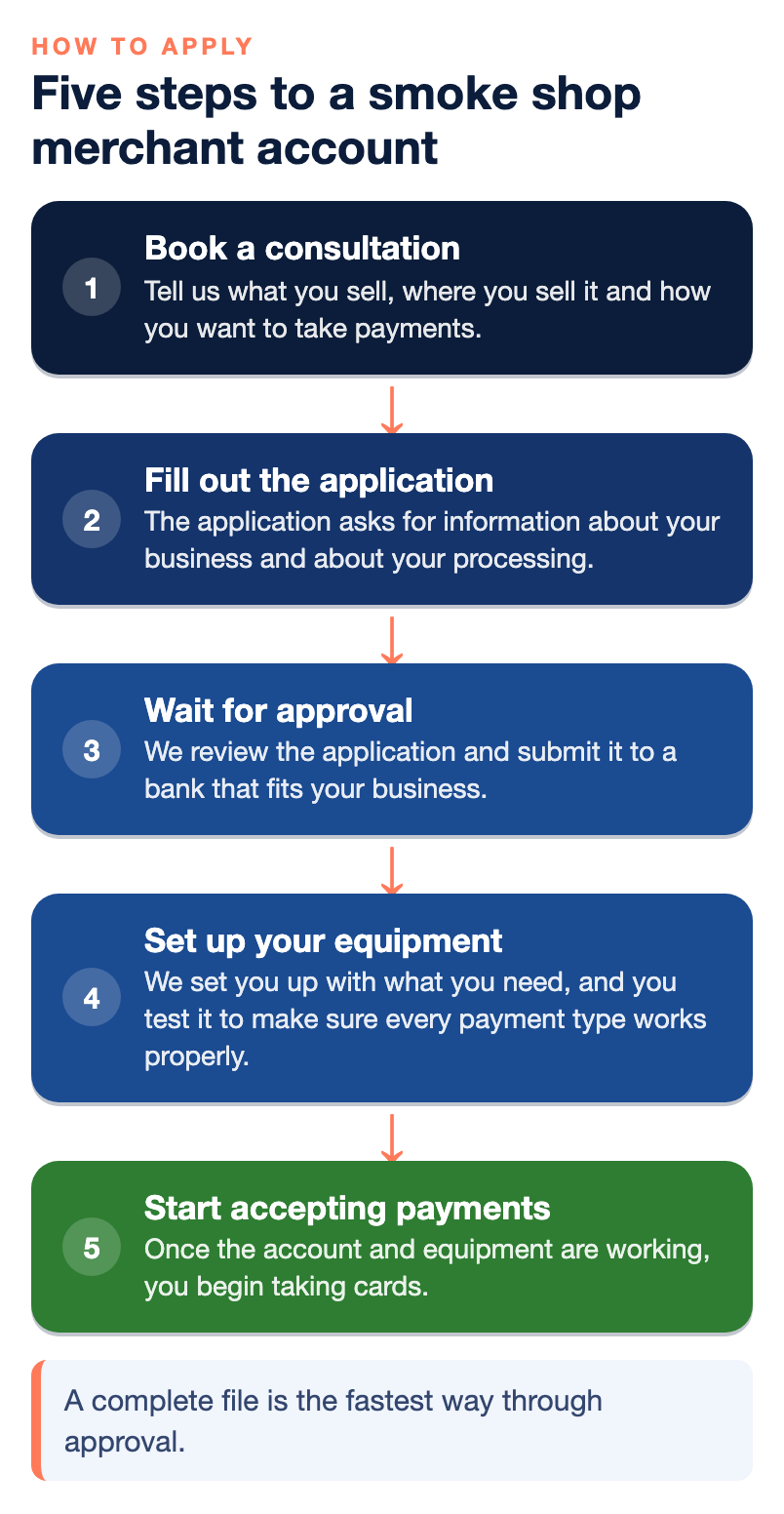
The process runs in five steps.
- Book a consultation. Set up an appointment or fill out the form on our website, and tell us what you sell, where you sell it and how you want to take payments: a credit card terminal, a mobile solution, a point of sale system, an ecommerce gateway or a mix.
- Fill out the application. The application asks for information about your business, including your name, address and contact information, and about your processing, such as your average monthly card volume and the types of cards you accept.
- Wait for approval. We review the application and submit it to a bank that fits your business. Depending on the complexity of the application and how complete the documents are, this can take a few days or longer.
- Set up your equipment. Once you are approved, we set you up with what you need, whether that is a terminal, a point of sale or a gateway, and you test it to make sure every payment type works properly.
- Start accepting payments. Once the account and equipment are working, you begin taking cards, following the security steps and the terms of your merchant agreement so transactions run smoothly.
Keeping the account healthy once you are approved
Approval is the start, not the finish. Most smoke shop accounts that close do so because something changed after the application and nobody told the processor, or because disputes crept up without anyone watching. A few habits keep the account in good standing.
First, keep your chargebacks low. For card-present sales, take chip and tap payments rather than keying card numbers by hand. For any card-not-present sales, use AVS and CVV checks, clear descriptions on the customer’s statement and fast answers to disputes. Second, know your merchant account’s terms and conditions, keep a steady transaction history and avoid sudden, unexplained changes in volume or ticket size that can trigger an account hold. Third, stay current on local and federal rules about selling tobacco and vape products, keep the proper disclosures on your website if you sell online, and check new vape products before they go on the shelf. Compliance is what keeps both your license and your merchant account.
Finally, call us before you change anything big. A new product line, a website, a second location or a wholesale arm can usually be added to your account cleanly when we know about it first. The same change discovered in a review can look like a problem. If your account was ever held or closed somewhere else, tell us that too. The first step is understanding why it happened, so it does not happen again.
Support and hours
Support works on two levels. Our office is open from about 9 or 10 a.m. to 6 p.m., and that is where you reach the payment consultants who know your account, your bank and your history. For anything after hours, merchants reach 24/7 support through the help desk for their product, so a terminal or gateway question on a busy Friday night still gets answered. Smoke shops keep long hours, and both levels matter.
Where to go next
If you are choosing the register as well as the account, start with the best POS systems for tobacco and smoke shops. For the FDA, Visa and Mastercard rules on vape and online tobacco, read our smoke shop and vape rules page. For more on fees, pricing models and how card payments work, browse our payments guides.
Bottom line
The right smoke shop merchant account is the one that is still open next year. That means a processor that underwrites tobacco, vape and accessories on purpose, an approval that lists every product and channel you sell, pricing you can read line by line, and reporting that pays you back through the Tobacco Scan Data Program. The cheapest-looking option often costs the most once a frozen deposit or a sudden closure enters the picture, and the honest trade-off is that a specialized account usually costs more than ordinary retail processing. For a smoke shop, that difference buys the account’s stability. If you want a setup built for your store, contact our team and we will put together a program that suits your business.
Frequently Asked Questions
Can smoke shops accept credit cards?
Yes. With a processor that underwrites high risk businesses, smoke shops can accept credit cards, debit cards, mobile wallets, contactless payments, ACH and eCheck payments and online payment links. The key is an account approved for every product and sales channel the shop actually uses.
Why are smoke shops considered high risk?
Banks label smoke shops high risk because the products are age-restricted, the rules on vape and alternative tobacco products change often, and tobacco and vape sales are seen as more likely to produce chargebacks. The label is about the category, not about how well a particular store is run.
Can I use an instant-approval payment app for my smoke shop?
Usually not for long. Many mainstream processors decline tobacco and vape businesses or shut accounts down without warning once a review catches up. A processor that specializes in high risk merchant accounts is the safer choice, because it submits your file to banks that want the category.
Does NPS work with CBD, hemp and cannabis accessory businesses?
NPS works with cannabis-related, non-plant-touching businesses only, such as smoke shops selling pipes and smoking accessories, CBD and hemp products, and companies that sell to cannabis businesses. We do not serve dispensaries, growers or any business that touches the plant.
What documents do I need for a smoke shop merchant account?
Expect to provide proof of your business’s legal identity, such as a business license or articles of incorporation, proof of your physical address, owner identification, a voided business check or bank letter, recent processing statements if you already accept cards, your tobacco and retail licenses, and a product list. Online sellers also need clear website policies.
Can my smoke shop sell online and still take card payments?
Yes, but online tobacco and vape sales bring additional Visa and Mastercard requirements, including registration and monitoring through the acquiring bank. NPS offers secure ecommerce gateways with fraud tools for smoke shops selling online. Tell your processor about the website before you start taking orders.
What is the Tobacco Scan Data Program?
NPS submits your point of sale scan data to participating tobacco manufacturers, and you get paid monthly for your tobacco sales and become eligible for buydown promotions. Depending on your volume, you can earn money back per carton, which helps cover the program fee. Ask us for current pricing.
How can smoke shops reduce chargebacks?
Take chip and tap payments instead of keying card numbers, use AVS and CVV checks on card-not-present sales, use a clear name on customer statements, answer disputes quickly and check ID at every age-restricted sale. Low chargebacks keep the account in good standing and can improve your pricing over time.