Nationwide Payment Systems
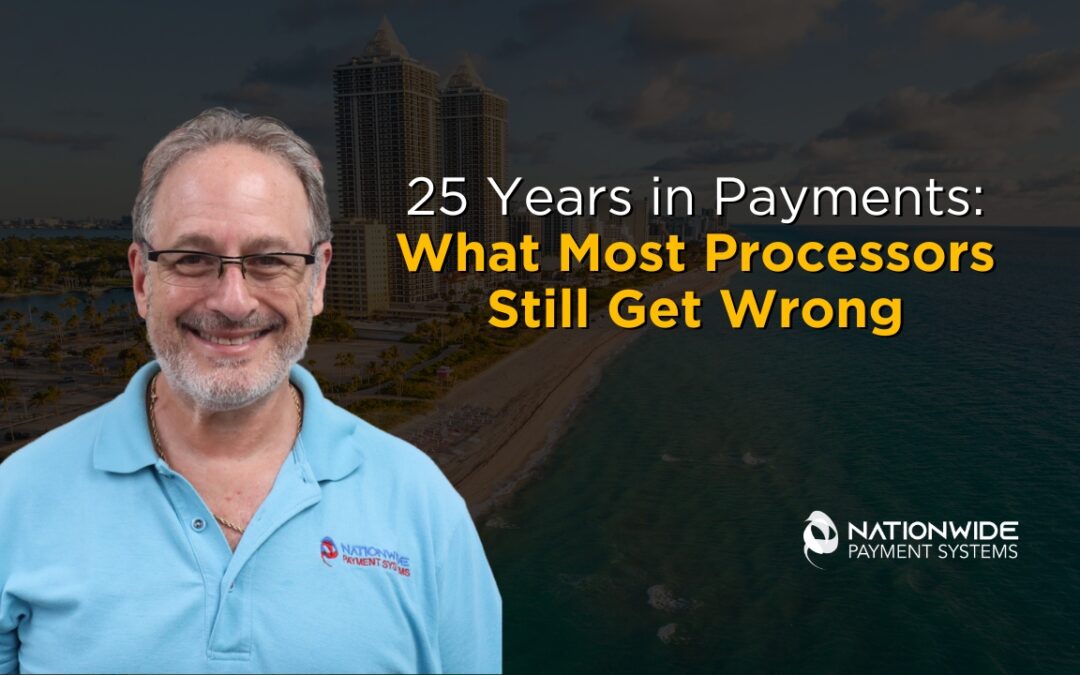
25 Years in Payments: What Most Processors Still Get Wrong
Allen Kopelman reflects on 25 years in payment processing — the industry's persistent blind spots, and why Nationwide Payment Systems was built to fix them.
After 25 years building Nationwide Payment Systems, CEO Allen Kopelman shares the mistakes the payment industry keeps making — and what businesses should actually demand from their processor.
Presented by Allen Kopelman, CEO — Nationwide Payment Systems-Host of B2B Vault: The Biz2Biz Podcast
AI OVERVIEW
After 25 years building Nationwide Payment Systems, CEO Allen Kopelman reflects on the payment industry's persistent problems — and why the answer is always the same: real solutions, real people, real accountability.
Twenty-five years is a long time to be in any industry. It's long enough to watch technology transform everything about how payments work — and long enough to notice that some of the most fundamental problems for small business owners haven't moved an inch.
When we started Nationwide Payment Systems in 2001, the internet was still finding its footing as a commerce platform. Mobile payments didn't exist. The idea of a merchant setting up a payment link and texting it to a customer in thirty seconds would have sounded like science fiction. The tools have gotten dramatically better. The industry's relationship with the merchants it serves — that's a different story.
This anniversary felt like the right moment to say what we've been seeing for 25 years. Not to celebrate ourselves — though we're proud of what we've built — but to lay out, as plainly as we can, what the payment processing industry keeps getting wrong. And what businesses should actually expect from their processor.
sponsored by

The Industry Has Changed. The Problems Haven't.
From dial-up terminals to AI-powered platforms — five eras, same frustrations.
2001-Dial-up terminals & paper statements
2006-Online gateways & e-commerce growth
2012-Mobile payments & flat-rate disruption
2018-SaaS platforms & integrated payments
2024- AI tools & all-in-one platforms
Through every one of those eras, the same complaints have followed us from merchant to merchant. The fees are confusing. Support is unreachable. The account got shut down without warning. The system doesn't fit how the business actually works. The processor doesn't understand what we do.
These aren't edge cases. They're the majority experience for small business owners navigating payment processing in America. And the rise of app-based, instant-approval, flat-rate platforms has in many ways made the situation worse — not because the technology is bad, but because it created an industry expectation that processing should require no relationship, no underwriting, and no human accountability. When things go well, that's fine. When things go wrong — and in payments, things always eventually go wrong — that approach fails merchants completely.
What Most Processors Still Get Wrong
Six persistent failures — and what the right approach looks like
1.One-Size-Fits-All Solutions for Businesses
That Are Nothing AlikeA pool service company and a medical practice and a nonprofit and an e-commerce retailer do not have the same payment needs. They don't have the same risk profiles, the same customer relationships, the same compliance requirements, or the same billing cadences. Forcing all of them into the same account structure — the same gateway, the same pricing model, the same reporting — means none of them gets something that actually fits. <strong>The right approach: build around how the business actually operates, not how the platform was designed.
2.Flat Rate Pricing That Looks Simple But Costs More
Flat rate pricing became popular because it's easy to explain. 2.6% plus 10 cents on everything. No surprises. But here's what that simplicity hides: <strong>debit cards processed under the Durbin Amendment can cost as little as 0.5%</strong>. Certain SIC code categories carry reduced interchange rates. Premium rewards cards cost more. On a flat rate, all of that variation disappears — and the difference goes to the processor, not the merchant. For a business processing $100,000 a month with significant debit volume, the cost of that simplicity can run into thousands of dollars annually.
3.No Real Support When It Actually Matters
We have spoken with merchants who had their account frozen on a Friday afternoon and couldn't reach a human being until Monday morning. We have spoken with merchants who spent weeks going in circles with automated support systems trying to resolve a chargeback. Payment processing is infrastructure — it's as critical to a business as electricity or the phone system. <strong>When something goes wrong, "submit a ticket" is not an acceptable answer.</strong> 24/7 live support from people who understand the merchant's specific industry isn't a luxury. It's the baseline.
4.Approving Merchants Without Understanding Their Business
Instant approval sounds like a feature. In practice, it often means the processor approved an account without knowing what the business actually does — and without checking whether that business type is permitted, what compliance requirements apply, or what underwriting controls are needed. That merchant operates for six months, builds a customer base, processes revenue — and then gets shut down when the platform's automated risk systems finally flag the account. <strong>The merchants who ask the most questions and request the most documentation aren't being difficult. They're the ones who will actually be there for you when something goes sideways.
5.Treating Chargebacks as the Merchant's Problem to Figure Out Alone
Chargebacks are one of the most confusing and consequential issues a merchant can face — and most processors provide minimal guidance when they happen. The rules are complex, the timelines are tight, the evidence requirements differ by dispute reason code, and the ultimate arbiter is the cardholder's bank, not the merchant's processor. <strong>Merchants deserve actual assistance</strong> — notification, explanation, help compiling evidence, and guidance on prevention — not just a notification that a dispute was filed and a balance deducted from their account.
6.Technology Without Education
he payment industry has produced remarkable technology over the past decade. Tap-to-pay. Real-time ACH. Dynamic billing descriptors. Level 2 and Level 3 data for B2B transactions. Cost recovery tools like dual pricing and surcharging. But handing a merchant a platform loaded with features and then leaving them to figure it out is not service — it's abdication. <strong>Technology only creates value when merchants understand how to use it</strong> and why each feature exists. Education isn't an add-on to the relationship. It's the foundation of it.
What We Built Instead
25 years of doing it the hard way — which turns out to be the right way
"Too many businesses are forced into cookie-cutter payment systems thatdon'tfithow theyactually operate. We built Nationwide Payment Systems to give merchants real solutions, real people, and real accountability."
— Allen Kopelman, CEO, Nationwide Payment Systems
Nationwide Payment Systems was built on a different premise from the start. Payments should help businesses grow — not create risk, confusion, or surprise shutdowns. That philosophy has driven every decision we've made over 25 years, from how we underwrite accounts to how we answer the phone to what we built into NPS One.
It has not always been the fastest or easiest path. Doing real underwriting takes longer than instant approval. Building industry-specific knowledge takes years of work. Maintaining 24/7 live support is more expensive than an automated ticket queue. But the merchants we work with don't need us to be fast and cheap — they need us to be right and reliable. Those are different things.
"Nationwide Payment Systems has announced the expansion of its specialized payment platform and Smart Invoicing tools, targeting growing companies in retail, B2B services, healthcare, nonprofits, and high-risk industries — addressing a critical gap in the market by pairing enterprise-grade technology with direct, relationship-based support."
As reported in Yahoo Finance · January 2026
That expansion — NPS One and the Smart Invoicing platform — represents the most significant product investment in our company's history. It is the culmination of 25 years of listening to what merchants actually need. Not what we thought they needed. Not what was easiest to build. What they told us, over and over, was missing from every other platform they had tried.
What NPS One Was Built to Fix
Unified Processing
One Platform for Everything
Credit card, ACH, gateway, invoicing, recurring billing, and QuickBooks sync — all in one account, one login, one support number. No more chasing down three vendors to figure out where a problem originated.
Real Pricing
Cost Plus & Interchange Optimization
Cost plus pricing passes actual interchange rates to merchants, including Durbin debit savings and SIC code reductions. Level 2 and Level 3 data processing for B2B transactions further reduces interchange costs on qualifying cards.
Real Support
24/7 Live, Industry-Knowledgeable
Every merchant works with dedicated relationship managers who understand the nuances of their specific industry — not a rotating support queue staffed by generalists reading from a script.
Pricing Flexibility
Fees That Fit Your Business
Dual pricing, surcharging, service charges, and no-fee setups — all configurable at the account level with granular overrides by customer or by individual transaction. No two businesses are forced into the same model.
Automated Billing
Recurring Revenue Without the Work
Recurring payments, Autopay, and subscription enrollment links eliminate manual monthly billing. Customers enroll themselves. Charges run on schedule. Revenue becomes predictable without becoming a burden.
Smart Invoicing
Professional Billing for Every Business Type
From split payments and deposit billing to nonprofit donation management and year-end donor receipts — Smart Invoicing is built for how service businesses, B2B companies, and nonprofits actually operate.
The Standard Every Merchant Should Hold Their Processor To
What you should be able to expect — and what to walk away from if you're not getting it
After 25 years, here is what we believe every merchant deserves from their payment processor — regardless of size, industry, or monthly volume.
The NPS Standard — What Every Merchant Deserves
-
Pricing transparency before you sign anything You should know exactly what you're paying, how the rate is calculated, and what happens if your transaction mix changes. No fine print. No surprise fees on your first statement.
-
A processor who actually understands your industry Your processor should know the compliance requirements, risk profile, and common chargeback patterns for your business type — before your account is approved, not after a problem arises.
-
A real person you can call when something goes wrong Not a chatbot. Not a ticket queue. A person who knows your account, understands your business, and can actually resolve the issue — on the day you call, not three business days later.
-
Education, not just a platform You should understand why each tool exists, how it affects your costs and compliance, and what you should be doing differently. A processor who teaches you is one who's invested in your success.
-
Technology that fits your workflow — not the other way around Your payment platform should adapt to how your business operates. If the technology requires you to change how you work, the technology is wrong for you.
-
Accountability that doesn't disappear when you're approved The relationship with your processor should not be strongest when they're trying to sign you up. It should be strongest when you need help — because that's when it actually matters.
Looking Forward from Year 25
What comes next — and why it starts with the same principles as year one
The expansion of NPS One is not the end of what we're building. Future plans include expanding B2B payment capabilities further, growing partnerships with CPAs and SaaS platforms, and investing in AI-driven reporting that gives merchants the financial visibility they need without requiring an accounting degree to interpret.
But the foundation under all of it is the same as it was in 2001. Payments should help businesses grow. The relationship between a merchant and their processor should be built on transparency, accountability, and genuine understanding of how that business operates. Enterprise-grade technology should be accessible to businesses of every size — not just the ones large enough to negotiate custom contracts.
Twenty-five years ago, we started this company because we believed there was a better way to do this. Every year since has reinforced that belief — and made us more committed to it. The industry hasn't fixed its core problems. That's still our job.
"Payments should help businesses grow — not create risk, confusion, or surprise shutdowns." — Allen Kopelman, CEO, Nationwide Payment Systems
Nationwide Payment Systems serves merchants nationally across retail, B2B services, healthcare, nonprofits, and high-risk industries. Allen Kopelman, CEO and founder, is also the host of B2B Vault: The Biz2Biz Podcast — available on Apple Podcasts, Spotify, and YouTube — where he regularly discusses payments, compliance, fintech, and the realities of running a business in today's environment.