• Book a Strategy Call
  • Contact Us
  • Get Started
  • About Us
  • Webinars
  • Home
  • NPSOne
    • NPSOne
    • Smart Invoicing
  • Solutions
    • Ecommerce
    • Dual Pricing Program
    • High Risk Merchant Services
    • Payment Consulting
    • Consumer Financing
  • Point of Sale
    • liquor Store POS
    • Nightclub POS
    • ATM Services
    • Mobile Payments
    • Retail POS
    • Restaurant POS
    • Retail Solutions
    • Crypto Processing
    • Cigar and Smoke Shop POS
    • NCR CounterPoint POS
  • High Risk & High Volume
    • High Volume Merchant Account
  • Toolbox
    • Payroll Solutions
    • PEO Section
    • Toolbox
    • Consumer Financing
    • Business Insurance
    • Business Loans
    • ISV Toolbox
    • Chargeback Rescue
  • Podcast/Blogs
    • B2B Vault Podcast
    • Payment Blogs
    • Green Sheet Blogs
    • Forbes Blogs
    • B2B Vault Podcast Blogs

AI Overview

In 2026, Mastercard introduced stricter enforcement within its Merchant Monitoring Program to combat fraudulent and deceptive eCommerce websites. The new rules require acquirers to investigate suspicious merchants within 72 hours and shut down confirmed scam operations immediately.

While designed to eliminate fake websites and phishing scams, these changes significantly impact legitimate businesses—especially in high-risk industries like supplements, telemedicine, and eCommerce. Businesses must now prioritize compliance, transparency, and proper underwriting—or risk sudden account termination. Nationwide Payment Systems provides the expertise needed to navigate these regulatory shifts.

Mastercard Fake Website Rule 2026: What Merchants Must Know

🚨 What Is Mastercard’s New Rule About “Fake Websites”?

This isn’t a single “new law” — it’s an aggressive expansion of fraud enforcement rules inside Mastercard’s monitoring system.

Key Update:

  • Banks and payment providers must review suspicious merchants within 72 hours.
  • If fraud is confirmed → processing is terminated immediately.

👉 Translation: There’s no more “wait and see.” It’s now investigate → shut down fast.

🔍 What Gets a Website Flagged?

Mastercard isn’t randomly targeting businesses — there are clear triggers:

🚩 High-Risk Signals:

  • High chargeback or fraud rates
  • Customers claiming, “never received product.”
  • Misleading claims or exaggerated marketing
  • Websites that resemble known brands
  • Missing policies (refunds, terms, contact info)
  • New merchants with rapid volume spikes
  • Cross-border traffic anomalies

👉 Even legit businesses can get flagged if they look risky.

⚠️ Why This Is a Big Deal for Merchants

1. Faster Shutdowns (This is new)

Before: Months of chargebacks → review.
Now: 🚨 72 hours → investigation → shutdown.

2. Compliance Is No Longer Optional

If your site doesn’t have Terms & Conditions, a Refund/Return Policy, a Privacy Policy, and clear contact info, you’re already at risk.

3. High-Risk Verticals Are Under Pressure

Industries feeling this the most include supplements/nutraceuticals, peptides & telemedicine, CBD/hemp, and subscription-based eCommerce. These aren’t banned, but they require specialized high-risk merchant services and robust payment processing solutions to stay stable under scrutiny.

4. Acquirers Are Taking Less Risk

Mastercard is pushing liability downstream to banks, ISOs, and payment facilitators. This results in more declines, faster account closures, and less tolerance for “gray area” merchants, especially those requiring a high-volume merchant account.

🤖 Why Mastercard Is Doing This

Fraud has evolved fast—especially with AI—leading to fake Shopify stores, cloned brand websites, and AI-generated product pages. Mastercard is shifting from “React to fraud” to “Prevent fraud before it scales.”

💡 What Smart Merchants Should Do Right Now

To stay approved and processing, use this checklist:

  • ✅ Website Compliance: Full legal policies, real business address/phone, and transparent product descriptions including shipping data.
  • ✅ Product Compliance: No exaggerated claims and proper disclaimers (especially for supplements).
  • ✅ Payment Strategy: Secure stable merchant services, offer ACH alongside cards, and monitor chargebacks aggressively.
  • ✅ Underwriting Readiness: Be ready to explain your business model and provide supplier/fulfillment details.

🧠 The Real Opportunity: Operational Security

Most providers will react with a simple "Declined — too risky." However, this environment creates an advantage for those who understand compliance. Beyond payments, businesses should look into integrated payroll services solutions and PEO sections to ensure their entire operational back-end is professional and documented.

🚀 Why This Matters for Growing Businesses

If you’re scaling eCommerce or running a high-risk vertical, you can’t afford random shutdowns. You need a partner that understands risk and keeps you compliant long-term with professional payment processing solutions and high-volume support.

📣 Final Thoughts

Mastercard’s crackdown isn’t just about stopping scams — it’s reshaping how merchants get approved and stay approved. The businesses that adapt will scale; the ones that ignore this will get shut down. Visit Nationwide Payment Systems to ensure your merchant account is secure for the 2026 landscape.
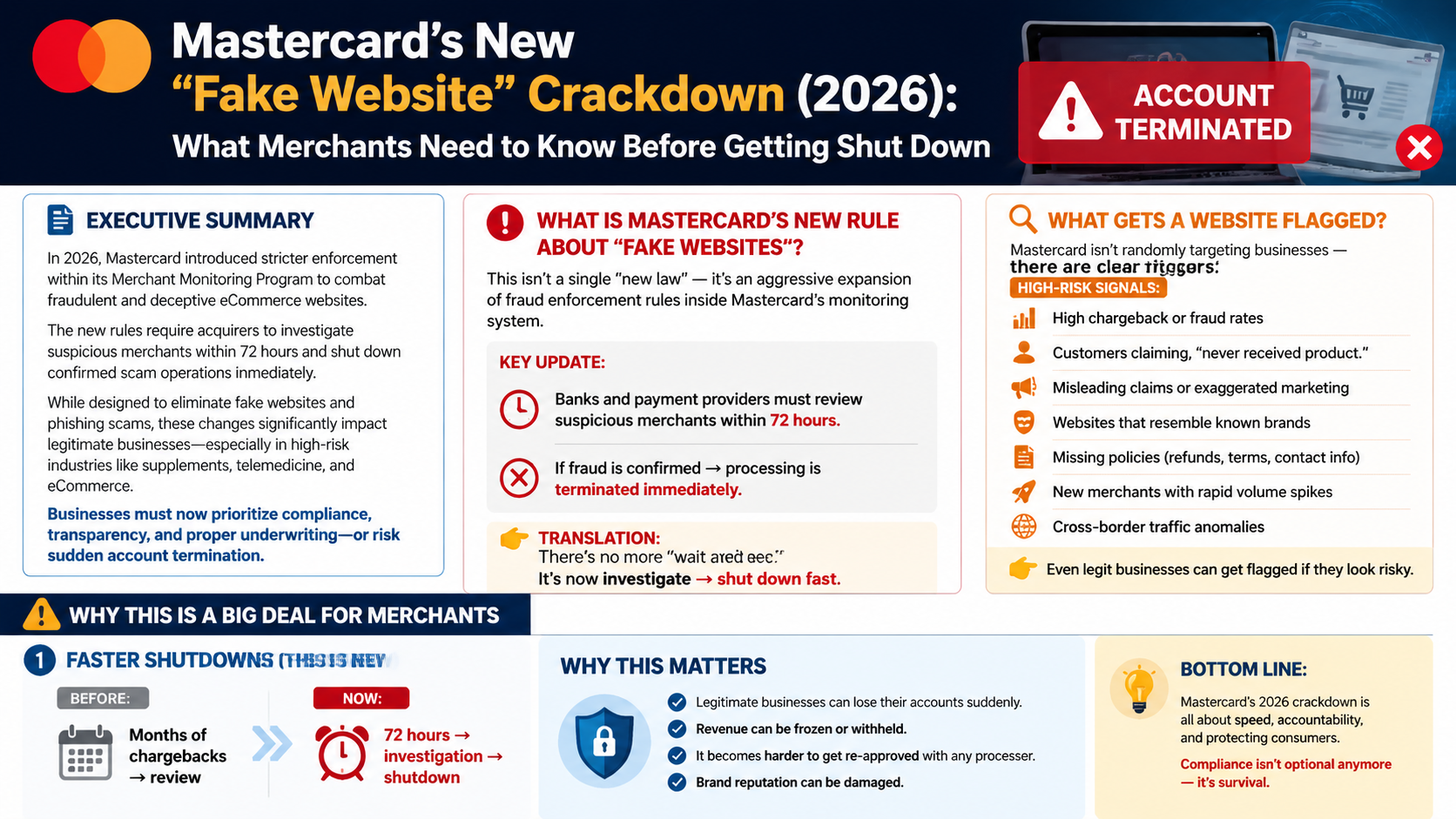
A detailed infographic regarding Mastercard’s 2026 crackdown on "fake websites" and deceptive eCommerce practices. The graphic includes sections for an Executive Summary, clear triggers for being flagged (such as high chargeback rates or missing policies), and a comparison showing how investigation times have shifted from months to just 72 hours. An "Account Terminated" warning graphic is visible in the top right corner.

sponsored by

Contact Us

Frequently Asked Questions

1. Is Mastercard banning certain types of websites? +
No — but they are enforcing much stricter monitoring and compliance standards on high-risk merchants to ensure transaction safety and reduce network liability.
2. What is the 72-hour rule? +
The 72-hour rule mandates that acquirers (payment processors) must investigate any merchant flagged for suspicious activity within 72 hours of receiving the alert.
3. Can legitimate businesses get shut down? +
Yes. Even legitimate businesses can be shut down if they appear non-compliant, have poorly defined terms of service, or operate in a manner that card networks deem too risky.
4. What industries are most affected? +
Industries like nutraceutical supplements, telemedicine, CBD/Hemp, and certain high-volume eCommerce sectors are under the highest level of scrutiny.
5. Do I need LegitScript approval? +
In many verticals, yes. LegitScript certification is often mandatory for telemedicine, pharmacies, and addiction treatment centers to maintain card processing.
6. What triggers a compliance investigation? +
Triggers include spikes in chargebacks, customer complaints, unusual fraud patterns, or marketing that makes unsubstantiated claims.
7. How do I avoid getting flagged? +
Maintain strong compliance by having clear refund policies, robust identity verification, and ensuring all marketing material is accurate and truthful.
8. Will Stripe or Square enforce this? +
Yes. These are Mastercard network rules. All payment aggregators and processors must enforce these standards or risk losing their ability to process Mastercard transactions.
9. Can I reopen after being shut down? +
It is extremely difficult. Once a business is placed on the MATCH LIST (Terminated Merchant File), it is nearly impossible to get a standard merchant account. Prevention is your best strategy.
10. Does this affect ACH payments? +
These rules primarily target credit card payments, but your overall business risk profile matters. Many high-risk merchants utilize ACH to diversify their payment options and mitigate risk.

Submit a Comment Cancel reply

Your email address will not be published. Required fields are marked *

Allen Kopelman
CEO - Nationwide Payment Systems

Latest Posts

  • A high-contrast banner featuring a small green sprout emerging from dark soil and dried leaves, symbolizing resilience. Bold yellow text on the left reads "Chargeback Survival Guide for Businesses (2026)" with the Nationwide Payment Systems logo positioned underneath.
    Chargeback Survival Guide 2026: How to Prevent & Win Disputes
  • An information-dense infographic titled "Fake Website Rule" detailing Mastercard’s 2026 enforcement standards. The graphic features a red "Account Terminated" alert, a 72-hour investigation timeline, and key risk triggers including "Authorization Rate Drops" and "New Merchant (≤ 6 months) Thresholds." The Nationwide Payment Systems logo is prominently displayed.
    Mastercard Fake Website Rule 2026: What Merchants Must Know
  • ACH Optimization Guide (2026) – Reduce Payment Fees & Improve Cash Flow 

B2B Vault: The Biz To Biz Podcast

B2B Vault: The Biz to Biz Podcast
Thomas Supplier
  • Follow
  • Follow
  • Follow


Location

1500 W Cypress Creek Rd #503, Fort Lauderdale, FL 33309



Call Us

(866) 677- 2265



hours

MON-FRI

10 am - 6 pm

Company

Privacy Policy

Contact Us

Newsletter

Terms & Conditions

About

Webinars

Refer a business

Partner with us

Customized Payment Processing