
High Risk Merchant Accounts: A Complete Guide for Small and Mid-Size Businesses
A high risk merchant account is a credit card processing account for a business that banks see as more likely to have chargebacks, heavy regulation or reputational exposure, and the right way to get one is to be underwritten honestly by a bank that already wants your kind of business. Nationwide Payment Systems (NPS) has placed high risk and hard-to-place businesses since 2001. We hold direct contracts with multiple banks and processors, so we are not brokers, and our job is to match your business model to a bank whose risk appetite fits it, keep your processing domestic rather than offshore, and structure pricing that protects your margin. This guide explains what the label means, what an underwriter actually looks at, which industries need a specialized account, how to get approved and how to stay approved once you are processing.
What is a high risk merchant account?
A high risk merchant account works exactly like a standard merchant account. Your customers pay by card in person or online, the money settles to your bank, and you see the same statements any other business sees. The difference is who approves it and how. Instead of a mainstream processor that runs every applicant through the same automated rules, a high risk account is underwritten by an acquiring bank that specializes in your industry and has looked at your real business before you process your first sale.
The term sounds alarming, and it should not. Being labeled high risk does not mean a business is illegal, shady, financially unstable or buried in disputes. Very often it simply means the business operates in an industry that requires specialized underwriting, extra licensing, card-brand registration or age controls. That is why we usually describe these companies as niche industries rather than high risk ones. There are banks that actively want many of these merchants in their portfolios. The work is finding the right bank for the right business, and doing it before something goes wrong rather than after.
It also helps to know why the label exists at all. When an acquiring bank approves a merchant account, it takes on financial exposure for every transaction that runs through it. If customers dispute charges, products are never delivered, refunds cannot be paid or a merchant disappears after collecting money, the acquiring side can be left holding the loss. Underwriting is the bank’s way of answering one question before it agrees to that exposure: what is the real risk of processing payments for this particular business? If you want the side-by-side version of how standard and specialized accounts differ, we cover it in low risk vs high risk merchant accounts explained.
What does a payment processor actually look at when it labels a business high risk?
Banks look at much more than what a company sells. The label usually comes from one or more of seven kinds of risk, and most businesses that end up in a high risk program trip at least two of them at once. Knowing which ones apply to you tells you what the underwriter will ask about and what you can do to make the file stronger.
1. Industry risk
Some industries have a history of higher chargebacks, more fraud, closer regulatory attention or reputational concerns. A business in one of those industries is treated as higher risk even when it is run well, because the bank is pricing the category as much as the company. That is the most common reason a perfectly ordinary business gets declined by a mainstream processor.
2. Regulatory risk
Businesses that sell regulated products may need licenses, registrations, certifications, age verification, prescription controls or product testing. Every one of those is something the bank has to confirm, and every one is something that can be challenged later, so regulated products bring more paperwork into underwriting and more monitoring after approval.
3. Chargeback risk
A company with excessive disputes is harder to approve regardless of its industry. A bank reads a high chargeback ratio as a sign of trouble with customer satisfaction, product quality or billing clarity, and it knows the card networks will hold the acquirer responsible if the ratio keeps climbing.
4. Future-delivery risk
A customer who pays today for something delivered six months from now creates far more exposure than someone who buys a product and walks out of the store with it. Travel, ticketing, memberships, events and some service businesses are the classic examples. If the event is canceled or the trip falls through, every one of those customers can ask for a chargeback at the same time.
5. Average-ticket risk
A business selling ten-dollar products presents a very different exposure from one that regularly processes transactions in the thousands. One dispute on a large ticket hurts more, and issuing banks know it, so a high average ticket on its own can move a business into a specialized program.
6. Card-not-present risk
Ecommerce, telephone orders and manually keyed transactions carry different fraud and dispute risks than a chip card dipped in person. The cardholder is not standing in front of you, so it is harder to prove who authorized the charge, and online-only businesses are reviewed with that in mind.
7. Recurring-billing risk
Subscriptions generate disputes about renewals, cancellations, free trials and whether the customer authorized the charge at all. Many of those chargebacks happen because a customer forgot they signed up, did not recognize the billing descriptor or could not find a way to cancel. Banks treat a subscription model very differently from a one-time retail sale for that reason.
What the underwriter reads in your file
Once the bank knows which risks apply, the underwriter checks how well your business manages them. Expect them to read your website first, because it is the public face of the business. They look for an accurate business name, a physical or mailing address, a customer-service phone number and email, clear product descriptions and pricing, and a posted refund policy, cancellation policy, shipping policy, privacy policy and terms and conditions, plus any subscription disclosures and disclaimers your industry requires.
After the website, they review your products and how you describe them, your processing statements if you already accept cards, your chargeback history and its causes, any licenses your industry needs, and for larger accounts your bank statements and financials. A strong application tells one consistent story. The application, the website, the statements, the licenses, the marketing and the transaction amounts should all describe the same business. Underwriters are trying to understand you, and the easiest file to approve is the one that makes that simple.
Do you need a high risk merchant account? Ten signs
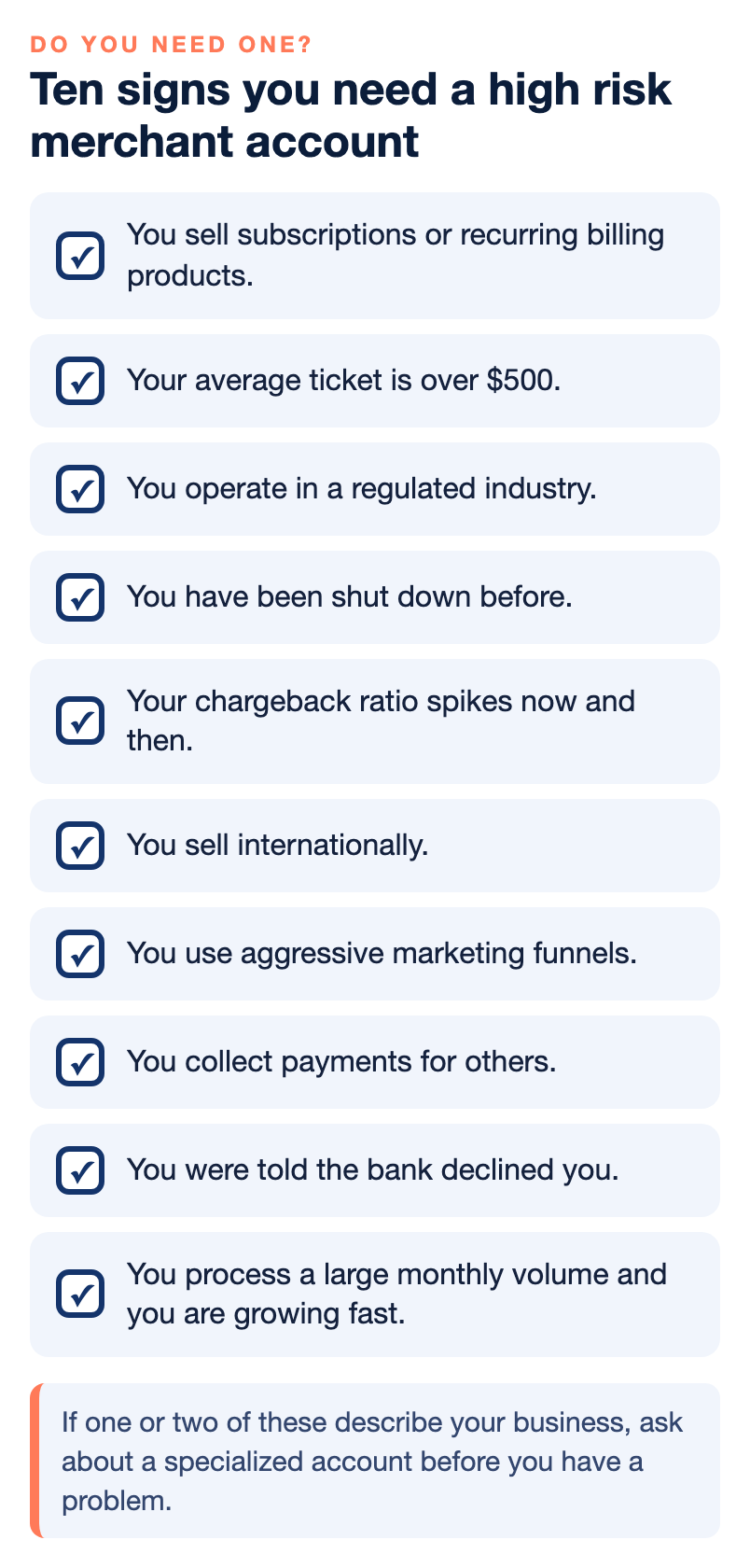
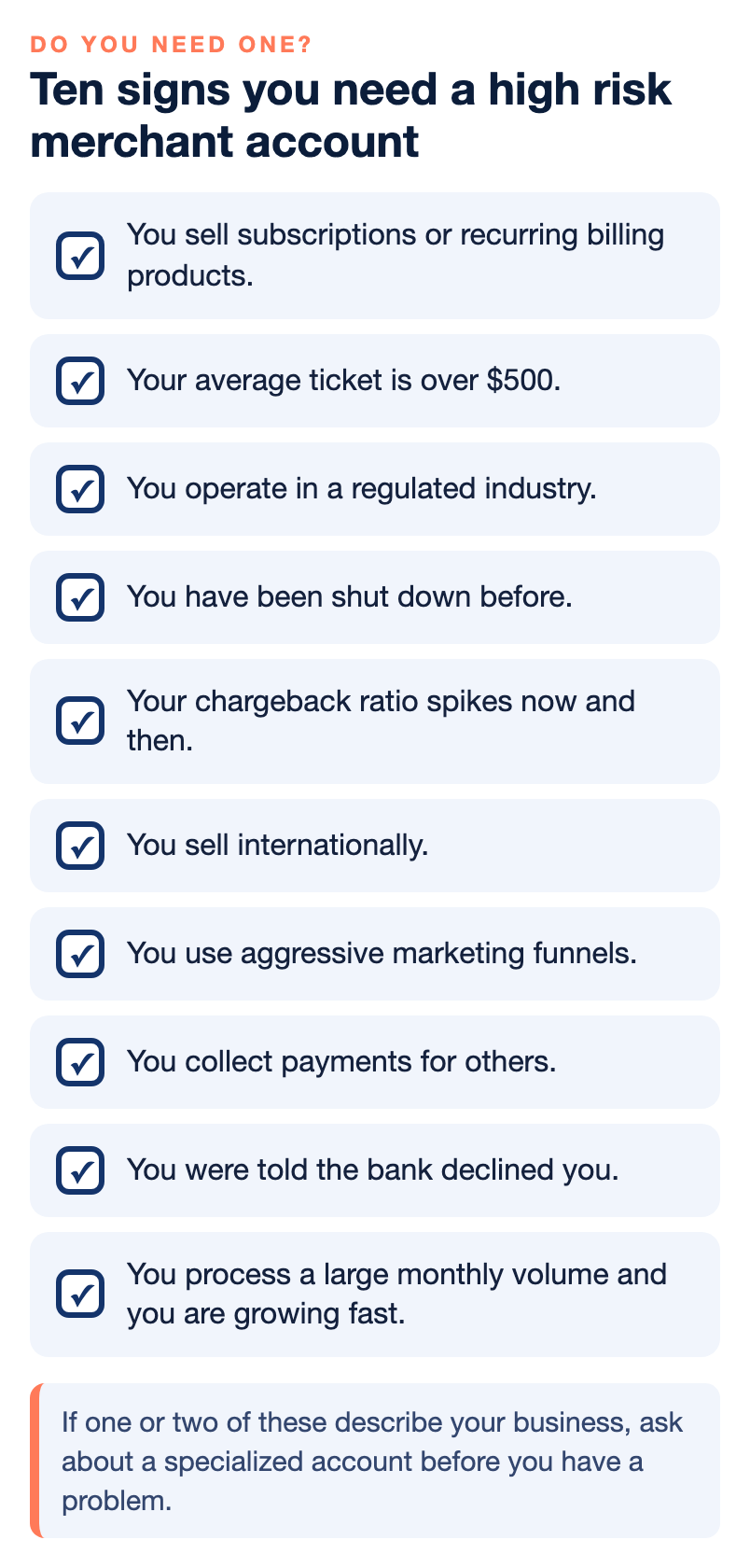
Many business owners do not realize they fall into this category until a processor shuts them down. If one or two of these signs describe your business, ask about a specialized account before you have a problem rather than after.
- You sell subscriptions or recurring billing products. That includes coaching, software, supplements and memberships, because recurring billing raises the odds of “forgot I signed up” disputes and refund friction.
- Your average ticket is over $500. High-end coaching, luxury goods, electronics, equipment and travel packages all fit here, because one dispute on a large sale hurts more.
- You operate in a regulated industry. If your product draws oversight from federal or state agencies, as nutraceuticals, CBD, peptides, supplements and financial services do, your file is automatically more complex.
- You have been shut down before. A past termination, a place on a monitoring program or a fund hold puts you in a higher-risk group, even if it was not your fault.
- Your chargeback ratio spikes now and then. Online education, information products, trial offers, drop shipping and event ticketing naturally see more disputes, and traditional processors get nervous while specialized banks expect some variance.
- You sell internationally. Cross-border sales add fraud risk, currency issues, retrieval requests and overlapping regulations.
- You use aggressive marketing funnels. Limited-time offers, countdown timers, free trials that roll into paid plans and influencer campaigns draw scrutiny even when they are legitimate.
- You collect payments for others. If you run a marketplace, act as an agent, split funds or manage payouts, you may be seen as a payment facilitator, which needs a different structure entirely.
- You were told “the bank declined you.” Often the bank never saw the file. The processor declined it internally because your model did not fit its own risk tolerance.
- You process a large monthly volume and you are growing fast. Rapid growth sets off automated reviews of velocity, ticket size and refunds, and fast growth on the wrong processor is a common path to a shutdown.
Businesses labeled high risk: how to find and get a merchant account
The biggest mistake we see is a niche business opening an account with an instant-approval payment platform or payment facilitator without first reading that provider’s rules. Those platforms are excellent tools for many mainstream businesses, but they are not built to accept every business model, and fast onboarding does not mean full approval. Creating an account in a few minutes is not the same thing as being underwritten. The platform can review your website, products, volume, average ticket, chargebacks, refunds, customer complaints and anything you added after signup at any time, and a business that falls in a restricted or prohibited category can lose its account with little warning.
Read the terms of service before you process a dollar
Most business owners never read their payment provider’s terms of service, and high risk merchants cannot afford to skip it. Before you use any payment company, find its terms of service, acceptable use policy, restricted business list, prohibited business list and prohibited products list. Then compare those rules with everything your company sells and advertises, not just the main product. Upsells, secondary products, supplements, subscriptions, digital content, website claims, social media ads, affiliate offers and recurring billing programs all count. Do this before you start taking payments, not after an account-review notice lands in your inbox.
“But my business is legal”
We hear this often, and it is a fair point that misses how payments work. A product being legal does not mean every payment processor has to support it. The processor, the acquiring bank and the card brands can each set requirements that go beyond whether the product itself is lawful, whether that is regulatory complexity, card-brand rules, banking-partner restrictions, an industry’s chargeback history or simple internal policy. That is why two similar merchants can have completely different experiences. One processor says no. A specialized processor says yes, provided you have the correct licenses, disclosures, registration and controls. Specialized underwriting exists to solve exactly that gap.
What happens if you process a prohibited business anyway
This is where the risk turns serious. A processor that discovers you are operating outside your approved business model can restrict transactions, delay funding, hold payouts, add a reserve, freeze funds, force refunds or terminate the account. In some cases a termination is reported to the card brands, including the Mastercard MATCH list, which makes it much harder to open a conventional merchant account afterward. We explain the reason codes in 14 reasons merchants end up on the MATCH list, and the related warning label in understanding the restricted merchant label. A MATCH listing is serious, but it does not automatically close every door. Specialized acquiring banks can review some MATCH-listed merchants case by case, depending on the reason code, what happened and whether the problem was fixed.
Your account must match what you actually sell
An underwriter approves your business based on what you showed them: the website, the merchant category, the volume, the average ticket, the fulfillment policy, the licenses and the suppliers. After approval you cannot quietly start running a different business through the same account. A clothing store approved for clothing should not begin processing CBD sales, and a general ecommerce store should not add peptides without telling anyone. Do not describe a CBD business as “general retail” or a vape shop as a convenience store because you think it will make underwriting easier. Hiding the real business creates a much bigger problem later than an honest application ever would. If a processor does not support your industry, the answer is to find one that does.
Regulated and industry-specific businesses: how high risk merchant accounts work
There is no single list that every bank follows. One acquiring bank may decline an industry that another bank actively wants, and the exact products and business model matter more than the category name. Still, the same industries come up again and again, and each one has its own reason for extra review and its own documents that make the file stronger.
| Industry | Why banks see more risk | What underwriting usually asks for |
|---|---|---|
| CBD and hemp | Federal and state rules, product labeling, health claims | Certificates of analysis, THC levels, supplier and label details |
| Smoke shops, vape and tobacco | Age restrictions, card-brand registration, online sales limits | Age-verification process, licensing, clear website disclosures |
| Firearms and ammunition | Regulated products, many processors stay out | Licensing verification and a bank comfortable with the industry |
| Adult products and entertainment | Brand risk, content standards, age controls | Card-brand registration, age controls, website content review |
| Telemedicine and online pharmacy | Healthcare rules, prescriptions, marketing claims | Licenses, pharmacy relationships, recognized certification |
| Nutraceuticals and supplements | Disease or weight-loss claims, trial offers | Ingredients, labels, marketing claims, refund policy |
| Travel, timeshare and ticketing | Customers pay long before delivery | Cancellation terms, refund policy, booking records |
| Subscriptions and memberships | Renewal, cancellation and free-trial disputes | Clear billing disclosures, authorization records, easy cancellation |
| Credit repair and debt services | Strict federal rules, banned on most platforms | Compliance documents and a specialized acquiring bank |
Many other niche businesses we work with fit the same pattern, including peptides and research products, kratom and kava, online dating, high-ticket coaching and consulting, precious metals and coins, pawn shops, bail bonds, licensed gaming, sweepstakes and esports, online alcohol, vehicle transport and moving companies, software and SaaS, discount clubs, drop shipping, document preparation, GLP-1 programs with the right certification, and multi-level marketing. If you do not see your industry here, ask. Our banking network covers more than any single list can.
CBD and hemp
CBD and hemp businesses usually need specialized acquiring relationships and careful documentation about ingredients, certificates of analysis, THC levels, suppliers, product labels and state and federal compliance. Health claims are where most CBD files run into trouble, so the website matters as much as the product. We go deeper on this in our guide to CBD payment processing.
Cannabis-related businesses: who we can and cannot serve
Plant-touching marijuana businesses remain extremely difficult for traditional credit card acceptance in the United States because of federal law. CBD, hemp and ancillary cannabis companies that do not touch the plant are distinct categories, and banks evaluate them individually. So here is the line, plainly. NPS works with cannabis-related businesses only: CBD and hemp, pipes and smoking accessories, medical card services such as the doctors and services that help patients get their medical card, and companies that sell products or services to cannabis businesses, as long as the business itself never touches the plant. We do not serve dispensaries, growers or any business that touches the plant, and we do not provide ATM services for dispensaries.
Adult businesses
We work with adult websites, strip clubs, bars, adult toy stores and lingerie shops. Most of these businesses are legal and well run, and many of them struggle to get approved mainly because of how their website is worded rather than what they sell. The card brands set specific rules for adult content, card-brand registration is often required, and age controls and content standards are reviewed closely, so a few changes to the site can decide whether a file is approved. Read Mastercard’s policy on adult content before you apply, and let us review the site with you first.
Smoke shops, vape and tobacco
Smoke shops, vape shops, tobacco and cigar businesses face card-brand registration requirements, regulatory compliance, age-verification rules and heavy restrictions on online sales. In-store and online sales are often underwritten differently, so tell us how you sell, and be upfront about every product category. Misclassification is one of the fastest ways to lose an account in this industry.
Telemedicine, pharmacy and GLP-1 programs
Telemedicine and online pharmacy files are reviewed for licensing, prescription practices, pharmacy relationships, marketing claims and fulfillment. Online pharmacies and GLP-1 programs generally need a recognized pharmacy certification before a bank will look at them, so have that in hand before you apply.
Travel, ticketing and memberships
These businesses are underwritten around future delivery. A bank wants to see clear cancellation terms, refund policies, booking confirmations and records of how you communicate with customers, because it is effectively guaranteeing services that have not happened yet. Expect questions about how far ahead customers pay and what happens if an event or trip is canceled.
Strategic bank matching: why the right bank matters more than the label
Here is the part of payment processing most merchants never see. Banks do not all want the same merchants. One acquiring bank may be comfortable with CBD, another may specialize in firearms, another understands travel, another likes nutraceuticals, another has years of experience underwriting adult businesses and another supports telemedicine. Some specialize in subscription businesses, some in high-ticket services and some in international processing. The goal is not to find somebody, anybody, willing to process the account. It is to find the acquiring bank whose risk appetite matches your business, because that is what produces a stable processing relationship instead of a short one.
That is what we mean by strategic bank matching. We work directly with multiple banks and full-liability processors and evaluate each one’s risk appetite, then place your business with the partner that understands your model, rather than pushing every company through the same bank. Because we hold direct contracts and are not brokers, you work with us directly instead of being handed off, one application can be shopped across several banks, and we stay your point of contact for pricing, support and account issues after approval. The difference shows up months later. A proper high risk account means your business model was reviewed up front, your website was checked, you were matched with a bank that accepts your category and the risk expectations were agreed before you processed a dollar. The short way to say it is “review properly, approve strategically,” instead of “approve fast, review later.”
How to choose a processor for a regulated business
When your business is regulated, the rate is only one line on the comparison, and it is rarely the line that decides whether you are still processing a year from now. A cheaper processor that shuts you down is not cheaper. Ask every provider you talk to these questions, and pay attention to how directly they answer:
- Does the processor understand my industry, and has it placed businesses like mine before?
- What documentation will underwriting require, and will they review my website before they submit the file?
- Do they understand the compliance rules for my products, including any card-brand registration?
- Do they offer fraud tools and chargeback management, and will they help me read my chargeback ratio?
- Do they support ACH, recurring billing and a payment gateway that works with my website or shopping cart?
- Do they explain reserves, holds and funding terms clearly, in writing, before I sign?
- Do they disclose every fee, and is there a real person to call when something goes wrong?
Be wary of any processor that promises instant approval for everything. In high risk payments, easy approval can become a very expensive problem later, because the review that should have happened at the start happens after you have built your business on the account. A processor is not a law firm, but a good one knows when compliance documents matter and when you need outside professional advice, and it tells you so before the bank does.
How to get approved: the documents and policies checklist
Being organized makes underwriting much easier, and a complete file is the single biggest thing you control. A sloppy application gets pended, and a pended file sinks to the bottom of an underwriter’s pile. A typical high risk application package includes:
- Government-issued identification for the owners, and the business EIN.
- A voided business check or a bank letter confirming the account.
- Articles of incorporation and a business license, with the business registered and in good standing.
- Three to six months of processing statements if you already accept cards, and recent business bank statements.
- Product information, supplier invoices and details on how orders are fulfilled.
- Any licenses or certifications your industry requires.
- Financial statements for larger accounts, and a short written explanation of past chargebacks when there is a history to explain.
Policies that belong on your website
A clear refund policy and a clear chargeback policy reduce risk and improve your odds more than most owners expect. State your return and refund policy plainly on the website, use checkout agreements where customers accept your terms before they pay, and provide tracking and proof of delivery for physical goods. Post your cancellation policy, shipping policy, privacy policy and terms and conditions where a customer can find them in one click. Subscription businesses should show the billing terms and an easy way to cancel. CBD sellers should avoid unproven health claims, and adult sites need the right disclaimers. We review your website, policies and procedures before submission so the underwriter does not find the problem first.
What not to do when you apply
Do not hide products. If you sell it, disclose it. Do not build a separate low-risk website for underwriting, because the site the bank reviews should be the business you actually run. Do not understate your monthly volume or your average ticket, since processing that does not match the approved profile sets off a review. And do not apply to every processor you can find after a shutdown. A business that has already had processing problems should first work out why, then apply to the right bank with that answer in hand.
How NPS preapproval works, step by step
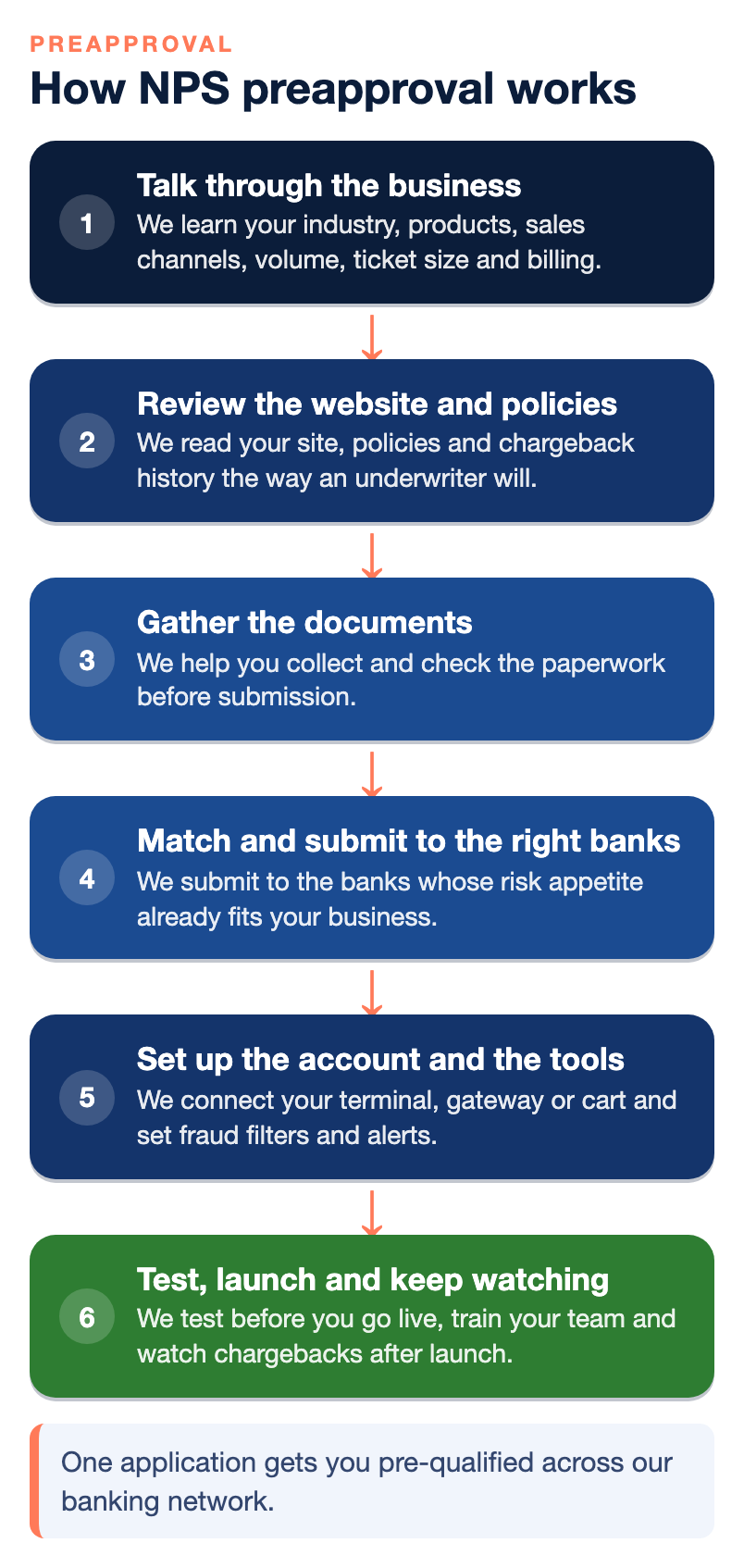
Our process starts with understanding the business, not with a rate sheet. One application gets you pre-qualified across our banking network, and we tell you up front exactly what is needed, which removes the back-and-forth that slows most high risk approvals. It runs in six steps:
- Talk through the business. We learn your industry, products, target customers, sales channels, monthly volume, average and highest ticket, fulfillment times and whether you bill on a recurring basis.
- Review the website and policies. We read your site, refund and cancellation policies, procedures, chargeback history and fraud controls the way an underwriter will, and help you fix anything that would hold up approval.
- Gather the documents. We help you collect and check the paperwork before submission, so the file goes in complete and accurate the first time.
- Match and submit to the right banks. We submit to the banks whose risk appetite already fits your business instead of guessing, which is why a complete file can be pre-qualified quickly.
- Set up the account and the tools. Once approved, we connect your terminal, gateway or shopping cart, and set your fraud filters, chargeback alerts and monitoring to fit your business.
- Test, launch and keep watching. We test before you go live, train your team on the tools and keep an eye on chargebacks, refunds and volume changes after launch.
Getting your file in order before it goes to underwriting saves time and keeps your application from being pended. It also means fewer hoops to jump through, and a processing setup that runs without interruption, so you can spend your attention on the business instead of on payment problems. All merchant accounts remain subject to underwriting, bank approval, card-brand requirements and applicable law, and we tell you honestly when a file is not ready yet.
What high risk processing costs and how it is priced
High risk processing usually costs more than standard retail processing, because the bank is taking on more risk and often needs extra tools, monitoring and underwriting to do it. But being labeled high risk should not mean accepting any rate someone hands you. Rates should be higher, not predatory. We process domestically rather than offshore, match you to a bank that prices your specific risk fairly, and structure pricing to fit the business. Depending on your industry and history, that can include:
- Interchange-plus pricing, where your business type supports it, so you see the card-network cost separately from the processor’s markup instead of sitting on an inflated flat rate.
- Dual pricing or surcharging, where the card brands and your state allow it, to offset processing costs.
- ACH billing for larger transactions, which can cost less and reduce card-related chargebacks.
- Custom rate programs built around your volume and chargeback history.
When you compare offers, ask for the entire cost structure: the processing markup, transaction fees, monthly fees, gateway fees, chargeback fees, PCI fees, any reserve, the early termination terms, equipment costs and registration fees. We walk through each model in our guide to merchant account pricing models. Clean operations improve your terms over time. A strong processing history, a low chargeback ratio, clear website policies and stable financials all work in your favor, and a business that cleans up its chargebacks can often move to better pricing later.
Reserves, explained plainly
Some acquiring banks set a reserve to protect against possible losses. The common version is a rolling reserve, where the bank holds a share of processing volume for a period and releases it on a schedule. Reserves are more common with significant future delivery, high chargebacks, rapid growth, limited processing history, high average tickets or subscription billing. Not every high risk merchant needs one, the structure depends on the bank and the business, and we work to keep the terms fair and to explain them in writing before you sign.
Fraud and chargeback protection, especially at high volume
Chargebacks are one of the biggest threats to a high risk business, and the best strategy is prevention first and evidence second. That starts with making sure customers understand what they bought, when they will be billed, how to cancel, how to reach support and what your refund policy says. Clear billing descriptors, fast receipts, quick answers to complaints, tracked delivery and easy cancellation stop many disputes before they are filed.
On top of good habits, we tailor fraud and chargeback tools to your business. Those include address verification and card security code checks, 3D Secure on online payments where it fits, tokenization and encryption to protect stored card data, velocity controls and fraud scoring to catch unusual patterns, chargeback alerts, custom rules for recurring billing and high-ticket items, help monitoring the card-brand programs, and dispute management with the documents to fight a chargeback when you should.
High volume deserves its own attention. Volume can be a positive sign, but only when the controls are in place, and high volume with high chargebacks is a red flag to every bank. Large and fast-growing accounts usually get custom underwriting, with closer looks at financial statements, refund ratios, fulfillment, customer support and reserve needs. If you process a lot, read the ultimate high risk merchant survival guide for chargeback programs and monitoring thresholds, and consider a multi-merchant account backup strategy so one account review never stops all of your sales.
The tools and support you get after approval
A high risk business needs all the same tools a mainstream business enjoys, not a stripped-down account. Through NPS you can run a virtual terminal, shopping cart and gateway integrations, invoicing and payment links, a customer manager, recurring billing, ACH and eCheck processing, and in-store POS and terminals with chip and tap support. We work with a variety of gateways and shopping carts and offer open API options for custom setups, so the payment side fits the website or store you already have. All of our solutions are PCI compliant.
Support works on two levels. Our office is open from about 9 or 10 a.m. to 6 p.m., and that is where you reach the consultants who know your account, your bank and your history. For anything after hours, merchants reach 24/7 support through the help desk for their product, so a terminal or gateway question at night still gets answered. If your account is ever reviewed, held or shut down somewhere else, call us first. The first step is working out why it happened, not opening another account and repeating the same mistake.
Where to go next
If you are not sure whether you need a specialized account at all, start with low risk vs high risk merchant accounts explained. If you already process and want to protect what you have, the survival guide and the backup strategy above are the two pages to read next. For everything else, from dual pricing to card-brand rules, browse our payments guides. When you are ready to talk about your own business, contact our team and we will review the business before anything goes to underwriting.
The bottom line
A high risk merchant account is not a punishment. It is a merchant account built for businesses that need more careful underwriting, and the biggest mistake owners make is trying to avoid the label instead of using it. Tell the bank what you sell and how you operate, provide the documents, make sure your website says what your business really does, understand your chargebacks and read the processor’s terms of service before you take a payment. Then work with a payment partner that knows which acquiring banks understand your industry. The right merchant account is not the one that approves you fastest. It is the one properly structured for the business you actually run, and that is the account we help you build.
Frequently Asked Questions
What is a high risk merchant account?
A high risk merchant account is a credit card processing account for a business that banks see as more likely to have chargebacks, heavy regulation or reputational exposure. It works like any merchant account. The difference is that it is underwritten by an acquiring bank that specializes in your industry instead of a mainstream processor that might decline you or shut you down later.
Why is my business considered high risk?
The label usually comes from your industry, regulatory requirements, chargeback history, future delivery, average ticket size, card-not-present sales or recurring billing. Industries like CBD, firearms, adult, nutraceuticals, telemedicine, travel and subscriptions are almost always labeled high risk regardless of how well the business is run. It is a category the banks assign, not a judgment on your company.
Does high risk mean my business is illegal?
No. Many completely legal businesses are classified as high risk because of their industry, business model, chargeback exposure, regulatory requirements, average ticket, recurring billing or future-delivery risk. Legal does not mean every processor will support you, which is why a specialized bank matters.
What documents do I need for a high risk merchant account?
Expect to provide owner identification, your EIN, a voided business check or bank letter, corporate documents and a business license, three to six months of processing statements if you already accept cards, recent bank statements, product and supplier information, any licenses your industry requires, and a website with clear refund, cancellation, shipping and privacy policies. Larger accounts may also need financial statements.
How fast can I get approved?
Often quickly. A complete application can be pre-qualified fast because we submit to banks whose risk appetite already fits your business instead of guessing. We tell you up front exactly what is needed, which removes the back-and-forth that slows most high risk approvals.
Can I get a merchant account if I was shut down or placed on the MATCH list?
Often, yes. A past termination or a MATCH listing is serious, but it does not automatically close every door. Specialized acquiring banks review MATCH-listed merchants case by case, depending on the reason code, what happened, whether the problem was fixed and how the business runs today.
Does NPS work with cannabis businesses?
NPS works with cannabis-related businesses only: CBD and hemp, pipes and smoking accessories, medical card services, and companies that sell to cannabis businesses, as long as the business never touches the plant. We do not serve dispensaries, growers or any plant-touching business, and we do not provide ATM services for dispensaries.
Are high risk merchant accounts more expensive?
They usually cost more than standard retail processing because the bank takes on more risk, but they should not be predatory. We process domestically, match you to a bank that prices your specific risk fairly, and can structure interchange-plus pricing where your business type supports it, so you are not stuck on an inflated flat rate.