No single payment method raises the most money at a fundraising event. What raises the most is a setup with no dead ends: every guest can give the moment they decide to, with whatever they have in their hand, in a few seconds, and can keep giving after they go home. In practice that means card readers that take tap and mobile wallets, a QR code that opens a donation page on any phone, cards on file for auctions and paddle raises, a recurring gift option, ACH or check for large pledges, and a way for donors to cover the processing cost. This guide explains why friction costs more than fees, how to match each method to each moment of the night, the tax paperwork that comes with event giving, and a checklist for event day.
The bottom line
- Friction costs more than fees. A guest who has to wait in line, find a pen or remember to give later often does not give at all.
- Offer more than one way to pay, because your guests carry different things: phones, cards, checkbooks and occasionally cash.
- Put cards on file at check-in for auctions and paddle raises, so checkout at the end is a confirmation, not a line.
- Turn one-night donors into monthly donors with a recurring option on the same page or form.
- Let donors cover the fee if they choose, so more of each gift reaches the mission.
- Keep ticket money and donations separate in your records, because the tax rules treat them differently.
Who wrote this, and what we will not claim
Nationwide Payment Systems (NPS) publishes this guide. We are a payment processing company in South Florida, in business since 2001, and we offer donation and payment tools for nonprofits, so we are not neutral. We also support local charities in South Florida ourselves. We do not publish survey numbers about which method wins, because event results depend on the crowd, the cause and the room, and any single figure would mislead you. We quote nobody’s rates.
Nothing here is tax or legal advice. Charitable contribution rules are set by the IRS and by states, which also regulate charitable solicitation and raffles. Talk to your accountant about receipts and disclosures, and check your state’s rules before you run games of chance.
Why friction costs more than fees
Most fundraising events have one or two moments when generosity peaks: the story from the stage, the video, the paddle raise, the last minutes of the auction. Giving that happens in those moments is impulse giving in the best sense. The person has decided, right now, to help. Every step between that decision and a completed gift is a chance to lose it. A line at the payment table, a reader that will not connect, a form that asks for twelve fields, a donor who meant to text a pledge and forgot by the parking lot.
That is why organizations sometimes focus on the wrong number. Processing fees are real and worth managing, and we cover how below. But a method with slightly lower fees that slows the line or excludes guests without the right card can raise less overall. The question to ask about every method is simple: how many seconds, and how many steps, does it take a guest to give with it?
Match the method to the moment
An event is several fundraising moments in a row, and each one suits a different way of paying.
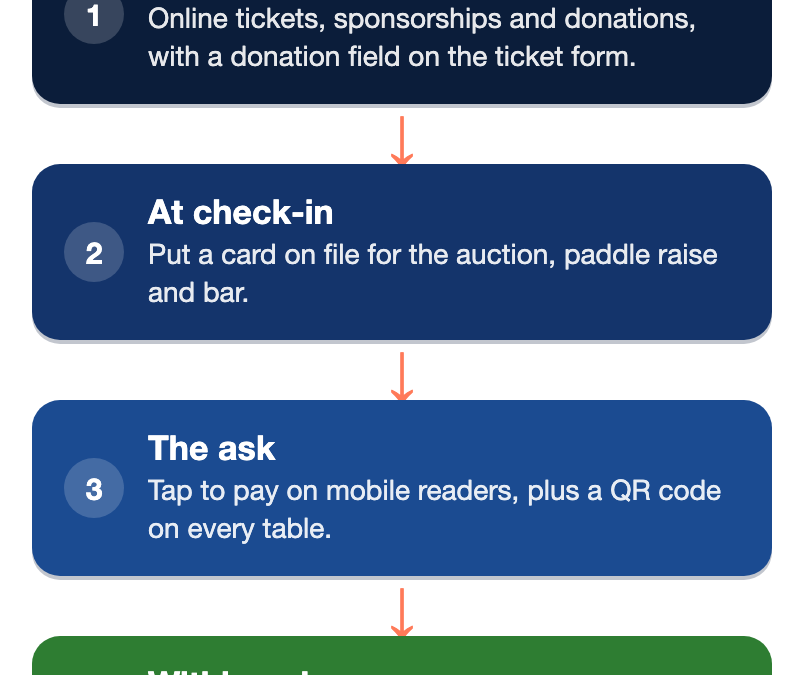
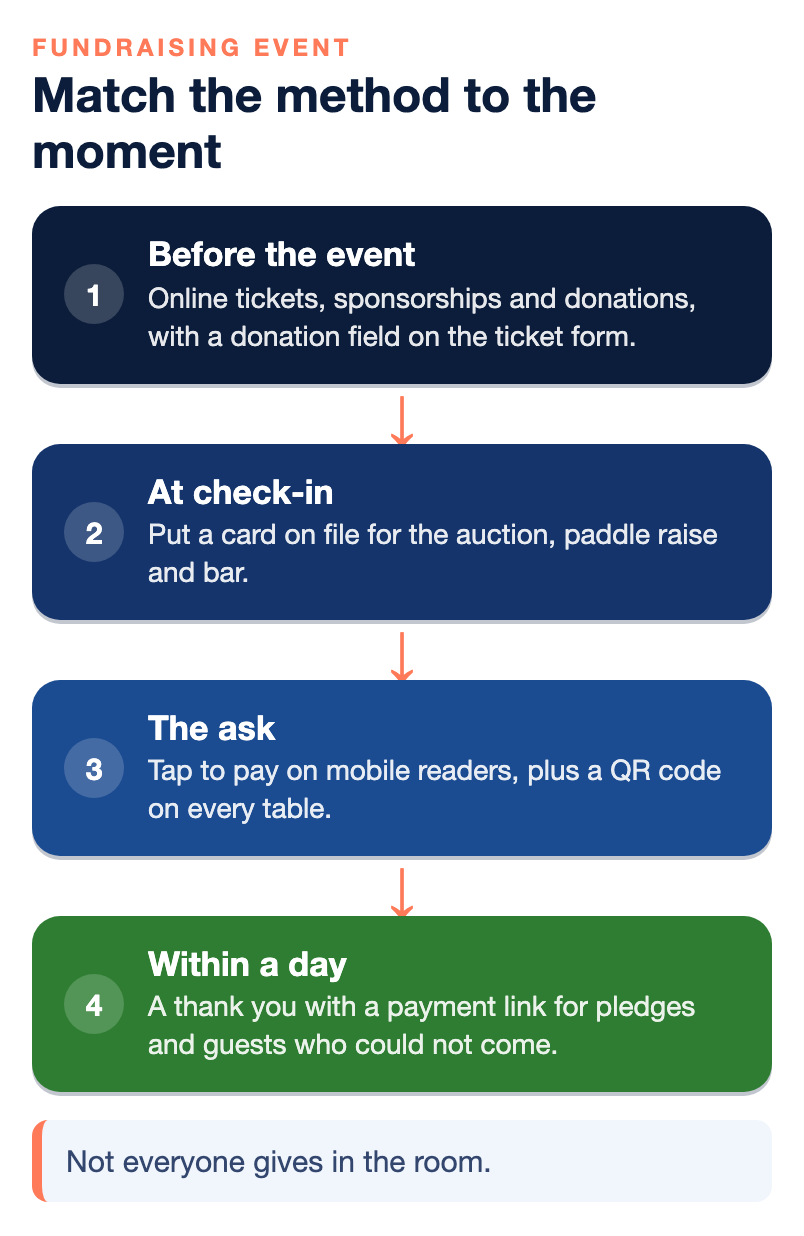
Registration and tickets, before the event
Most ticket revenue comes in online before anyone arrives. A hosted donation or ticket page with a card form, mobile wallets and ACH lets supporters buy tickets, sponsor a table or give if they cannot attend. Add a donation field to the ticket form, because people buying a ticket are already in a giving mood. Sponsorships and corporate tables are often larger and may be paid by invoice or ACH, which is easier for a company’s accounts payable team than a card.
Check-in: put a card on file
For events with an auction, a paddle raise or a bar, the single most useful step is collecting a card at check-in, with the guest’s permission, so purchases and pledges can be charged to it later. Guests bid and pledge freely, and checkout becomes a quick confirmation instead of a long line at the end of the night when everyone is tired and leaving. Tell guests clearly what the card will be used for, and send an itemized receipt.
The ask: tap, QR codes and mobile giving
When the speaker makes the ask, guests need a way to respond in seconds from wherever they are sitting. Three methods work well together:
- Tap to pay on a mobile reader. Volunteers carry readers that take chip, tap and mobile wallets such as Apple Pay and Google Pay. Many guests no longer carry a wallet, but nearly all of them carry a phone.
- A QR code on every table and on the screen. It opens a mobile donation page with suggested amounts and a recurring option. Guests give from their own phones without waiting for a volunteer, which means everyone can give at the same moment.
- Paddle pledges charged to the card on file. For a live paddle raise, recording pledges against the card collected at check-in is usually the smoothest path.
Test the QR code with several kinds of phones before the event, keep the page to a few fields, and make sure it loads quickly on a weak signal, because event venues are notorious for poor reception.
The auction and the bar
Silent and live auction items, raffles where they are legal, and drinks all add up. A POS or mobile reader that can ring items by name, apply them to a guest’s tab and print or email a receipt keeps your records clean. If you sell items, make sure the item value is recorded, since that affects the donor’s receipt.
Cash and checks
Some guests, often among the most generous, still prefer a check, and some will hand over cash. Keep a secure place to collect both, with a volunteer who records each one with the donor’s name for the receipt. Large pledges paid by check or ACH after the event are also common, and ACH usually costs less to process than a card for a large gift.
After the event: links and follow-up
Not everyone gives in the room. Within a day, send a thank you with a payment link to everyone who attended, everyone who bought a ticket and could not come, and every guest who pledged but has not paid. Payment links sent by email or text let donors finish their gift in a minute. A dedicated link or QR code for each campaign lets you see exactly how much the event raised, including the follow-up.
Recurring gifts: the method that keeps giving
An event is a natural moment to ask for a monthly gift, because the guest has just heard why the work matters. Offer a recurring option right on the donation page and the pledge card, with a monthly amount next to each one-time amount. A guest who might give a single gift tonight may be just as happy to give a smaller amount every month, and over a year a monthly gift can add up to more while it keeps coming without another ask. Recurring gifts work by card or ACH, and donors should be able to update or cancel them on their own, which builds trust.
Processing fees: manage them without adding friction
Every card payment has a processing cost, and on a large event the total is noticeable. There are three fair ways to manage it, and none of them should make giving harder.
- Let donors choose to cover the fee. A simple checkbox on the donation page lets a donor add the processing cost to the gift, so the organization receives the full amount they intended. Some donors are glad to do it when asked plainly.
- Use ACH for large gifts and pledges. ACH generally costs less than cards for large amounts, which matters when a sponsor or major donor pays a big pledge.
- Pick pricing that fits your volume. Nonprofits are priced like any other merchant, by volume, average gift, card types and how payments are taken. Ask for an itemized quote in writing and compare it with what you pay now.
Be careful with words. A voluntary option for donors to cover costs is different from adding a mandatory surcharge to a card payment, and surcharges are governed by card network rules and some state laws. Our guide to ACH and how it reduces payment fees explains when ACH makes sense, and our article on accepting Apple Pay and Google Wallet covers mobile wallets at the table.
Receipts and the tax rules for event giving
Event giving brings a tax detail that everyday donations do not. When a guest pays for a ticket, a dinner or an auction item and receives something of value in return, only the amount above the value of what they received is generally a charitable contribution. The IRS calls this a quid pro quo contribution. It gives an example: a donor who pays $100 and receives a concert ticket valued at $40 has made a $60 contribution. When a quid pro quo payment is more than $75, the organization must give the donor a written statement explaining that only the amount above the value received is deductible, along with a good faith estimate of that value.
Separately, for any single contribution of $250 or more, a donor needs a written acknowledgment from the organization to claim the deduction, and it must say whether the organization provided goods or services in return. So plan the paperwork before the event:
- Decide the fair market value of the dinner, tickets and auction items ahead of time, and record it.
- Print the disclosure on tickets, invitations or receipts where it applies.
- Keep donations separate from ticket and auction revenue in your payment system and your books, using separate payment categories or campaigns.
- Send each donor a receipt that shows what was a gift and what was a purchase.
This is one reason we built separate payment categories into our nonprofit tools: a donation, a ticket and an auction item can each be tracked on its own, so receipts and reports come out right. Your accountant can tell you how these rules apply to your specific event.
Event-day payment checklist
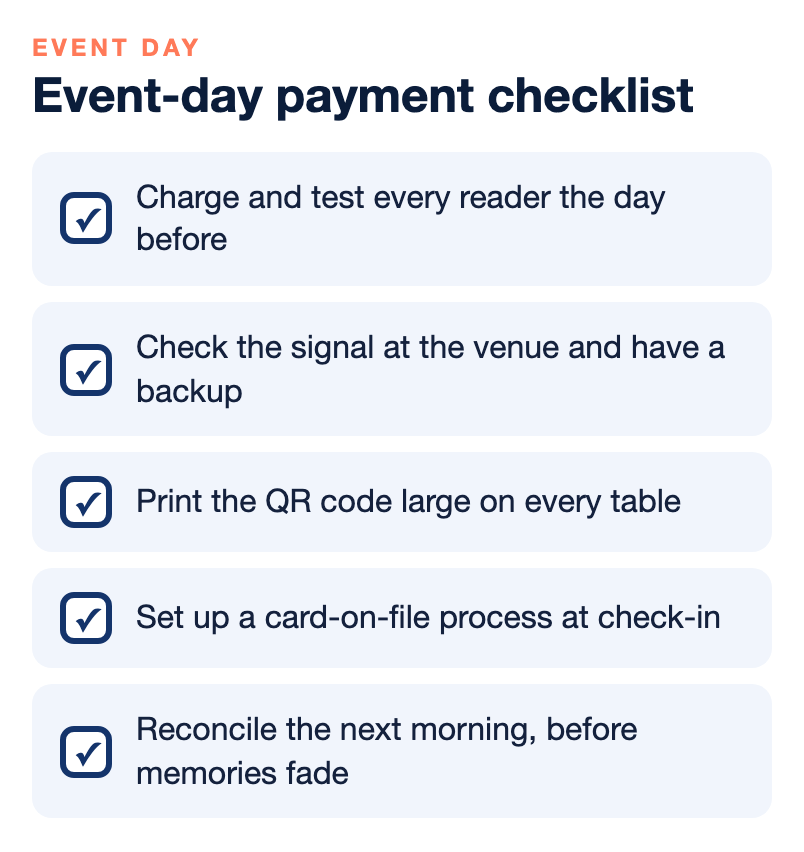
- Charge and test every reader the day before, on the same network you will use at the venue.
- Check the signal at the venue and have a backup, such as a reader on a cellular connection or a mobile hotspot.
- Print the QR code large on every table and put it on the screen during the ask.
- Train volunteers to run a payment, record a cash or check gift and answer the question “is this tax deductible?” with the answer you prepared.
- Set up a card-on-file process at check-in, with clear wording about how it will be used.
- Prepare the receipts with item values and the disclosure language.
- Load the follow-up links so the thank you message goes out within a day.
- Reconcile the next morning: cards, ACH, cash and checks against each campaign, before memories fade.
Where NPS fits, and where it does not
We offer payment tools built for this. NPSONE Smart Invoicing for nonprofits combines QR code donations, hosted donation pages, payment links by email, text or social media, recurring monthly giving, ACH and card acceptance, ticket and sponsorship payments, and campaign tracking, with donations kept separate from tickets, tuition, memberships and other payments. Donors get a dashboard where they can see their gifts, download receipts and manage recurring donations, and organizations can let donors cover the processing cost. Our donation and payment solutions for nonprofits page lists the features, and our online donation platform covers campaign pages you can share. Mobile readers that take tap and mobile wallets over Wi-Fi or a cellular connection are described on our mobile payments page.
We may not be the right choice for every organization. A very small group that runs one bake sale a year may be fine with a simple payment app. We underwrite each account, so we are not an instant self-service signup, and we ask for the documents a properly underwritten account needs. We price each merchant individually and do not publish one universal rate. The NPS payments guides collect our other articles on accepting payments.
Next step
The payment setup that raises the most at a fundraising event is the one with no dead ends: tap and mobile wallets in volunteers’ hands, a QR code on every table, cards on file for the auction, a recurring option for the guests who want to do more, ACH for the big pledges, and a thank you with a link the next morning. Plan the receipts before the doors open, and keep every kind of payment in its own category.
If you are planning an event and want to talk through readers, donation pages or how to set up your campaigns, you can talk with our team. If a simpler tool fits your event better, we will tell you.
Frequently asked questions
What is the best way to collect donations at a fundraising event?
Offer several fast ways to give at once: mobile readers that take tap and mobile wallets, a QR code that opens a short donation page, and cards on file for auctions and paddle raises. Keep cash and checks as an option. The fewer steps between deciding and giving, the more you raise.
Do QR codes work for event donations?
Yes, when the page behind them is short and loads quickly. A QR code lets every guest give from their own phone at the same moment instead of waiting for a volunteer. Test it on several phones and on the venue’s signal before the event.
Should we collect credit cards at check-in?
For events with an auction, paddle raise or bar, it usually helps. Guests bid and pledge freely, and checkout becomes a quick confirmation. Tell guests clearly how the card will be used and send an itemized receipt.
Can donors pay the processing fee?
Yes, many donation tools let donors choose to cover the processing cost so the organization receives the full intended gift. Make it optional and explain it plainly. A voluntary option is different from a mandatory card surcharge, which has its own rules.
Is an event ticket tax deductible?
Usually only the part above the value of what the guest received. For a quid pro quo payment over $75, the IRS requires the organization to give a written statement with a good faith estimate of that value. Ask your accountant how this applies to your event.
Should we ask for monthly gifts at an event?
Yes. Guests have just heard why the work matters, so it is a natural time to offer a recurring option next to each one-time amount. Monthly gifts by card or ACH keep coming without another ask.
Is ACH better than credit cards for large donations?
Often, yes, because ACH generally costs less to process than a card for large amounts. It suits sponsorships, major gifts and pledges paid after the event. Cards stay the fastest option in the room.
What should we do with payments after the event?
Send a thank you with a payment link within a day to attendees, ticket buyers who could not come and anyone with an unpaid pledge. Then reconcile cards, ACH, cash and checks against each campaign. Keep donations separate from ticket and auction revenue.