Nationwide Payment Systems
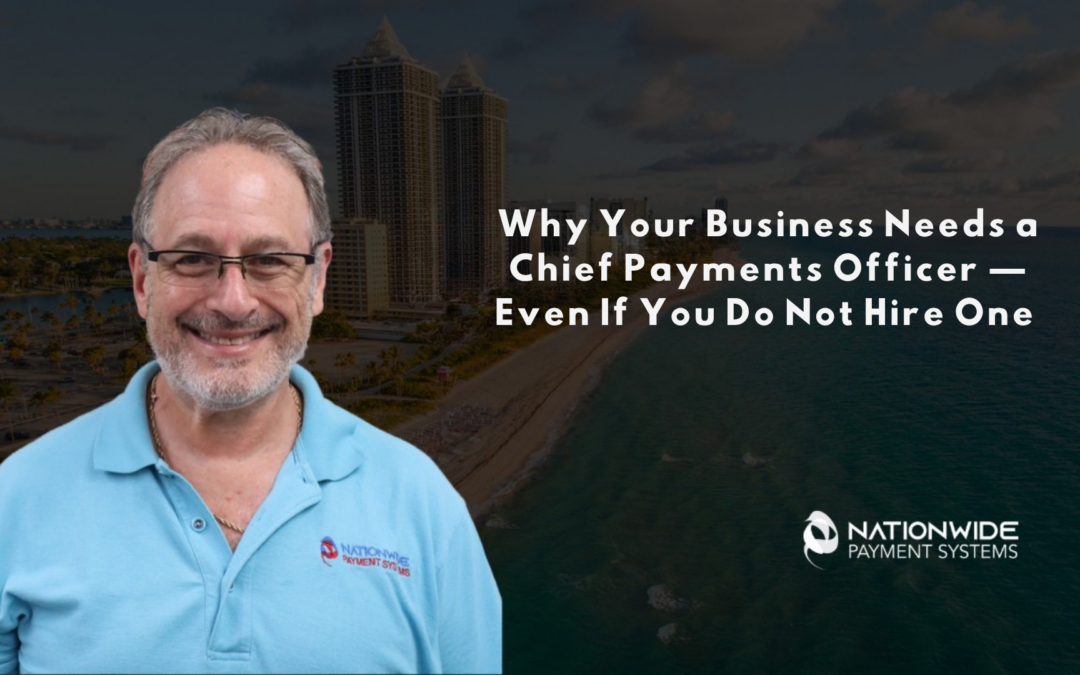
Why Your Business Needs a Chief Payments Officer — Even If You Do Not Hire One
Your CPA handles taxes and your attorney handles legal risk. But who manages payments, interchange, compliance, chargebacks, fraud tools, and bank relationships? Learn why your business may need an outsourced Chief Payments Officer from Nationwide Payment Systems.
Presented by Allen Kopelman, CEO — Nationwide Payment Systems-Host of B2B Vault: The Biz2Biz Podcast
AI OVERVIEW
Your business probably has a CPA to manage taxes.
You may have an attorney to manage legal risk.
You might have an IT company to manage technology.
But who is managing the money movement inside your business?
That is the role of a Chief Payments Officer.
A Chief Payments Officer makes sure your business is not just accepting payments but accepting payments the right way. That means having the right merchant account, the right gateway, the right ACH setup, the right POS or invoicing tools, the right fraud controls, the right chargeback strategy, the right interchange categories, and the right relationships with banks and processors.
For many businesses, payments are one of the largest operating expenses after payroll, rent, inventory, and software. Yet payments are often one of the least managed parts of the company.
Most businesses do not need to hire a full-time payment executive.
But they do need someone watching the payment strategy.
That is where Nationwide Payment Systems comes in.
Nationwide Payment Systems can act as your outsourced Chief Payments Officer. We help businesses review their current payment setup, improve pricing structure, evaluate interchange categories, manage processor and bank relationships, reduce payment friction, add better technology, review chargeback exposure, and implement tools like ACH, payment links, recurring billing, invoicing, and QuickBooks Online sync through platforms like NPSONE Smart Invoicing.
You can work with Nationwide Payment Systems as a paid advisor or contractor. Or, when you use the banking, processing, gateway, ACH, POS, or payment technology relationships we help arrange, we may be compensated through those relationships instead of charging you a separate consulting fee.
Either way, the mission is the same:
Better payment strategy. Better technology. Better banking relationships. Better control over how your business gets paid.
Quick Answer: Why Does Your Business Need a Chief Payments Officer?
Your business needs a Chief Payments Officer because payments now affect cash flow, customer experience, accounting, compliance, chargebacks, fraud prevention, software, banking relationships, and profitability.
A Chief Payments Officer helps your business choose the right merchant account, gateway, ACH solution, invoicing tools, POS system, pricing model, fraud tools, and processor relationship. This role also helps make sure your transactions are set up properly, your interchange categories are reviewed, your chargebacks are managed, and your business is positioned correctly with banks and processors.
For small and mid-sized businesses, this role can be outsourced instead of hired full-time.
sponsored by

Quick Answer: Why Does Your Business Need a Chief Payments Officer?
Your business needs a Chief Payments Officer because payments now affect cash flow, customer experience, accounting, compliance, chargebacks, fraud prevention, software, banking relationships, and profitability.
A Chief Payments Officer helps your business choose the right merchant account, gateway, ACH solution, invoicing tools, POS system, pricing model, fraud tools, and processor relationship. This role also helps make sure your transactions are set up properly, your interchange categories are reviewed, your chargebacks are managed, and your business is positioned correctly with banks and processors.
For small and mid-sized businesses, this role can be outsourced instead of hired full-time.
The Problem: Most Businesses Have No One Managing Payments
Most business owners know what they pay for rent.
They know payroll.
They know insurance.
They know software costs.
They know inventory costs.
But when you ask them what their true cost of accepting payments is, many cannot answer.
They may know their “rate,” but they do not know their real effective rate. They may know they accept credit cards, but they do not know whether transactions are downgrading into more expensive interchange categories. They may use ACH, invoices, POS, and online payments, but none of it is connected into a real strategy.
That is the problem.
Payments touch almost every sale, yet nobody inside the company owns the payment strategy.
The merchant account was set up years ago. The gateway was chosen because it was easy. The POS system came bundled with processing. The invoices are sent from one system. The payments are accepted in another. QuickBooks is updated manually. Chargebacks are handled after the fact. Fraud tools are either not turned on or not understood. And when the bank or processor asks for documentation, everyone scrambles.
That is not a strategy.
That is a patchwork.
Payments Are No Longer Just Credit Card Processing
There was a time when payment processing meant one thing:
“I need to take credit cards.”
That world is gone.
Today, payments include:
- Credit cards
- Debit cards
- ACH payments.
- Payment links
- Branded invoices
- Customer portals
- Recurring billing
- Subscriptions
- E-commerce checkout
- POS systems
- Mobile payments
- QR code payments
- Hosted payment pages
- QuickBooks Online sync
- Gateways
- APIs
- Webhooks
- Chargeback tools
- Fraud prevention
- Bank underwriting
- Compliance reviews
- Reporting and reconciliation
Payments are not just a terminal on the counter anymore.
Payments are financial infrastructure.
And when your payment infrastructure is not managed correctly, your business can lose money, waste time, frustrate customers, and create unnecessary risk.
What Is a Chief Payments Officer?
A Chief Payments Officer is an executive-level payments strategist responsible for how a business accepts, manages, optimizes, protects, and reconciles incoming payments.
This role oversees the full payment ecosystem, including merchant accounts, ACH, gateways, POS systems, invoicing, e-commerce, chargebacks, fraud prevention, interchange optimization, processor relationships, compliance documentation, settlement, and reporting.
In a large corporation, this might be an internal executive.
In a small or mid-sized business, it is often better handled by an outsourced expert.
That is where Nationwide Payment Systems can fill the role.
What Is a Fractional or Outsourced Chief Payments Officer?
A fractional Chief Payments Officer or outsourced Chief Payments Officer gives your business access to payment expertise without hiring another full-time executive.
Think of it like having:
- A fractional CFO for finance
- A CPA for taxes
- An attorney for legal
- An IT company for technology
- A payments expert for money movement
A fractional Chief Payments Officer helps answer questions like:
- Are we using the right processor?
- Are we paying too much?
- Are we on the right pricing model?
- Are our transactions qualifying correctly?
- Are we using ACH where it makes sense?
- Should we use Level 2 or Level 3 data?
- Is our gateway set up properly?
- Are our invoices easy to pay?
- Are we reducing chargeback risk?
- Are we using the right fraud tools?
- Are we positioned correctly with our bank?
- Is our payment technology helping or hurting our cash flow?
This is not about selling a terminal.
This is about managing one of the most important financial systems inside your business.
Why Payments Need a Seat at the Executive Table
Payments directly affect revenue.
That alone should make them important.
But payments also affect much more than revenue.
They affect how quickly your business gets paid, how much you keep from every transaction, how easily customers can pay, how accounting reconciles deposits, how chargebacks are handled, how processors view your risk, and how your business scales.
A bad payment setup can create problems across the entire company.
For example:
- Sales closes the deal, but invoicing slows collection.
- Accounting receives deposits but cannot easily match them.
- Operations wants automation, but the gateway does not integrate.
- Customers want ACH, but the business only accepts cards.
- The owner wants better rates, but nobody understands interchange.
- Chargebacks arrive, but nobody has documentation ready.
- Fraud increases, but the gateway tools were never configured.
- The processor asks for information, but nobody manages the relationship.
That is why payments should not be treated as an afterthought.
They should be managed like a core business function.
Traditional Processor vs. Chief Payments Officer Approach
|
Function |
Traditional Processor |
Chief Payments Officer Approach |
|
Main Focus |
Selling processing |
Building payment strategy |
|
Pricing |
Quoting a rate |
Reviewing total cost, pricing model, and interchange qualification |
|
Technology |
Terminal or gateway |
Full payment stack: POS, ACH, gateway, invoicing, portal, API, accounting sync |
|
Interchange |
Rarely explained |
Reviewed for downgrades, categories, Level 2/3 opportunities, and optimization |
|
ACH |
Often an add-on |
Used strategically to improve cash flow and reduce card dependency |
|
Chargebacks |
Reactive support |
Proactive documentation, policy review, dispute strategy, and risk reduction |
|
Fraud |
Basic tools |
Gateway filters, AVS/CVV, velocity controls, 3D Secure, and monitoring |
|
Compliance |
Limited guidance |
Underwriting, website, documentation, policies, and bank relationship support |
|
Relationship Management |
Call center support |
Ongoing communication with processors, gateways, and banks |
|
Goal |
Process transactions |
Improve cash flow, reduce friction, lower risk, and support growth |
The difference is simple.
A processor helps you accept payments.
A Chief Payments Officer helps you manage payments.
That is a much bigger job.
A Chief Payments Officer Does More Than Manage Payments
Most business owners think payment processing starts and ends with getting approved and taking cards.
That is only the surface.
A real Chief Payments Officer looks deeper.
At Nationwide Payment Systems, we help businesses manage the full payment ecosystem, including:
- Merchant account structure
- Interchange category optimization.
- ACH and card acceptance.
- Gateway setup
- POS and invoicing technology
- QuickBooks Online sync
- Chargeback management
- Fraud prevention tools
- Bank and processor relationship management.
- Underwriting and compliance support
- Payment links and recurring billing
- Risk review and ongoing payment strategy.
This matters because the way a transaction is entered, authorized, categorized, processed, and settled can affect what the business pays, how quickly it gets funded, how much risk it carries, and how well it can defend itself when disputes happen.
That is not basic processing.
That is payment strategy.
Are Your Payments Being Routed Into the Right Interchange Categories?
One of the most overlooked parts of payment processing is interchange.
Interchange is the underlying cost structure associated with card transactions. Every transaction falls into a category based on factors such as card type, business type, transaction method, risk level, data submitted, and whether the payment is card-present, card-not-present, debit, rewards, corporate, purchasing card, or business card.
Most merchants never ask one very important question:
Are my transactions qualifying for the best possible interchange categories?
That question matters.
If your business is not set up correctly, transactions can be downgraded into more expensive categories. That means you may be paying more than necessary without realizing it.
A Chief Payments Officer helps review whether your business is processing transactions in a way that supports better qualification.
That may include:
- Reviewing merchant statements
- Identifying downgrades
- Looking at card-present vs. card-not-present activity
- Reviewing whether Level 2 or Level 3 data applies
- Evaluating B2B and purchasing card transactions
- Making sure the correct MCC and business type are being used.
- Reviewing gateway settings
- Looking at authorization and settlement practices
- Evaluating whether ACH should be used for certain customers.
- Reviewing invoice, payment link, and recurring billing workflows
This is where Nationwide Payment Systems adds value.
We do not just look at the “rate.”
We look at the structure behind the rate.
Because in payments, the wrong setup can quietly cost business money every single month.
Interchange Optimization Is Not Just About Lower Rates
A lot of business owners are trained to ask one question:
“What is your rate?”
That is the wrong starting point.
A better question is:
How is my business actually processing transactions, and are those transactions qualifying properly?
Two businesses can have the same quoted rate but very different real costs.
Why?
Because the final cost depends on the card type, transaction method, interchange category, gateway setup, data quality, risk level, industry type, and pricing structure.
That is why interchange optimization matters.
A Chief Payments Officer may look at:
- Whether debit cards are being priced correctly
- Whether rewards cards are driving up costs
- Whether business cards are qualifying properly
- Whether purchasing cards need Level 2 or Level 3 data
- Whether card-not-present transactions are downgrading
- Whether recurring transactions are coded properly
- Whether batch timing is causing issues
- Whether the gateway is passing the right data
- Whether the merchant category code is appropriate
- Whether ACH should replace cards for certain invoices
This is not about chasing the cheapest processor.
It is about designing a better payment structure.
Your Processor and Bank Relationships Matter
Many business owners do not realize that payment processing is also a banking relationship.
Behind every merchant account are risk rules, underwriting reviews, monitoring systems, compliance requirements, processor policies, and bank relationships.
If your business grows, changes products, adds e-commerce, starts recurring billing, has a spike in volume, receives chargebacks, or triggers risk alerts, your processor or bank may start asking questions.
If nobody knows how to answer those questions, your account can face problems.
That may include:
- Held funds.
- Reserves
- Processing limits
- Delayed deposits
- Extra documentation requests
- Account reviews
- Higher risk classification
- Sudden account termination
This is why relationship management matters.
Nationwide Payment Systems helps businesses communicate with banks, processors, gateways, and underwriting teams so the business is better positioned and better understood.
We help with:
- Merchant account applications
- Underwriting documentation
- Processing volume reviews
- Business model explanations
- Website and policy reviews
- Compliance documentation
- Chargeback and fraud concerns
- Risk monitoring issues.
- Processor communication
- Banking relationship support
The goal is not just to get approved.
The goal is to stay approved, stay compliant, and have the right payment relationship as the business grows.
Compliance Is Part of Payment Strategy
Compliance is not just for big companies.
Any business accepting payments needs to think about compliance.
That may include:
- Proper refund policies
- Clear terms and conditions
- Privacy policy
- Secure payment pages
- Accurate billing descriptors
- Recurring billing authorization
- Website content consistency
- Product and service descriptions
- Proof of business ownership
- Domain ownership
- Proper contact information
- Fraud prevention practices
- Chargeback documentation
- Industry-specific underwriting requirements
If your website says one thing, your merchant application says another, and your transactions show something different, that creates risk.
If your business sells regulated products, offers subscriptions, invoices high-ticket customers, operates online, or accepts card-not-present payments, compliance becomes even more important.
A Chief Payments Officer helps make sure the payment side of the business is not creating unnecessary exposure.
Chargebacks and Fraud Are Payment Strategy Problems
Chargebacks are not just customer service problems.
They are payment strategy problems.
A business with weak payment policies, poor documentation, unclear billing descriptors, missing receipts, inadequate fraud controls, or sloppy recurring billing authorization can quickly create unnecessary dispute exposure.
A Chief Payments Officer helps identify those risks before they become expensive.
Nationwide Payment Systems can help businesses review:
- Chargeback trends
- Fraud exposure
- Billing descriptors
- Refund policies
- Terms and conditions
- Proof of delivery
- Signed invoices
- Recurring billing authorizations
- Card-present vs. card-not-present rules
- AVS and CVV usage
- 3D Secure options
- Fraud filters
- Velocity controls
- Gateway risk settings
- Customer communication practices
The right fraud tools and documentation process can make a major difference.
You cannot stop every bad transaction.
But you can build a payment environment that reduces fraud, improves dispute response, and gives your business a better chance when chargebacks happen.
Why Most Businesses Are Using the Wrong Payment Tools
Most businesses do not intentionally choose the wrong tools.
They grow into them.
In the beginning, simple tools are attractive because they are easy.
A business may start with Stripe, Square, PayPal, QuickBooks, or a bundled POS processor because it works quickly and does not require much setup.
That may be fine at the start.
But as business grows, the problems appear.
The company may need:
- Better pricing
- ACH payments.
- Better invoicing
- QuickBooks Online sync
- Payment links
- Recurring billing
- Customer portals
- Lower card dependency
- Better support
- Better reporting
- Better chargeback tools
- More control over underwriting
- More flexible gateway options
- Multi-location support
- API access
- Human relationship management
At that point, the question changes.
It is no longer:
“Can we take payments?”
The better question becomes:
“Is our payment system built for the business we are becoming?”
That is where a Chief Payments Officer becomes valuable.
Signs Your Business Has Outgrown Basic Payment Processing
You may need a Chief Payments Officer if:
- You process more than $50,000 per month.
- You do not understand your merchant statement.
- You are using Stripe, Square, PayPal, or QuickBooks because it was easy.
- You send invoices and wait too long to get paid.
- You manually reconcile deposits.
- You accept ACH and cards, but they are not connected.
- You have multiple payment systems that do not talk to each other.
- You have chargebacks or fraud issues.
- Your processor support is slow or generic.
- You are opening multiple locations.
- You sell online and in person.
- You have high-ticket transactions.
- You accept business cards or purchasing cards.
- You need Level 2 or Level 3 data.
- You have recurring billing or subscriptions.
- Your bank or processor does not understand your industry.
- Your software, POS, gateway, and accounting tools are disconnected.
- You are worried about held funds, reserves, or account stability.
If any of these sound familiar, your business may not need another processor.
It may need payment leadership.
How Nationwide Payment Systems Fills the Chief Payments Officer Role
Nationwide Payment Systems does not just help businesses “take payments.”
We help businesses manage the entire payment relationship.
That includes pricing, interchange qualification, ACH, gateways, invoicing, POS systems, fraud tools, chargeback strategy, compliance documentation, underwriting, and communication with banks and processors.
In other words, we act like your outsourced Chief Payments Officer.
Our role is to help your business make smarter decisions about how money moves in and out of the company.
We Review Your Current Payment Setup
The first step is understanding what you already have.
That may include reviewing:
- Merchant statements
- Effective processing costs
- Interchange categories
- Downgrades
- Monthly fees
- Gateway fees
- ACH fees.
- Chargeback fees
- Deposit timing
- POS system
- Gateway setup
- Invoicing workflow
- Online checkout
- QuickBooks process
- Customer payment experience
- Fraud settings
- Chargeback history
- Processor and bank relationship
This gives us a clear picture of what is working, what is outdated, and what needs to change.
We Help Build a Better Payment Strategy
Once we understand your business, we can help design a better plan.
That may include:
- Moving from flat-rate pricing to interchange-plus
- Adding ACH to reduce card dependency
- Implementing smart invoicing
- Adding payment links
- Setting up recurring billing
- Creating branded hosted payment pages
- Connecting payments to QuickBooks Online
- Using Level 2 or Level 3 data where applicable
- Improving chargeback documentation
- Reviewing fraud tools
- Helping with POS or gateway upgrades
- Supporting multi-location processing
- Designing embedded payments for software platforms
- Improving communication with banks and processors
This is not a cookie-cutter approach.
A restaurant, liquor store, B2B distributor, property management company, nonprofit, medical service company, e-commerce business, and software platform do not need the same payment strategy.
That is exactly why this role matters.
NPSONE Smart Invoicing: Technology That Supports the Strategy
The Chief Payments Officer does not only review rates and statements.
They also look at payment workflow.
For many businesses, the biggest payment problem is not just cost.
It is collection.
Invoices go out late. Customers pay late. Checks are mailed. ACH is not offered. Card payments are disconnected. QuickBooks has to be updated manually. The owner has no clear view of who paid, who did not, and what needs to be followed up on.
That is where NPSONE Smart Invoicing becomes a major part of the strategy.
NPSONE Smart Invoicing brings together:
- Merchant account
- ACH account.
- Payment gateway
- Two-way QuickBooks Online sync
- Branded invoicing
- Payment links
- Recurring billing
- Customer payment portal
- Card and ACH acceptance
- Payment-on-file
- Unlimited users
- Hosted payment pages
- QR code payment options
Instead of using multiple disconnected tools, businesses can centralize more of the invoice-to-cash workflow.
That means customers can pay faster.
Business can reconcile easier.
And the owner gets better control over cash flow.
Do Not Be the Bank for Your Customers
One of the biggest mistakes businesses make is financing their customers without realizing it.
They send invoices.
They wait 15 days.
Then 30 days.
Then 45 days.
Then someone follows up.
Then maybe a check arrives.
That is not good cash flow management.
If your business provides the product or service, you should have a clear path to collect payment quickly.
That does not mean every customer has to pay by card.
It means customers should have options:
- ACH
- Credit card
- Debit card
- Payment link
- Customer portal
- Recurring billing
- Payment-on-file
- Subscription billing
- QR code payment
- Hosted checkout page
A Chief Payments Officer helps your business reduce friction between billing and collecting.
Because every day an invoice sits unpaid, your business is financing the customer.
How Nationwide Payment Systems Is Compensated
Nationwide Payment Systems can support your business in one of two ways.
Option 1: Paid Advisory or Contractor Relationship
Some businesses want independent payments consulting.
In that model, your business pays Nationwide Payment Systems directly for advisory, review, strategy, or project work.
This may include:
- Statement review
- Payment technology audit
- Gateway review
- POS/payment workflow evaluation
- Interchange review
- Chargeback review
- Fraud tool review
- Processor comparison
- Underwriting guidance
- Payment migration planning
- SaaS or ISV payment strategy
- Banking relationship support
This works like hiring a fractional CFO, outsourced CTO, or business consultant.
You are paying for expertise, strategy, and experience.
Option 2: Provider or Bank Compensation
In many cases, businesses do not pay a separate consulting fee.
Instead, when we help place your business with one of our banking, processing, gateway, ACH, POS, or payment technology relationships, Nationwide Payment Systems may be compensated by the provider, processor, or banking relationship involved.
That means your business may receive advisory guidance, implementation support, and ongoing payment relationship management without paying a separate consulting fee directly to us.
This model gives businesses flexibility.
Some companies want independent review.
Others want implementation and ongoing payment support through the processing relationship.
Either way, our job is to help you make better payment decisions.
Who Needs an Outsourced Chief Payments Officer?
Not every business needs this level of help.
If you process a few thousand dollars a month and have a simple payment setup, you may be fine.
But if payments are becoming more complex, you probably need someone watching the strategy.
This role is especially valuable for:
- B2B companies
- Wholesalers
- Distributors
- Professional service firms
- Property management companies
- Retailers
- Restaurants
- Bars and hospitality businesses
- Nonprofits
- E-commerce businesses
- High-ticket merchants
- Subscription businesses
- Healthcare-related businesses
- Regulated or higher-risk merchants
- SaaS companies
- ISVs and software platforms
- Multi-location businesses
- Businesses processing $50,000+ per month
The more payment complexity you have, the more valuable a Chief Payments Officer becomes.
Industries That Benefit From a Chief Payments Officer
B2B Companies
B2B companies often deal with invoices, ACH, corporate cards, purchasing cards, high-ticket transactions, and repeat customers.
A strong payment strategy may include:
- ACH acceptance.
- Level 2 or Level 3 data
- Payment links
- Customer portals
- Recurring billing
- QuickBooks Online sync
- Interchange optimization
- Faster invoice collection
B2B companies should not be stuck manually chasing payments.
Wholesalers and Distributors
Wholesalers and distributors need payment systems that support ongoing customer relationships.
That may include:
- Repeat billing.
- Payment-on-file
- ACH
- Card payments
- Customer portals
- Product payment links
- Accounting sync
- Better reporting
A better payment workflow can reduce collection delays and improve cash flow.
Professional Services
Law firms, accounting firms, consultants, marketing agencies, and service companies need easy ways to collect from clients.
This may include:
- Invoice payment links.
- ACH payments.
- Card payments
- Recurring retainers
- Customer portals
- Online payment pages
- QuickBooks Online sync
The easier it is for clients to pay, the faster the business collects.
Retailers and Multi-Location Businesses
Retailers need payment systems that work in the real world.
That includes:
- POS integration
- Inventory considerations
- In-store payments
- Online payments
- Gift and loyalty options.
- Multi-location reporting
- Fast support
- Reliable settlement
- Competitive pricing
A Chief Payments Officer helps make sure retail payment systems are not holding the business back.
Restaurants, Bars, and Hospitality
Restaurants, bars, nightclubs, and hospitality businesses have unique payment needs.
They deal with:
- Tips
- Tabs
- Mobile payments
- POS systems
- Chargebacks
- Deposits
- Split checks
- Online ordering
- Gift cards
- Loyalty
- High transaction volume
The wrong setup can create major operational pain.
The right strategy can improve speed, reporting, and profitability.
Property Management Companies
Property managers need reliable rent and fee collection.
A payment strategy may include:
- ACH rent payments.
- Card payments
- Recurring billing
- Tenant payment portals
- Late fee workflows
- Payment links
- Automated reminders
- Reporting and reconciliation
For companies managing 10, 50, 100, or 500+ units, payment automation can make a serious difference.
E-Commerce Businesses
E-commerce businesses face payment challenges that many brick-and-mortar businesses do not.
They need to think about:
- Card-not-present risk
- Fraud filters
- Chargebacks
- Gateway settings
- Checkout friction
- Alternative payment methods
- Processor risk review
- Refund policies
- Website compliance
- Subscription billing
- Account stability
A Chief Payments Officer can help e-commerce businesses build a safer, more scalable payment environment.
Software Companies and ISVs
Software companies that want to embed payments need more than a merchant account.
They need strategy around:
- APIs
- Webhooks
- Boarding workflows
- White-label payments
- Revenue share
- Gateway technology
- Underwriting
- Risk management
- Merchant support
- Recurring billing
- Reporting
Nationwide Payment Systems can help ISVs and software vendors build a payment strategy that supports both their customers and their revenue model.
The Real Cost of Poor Payment Strategy
Poor payment strategy does not always show up as one obvious problem.
It shows up in small leaks across the company.
Those leaks include:
- Higher processing costs
- Expensive interchange downgrades
- Late invoice payments
- Manual reconciliation
- Lost time chasing customers
- Poor customer payment experience
- Chargeback losses
- Fraud exposure
- Held funds.
- Confusing statements
- Weak processor support
- Technology that does not integrate
- Deposits that are hard to match
- Banking relationships that do not fit the business.
One leak may not seem serious.
But when several of these issues happen at the same time, they can cost the business thousands of dollars, hours of labor, and unnecessary stress.
A Chief Payments Officer helps identify and fix those leaks.
Why “Saving Money” Is Not the Whole Story
Many processors lead with one message:
“We can save you money.”
That is not enough anymore.
Yes, pricing matters.
But if your payment system is broken, a lower rate does not solve the real problem.
A better question is:
Is your payment system helping your business collect more money, faster, with less friction, less risk, and better visibility?
That is the real conversation.
Payments should be viewed as a growth tool.
The right payment strategy can help a business:
- Improve cash flow.
- Reduce manual work.
- Offer customers more ways to pay.
- Reduce declined payments.
- Lower unnecessary processing costs
- Improve reconciliation.
- Support online and offline sales.
- Add recurring revenue.
- Reduce payment delays.
- Improve customer experience.
- Strengthening banking relationships
- Reduce fraud and chargeback exposure.
That is not commodity processing.
That is financial infrastructure.
The Nationwide Payment Systems Difference
Nationwide Payment Systems is not just a processor.
We are a payment strategy partner.
We help businesses understand how payments affect cash flow, pricing, compliance, risk, technology, customer experience, and banking relationships.
Our work may include:
- Merchant account review
- Payment statement analysis
- Interchange category review.
- ACH strategy.
- Gateway setup
- Smart invoicing
- POS system guidance
- QuickBooks Online sync
- Chargeback support
- Fraud tool review
- Compliance and underwriting support
- Processor and bank relationship management
- E-commerce payment strategy
- B2B payment strategy
- SaaS and ISV payment strategy
We help business owners stop guessing about payments.
Then we help build a better plan.
Get a Chief Payments Officer Without Hiring One
Your business does not need another salesperson quoting rates.
You need someone who understands payments, banking, compliance, technology, interchange, chargebacks, fraud prevention, and cash flow.
Nationwide Payment Systems can act as your outsourced Chief Payments Officer.
We can work with your business as a paid advisor or contractor. Or, when you use the banks, processors, gateways, and technology partners we help arrange, we may be compensated through those relationships instead of charging you a separate consulting fee.
Either way, the mission is the same:
Better payment strategy. Better technology. Better banking relationships. Better control over how your business gets paid.
Final Thought: Someone Should Own Payments in Your Business
Every business has someone responsible for sales.
Someone responsible for accounting.
Someone responsible for operations.
Someone responsible for technology.
But payments often sit in the middle with no clear owner.
That is a mistake.
Payments affect revenue, cash flow, customer experience, compliance, fraud, chargebacks, banking relationships, and profitability.
If your business is growing, your payment strategy should grow with it.
Nationwide Payment Systems can step in as your outsourced Chief Payments Officer — helping you review your current setup, improve your technology, strengthen your banking relationships, evaluate interchange, manage processor communication, reduce risk, and create a smarter plan for how your business gets paid.
You have a CPA for taxes.
You have an attorney for legal.
You may have IT support for technology.
Now it is time to ask:
Who is managing your payments?
Call to Action
Schedule a Payment Strategy Review With Nationwide Payment Systems
If your business is processing payments, sending invoices, accepting ACH, using a gateway, dealing with chargebacks, managing POS systems, or trying to improve cash flow, it may be time to bring in a payments expert.
Nationwide Payment Systems can help your business review its current payment setup and identify opportunities to improve pricing, technology, interchange qualification, fraud tools, chargeback strategy, ACH, invoicing, and bank relationships.
Book a payment strategy review today.
Visit: NationwidePaymentSystems.com
Explore solutions: NationwidePaymentSystems.com/solutions