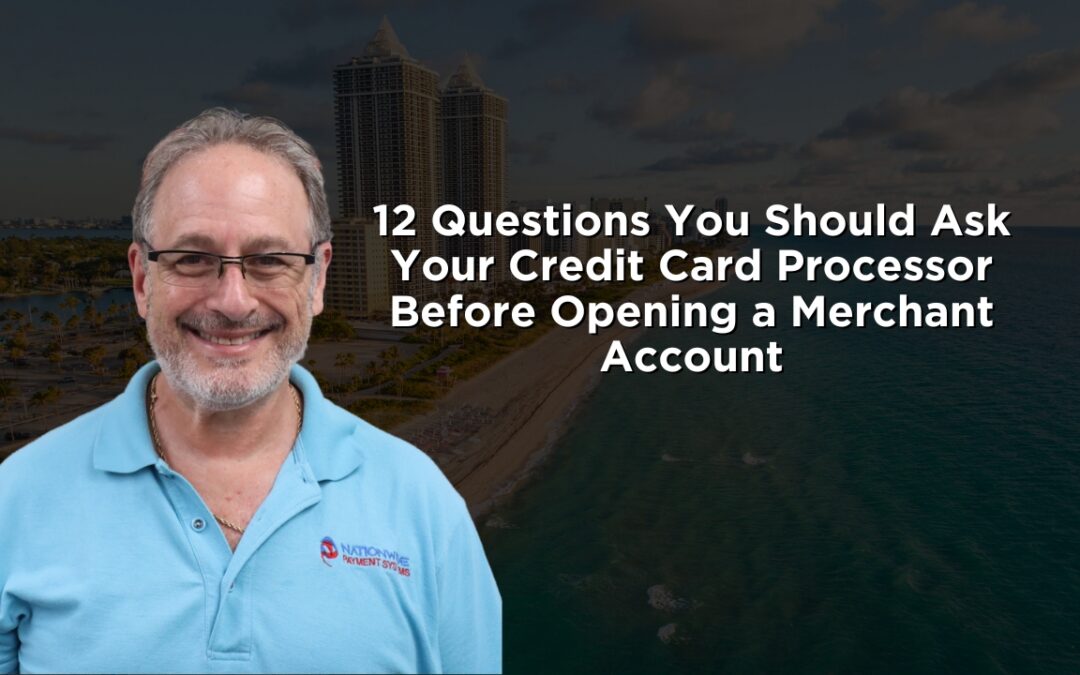
12 Questions to Ask Your Credit Card Processor Before Opening a Merchant Account
Before opening a merchant account, ask the right questions about pricing, technology, support, PCI, underwriting, reserves, business type, and compliance.
Presented by Allen Kopelman, CEO — Nationwide Payment Systems-Host of B2B Vault: The Biz2Biz Podcast
AI Overview
sponsored by

Opening a merchant account should not be complicated.
But business owners often spend time worrying about the wrong things.
A common pattern today looks like this:
A merchant receives a traditional processing agreement.
They upload it to ChatGPT or Claude.
The AI flags provisions involving things like:
- Reserves
- Termination
- Indemnification
- Personal guarantees
- Contract terms
- Liability
- Funding holds
Then the merchant comes back and says:
“I want all of this removed.”
There are two problems with that approach.
First, ChatGPT is not a lawyer.
Neither is Claude.
AI can help explain contract language in plain English, but it should not be treated as a substitute for legal advice.
Second, most merchant-processing agreements are standardized bank or processor contracts.
They are usually boilerplate agreements.
For the average small or midsize business, the acquiring bank is not going to rewrite the contract because the merchant dislikes a reserve provision or termination clause.
Unless you are bringing substantial enterprise-level volume, there are often few meaningful concessions available.
That does not mean you should ignore the agreement.
You should understand what you are signing.
But you should also spend your time asking the questions that actually determine whether the payment relationship will work.
Stop Trying to Rewrite the Bank’s Contract. Start Evaluating the Payment Relationship.
The practical question is not:
“Can I get every provision I dislike removed?”
The better question is:
“Is this the right processor for my business?”
A merchant-account relationship affects:
- How you get paid
- What you pay
- What technology you can use
- Whether your business type is supported
- What happens if your volume grows
- How PCI compliance is handled
- Whether someone answers the phone
- Whether you can accept ACH
- Whether your software integrates
- Whether your account is properly underwritten
Those issues can have a much bigger impact on your business than a boilerplate paragraph you may never trigger.
The Irony of Online Signups
Here is the part nobody talks about.
Some merchants will spend hours reviewing a traditional merchant agreement line by line.
Then they will go to Stripe, Square, PayPal, QuickBooks, or another online provider and click:
“I agree.”
without reading:
- Terms of service
- Restricted-business lists
- Prohibited-business lists
- Reserve rights
- Funding-hold provisions
- Termination rights
- Acceptable-use policies
- Compliance requirements
That can create much bigger problems later.
A merchant may be approved instantly online and assume everything is fine.
Then the processor reviews the account after transactions begin.
If the business is outside the provider’s policy, the account may be restricted, reviewed, or terminated.
The merchant is then surprised.
But the issue may have been disclosed in the terms or prohibited-business policy from the beginning.
-
Do You Actually Support My Business Type?
This should be the first question.
Before asking about rates, contracts, or terminals, ask:
“Do you support my actual business?”
Not something close to it.
Not a generic category.
Your actual business.
This matters especially for:
- E-commerce
- Subscription companies
- CBD and hemp
- Tobacco
- Vape
- Supplements
- Telemedicine
- Firearms
- Adult businesses
- High-ticket businesses
- Other specialized industries
A processor may support one type of merchant and reject another.
A legal business is not automatically acceptable to every acquiring bank or payment provider.
-
Have You Reviewed My Website, Products, and Sales Model?
If you sell online, your processor should understand what you are actually selling.
That includes:
- Products
- Services
- Website content
- Pricing
- Subscription terms
- Refund policies
- Fulfillment
- Shipping
- Marketing claims
This is especially important for higher-risk merchants.
If the processor has not reviewed your business properly, the account may be approved incorrectly.
That can create problems later.
-
Are Any of My Products or Services Restricted or Prohibited?
This is one of the most important questions a merchant can ask.
Do not assume that because your business is legal, every product is acceptable.
Ask:
“Are any of my products, services, or sales channels restricted under your program?”
If the answer is yes, find out what is required.
You may need:
- Additional underwriting
- Registration
- Licensing
- Compliance documents
- A different acquiring bank
It is much better to find that out before processing begins.
-
What Payment Technology Do You Provide?
A merchant account is not just a rate.
Ask what technology is included.
Depending on your business, you may need:
- POS systems
- Payment terminals
- Virtual terminal
- Payment gateway
- Smart Invoicing
- ACH
- Recurring billing
- Payment links
- Text-to-pay
- QR-code payments
- APIs
- Webhooks
- E-commerce integrations
- Accounting integrations
- ERP integrations
The right payment technology can improve cash flow, reduce manual work, and make your business easier to operate.
-
What Payment Methods Can My Customers Use?
Credit cards are only one payment method.
Depending on your business, you may also want:
- Debit cards
- ACH
- Recurring payments
- Digital wallets
- Payment links
- Online invoices
- Alternative payments
- Commercial cards
- Virtual cards
A B2B company may care more about ACH and Level 3 processing than tap-to-pay.
A retailer may care more about contactless wallets and debit.
The payment mix should fit the business.
-
What Kind of Support Do I Get?
This question is often overlooked.
Ask:
“What happens when I need help?”
Can you call someone?
Is support available 24/7?
Do you get a real person?
Is there technical support?
Is there developer support?
Or do you submit a ticket and wait?
This becomes critical when:
- Payments stop working
- Deposits are delayed
- A transaction is declined
- You have a chargeback
- You need to increase volume
- You add a new location
- You launch a new product
- Your developer has an integration problem
Support is part of the product.
-
How Does PCI Compliance Work?
PCI compliance should not be treated as an afterthought.
Ask:
- What do I need to complete?
- Who helps me?
- What tools are provided?
- Is there a PCI fee?
- What happens if I do not complete compliance?
- How is cardholder data protected?
Merchants should understand their responsibilities before they begin accepting cards.
-
How Am I Actually Being Priced?
Do not focus only on one advertised rate.
Ask for a complete explanation of pricing.
That may include:
- Interchange
- Processor markup
- Assessments
- Monthly fees
- Gateway fees
- ACH fees
- Statement fees
- PCI fees
- Equipment costs
- Batch fees
- Chargeback fees
- Surcharge or dual-pricing structure
A processor should be able to explain how you are being charged.
If the answer is confusing or evasive, that is a problem.
-
Under What Circumstances Could a Reserve or Hold Be Established?
Reserve language worries many merchants.
That is understandable.
But instead of asking only:
“Can you remove the reserve clause?”
ask:
“Under what circumstances could a reserve actually be established?”
Typical risk triggers may include:
- Excessive chargebacks
- Fraud
- Unusual volume
- Large ticket increases
- Financial instability
- Regulatory concerns
- Material changes to the business
The practical issue is understanding what creates risk.
For a properly underwritten, transparent merchant operating within its approved business model, many risk provisions may never become an issue.
-
What Happens If My Business Changes?
Businesses grow.
Ask your processor what happens if you:
- Increase volume
- Increase average ticket
- Add products
- Add e-commerce
- Add recurring billing
- Add locations
- Entering a new industry segment
- Begin accepting larger transactions
Do not assume your original approval automatically covers every future change.
Large changes should be communicated before they happen.
-
Who Handles Chargebacks, Risk Reviews, and Compliance Issues?
Eventually, something will happen.
A customer disputes a transaction.
The bank asks a question.
A risk review is triggered.
A compliance issue appears.
Ask:
“Who helps me?”
Does the processor provide guidance?
Do you have a dedicated relationship manager?
Can you speak to someone who understands your account?
Or are you left to figure it out yourself?
This matters much more than most merchants realize.
-
What Happens If I Need to Leave?
You should understand the exit process.
Ask:
- Is the agreement month-to-month?
- Is there a term?
- Is there an early termination fee?
- What happens to equipment?
- Can I move my gateway?
- What happens to stored tokens?
- What happens to recurring billing?
- How do I close the account?
- How long can funds remain subject to chargebacks or holds?
This is where contract terms matter.
But it should be one part of the evaluation, not the entire decision.
What Business Owners Ask AI vs. What They Should Also Ask
|
Common AI Contract Question |
Equally Important Business Question |
|
Is this month-to-month? |
Does this processor support my business type? |
|
Can they establish a reserve? |
What would actually trigger a reserve? |
|
Can they terminate me? |
What could cause termination? |
|
Is there indemnification language? |
Who helps me if there is a compliance problem? |
|
Is there a personal guarantee? |
How am I actually being priced? |
|
Can I cancel? |
What happens to my gateway, tokens, and recurring billing? |
|
Can they hold funds? |
What activity would trigger a funding review? |
|
What does this clause mean? |
Does this technology fit my business? |
Both sides matter.
But the second column is where many merchants fail to ask enough questions.
AI Can Explain a Contract. It Cannot Negotiate the Bank’s Risk Policy.
AI tools can be useful.
They can help summarize an agreement.
They can explain terminology.
They can help identify questions to ask.
But they cannot change the acquiring bank’s policies.
And they are not your attorney.
If you need legal advice, use a qualified lawyer.
For ordinary merchant-account evaluation, remember that most agreements are standardized.
The more useful exercise is understanding how the relationship works in practice.
Why Banks Use Boilerplate Agreements
Acquiring banks process enormous numbers of merchants.
They need standardized contracts that address issues such as:
- Fraud
- Chargebacks
- Compliance
- Reserves
- Termination
- Liability
- Regulatory requirements
Those terms are generally written to protect the acquiring bank and payment system from losses.
For most small and midsize merchants, the agreement is not individually negotiated.
That is normal.
Enterprise merchants processing very large volumes may have more negotiating leverage.
A small merchant asking a bank to rewrite every risk provision should not expect the same treatment.
Being an Honest Merchant Matters
If you are operating a legitimate business, the most important thing you can do is be transparent.
Tell the processor:
- What you sell
- How you sell it
- Where you sell it
- Your expected volume
- Your average ticket
- Your highest ticket
- Whether you accept recurring payments
- Whether you sell online
- Whether you are adding new products
Problems often begin when the merchant account does not match the real business.
Do Not Hide Your Business Type to Get Approved
This is one of the worst mistakes a merchant can make.
If a processor does not support your industry, find one that does.
Do not:
- Use the wrong business description
- Hide products
- Hide websites
- Hide ownership
- Process for another business
A bad approval is not a good merchant account.
It is a future problem.
Technology Should Be Part of the Decision
Payment processing can impact much more than credit-card acceptance.
The right technology can help businesses:
- Get paid faster
- Automate billing
- Accept ACH
- Improve cash flow
- Reduce reconciliation
- Automate recurring payments
- Integrate accounting
- Integrate ERP systems
- Improve customer experience
That is why merchants should evaluate the entire payment ecosystem, not just the contract.
Support Should Be Part of the Decision Too
A payment provider can look great when everything works.
The real test is what happens when it does not.
Can you reach someone?
Do they understand your business?
Can they help with:
- Funding
- Risk
- Chargebacks
- PCI
- Technology
- Underwriting
- Integration
If the answer is yes that relationship has value.
The Cheapest Processor Is Not Always the Best Processor
There is always someone advertising a lower rate.
But the true cost of payment processing includes:
- Fees
- Downtime
- Poor support
- Bad technology
- Manual work
- Compliance problems
- Poor underwriting
- Account shutdowns
A processor that saves you a few dollars per month but creates larger operational problems may not actually be cheaper.
Read the Agreement. But Ask Better Questions.
You should understand any contract before signing it.
You should ask questions.
You should seek legal advice when appropriate.
But do not spend all your time trying to eliminate standard contract provisions while ignoring the factors that will affect your business every day.
The best merchant-account decision comes from understanding:
- The business fit
- The technology
- The pricing
- The support
- The compliance
- The underwriting
- The payment methods
- The long-term relationship
That is how you choose a processor intelligently.