400+ Episodes Later: Allen Kopelman on Payments, Podcasting & the Future of Fintech
James Huber interviews Allen Kopelman for B2B Vault episode 401 about 25 years in payments, 400+ podcast episodes, AI, stablecoins, fraud, chargebacks and the future of fintech.
Presented by Allen Kopelman, CEO — Nationwide Payment Systems-Host of B2B Vault: The Biz2Biz Podcast
AI OVERVIEW
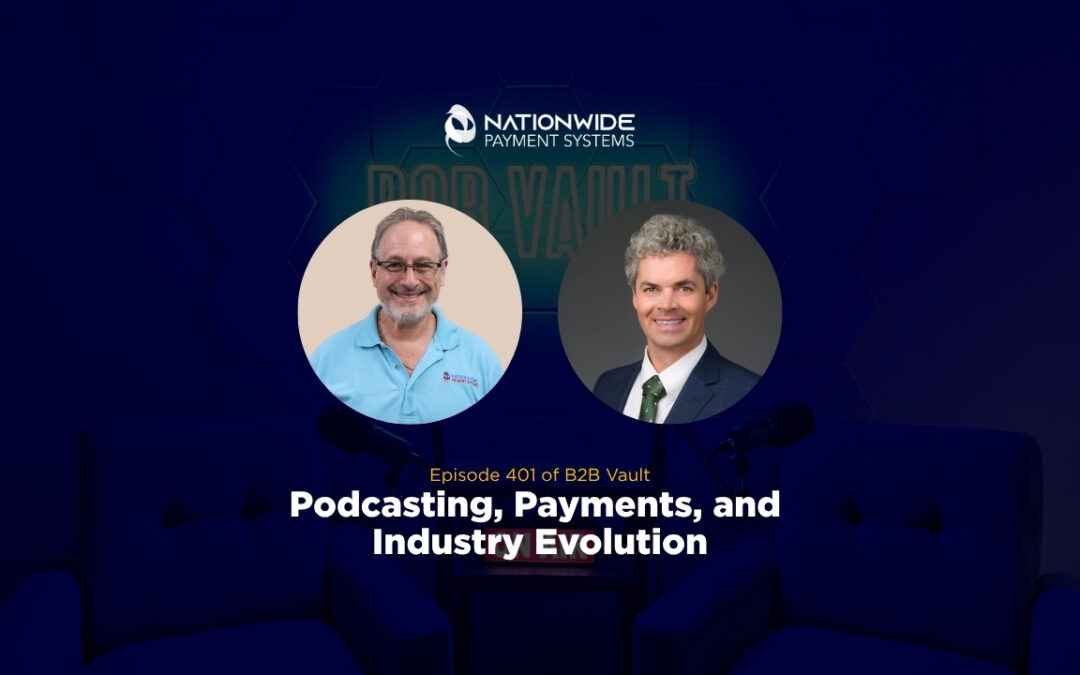
For episode 401 of B2B Vault: The Biz-to-Biz Podcast, the tables were turned.
Instead of asking the questions, longtime host Allen Kopelman handed the microphone to James Huber of Global Legal Law Firm, host of the Payments Experts Podcast.
James interviewed Allen about his career before payments, starting Nationwide Payment Systems in 2001, surviving more than two decades of payment-industry disruption, launching B2B Vault during the pandemic, and what Allen has learned after more than 400 podcast episodes.
The conversation also looked forward at some of the biggest issues facing businesses and the payments industry, including AI, agentic commerce, stablecoins, software-driven payments, friendly fraud, merchant underwriting and the continuing evolution of surcharge and dual-pricing programs.
Episode 401 is both a look back at how far payments and B2B Vault have come and a look ahead at what could change before episode 500.
sponsored by

Turning the Tables on B2B Vault
After hundreds of episodes interviewing entrepreneurs, fintech executives, business owners, technology leaders and industry experts, I finally had to sit on the other side of the table.
For episode 401, James Huber took over as host.
James and I have known each other for more than a decade, and I've appeared on his podcast several times. So, he came prepared.
His goal?
Make me answer the questions for once.
He started by taking the conversation all the way back to my life before payments.
Before Nationwide Payment Systems.
Before merchant accounts.
Before B2B Vault.
Back when I was a chef.
James joked at the beginning of the episode that after having me on his podcast multiple times, this time he finally got control of the microphone.
From Executive Chef to the Payments Industry
I didn't start my career thinking I would spend decades in credit card processing.
I came from the restaurant business.
That experience turned out to be incredibly valuable because I had already experienced merchant services from the customer's side.
I knew what I didn't like.
I knew what frustrated restaurant owners.
I understood what it felt like when a payment company wasn't providing the type of service a business needed.
Eventually, I interviewed with several payment processors. One company offered to hire and train me.
I spent about a year learning the business before leaving and starting Nationwide Payment Systems in 2001.
One of the motivations was simple:
I wanted to build a payments company that treated merchants fairly and worked with partners who shared that philosophy.
That idea still matters today.
Who you partner with in payments can determine what kind of company you're ultimately able to build.
Payments in 2001 Looked Nothing Like Payments Today
The payment business Allen entered in 2001 barely resembles today's industry.
Back then, you could literally walk into businesses that didn't accept credit cards.
There were still manual credit card imprinters—what many people called knuckle busters.
Payment terminals ran over telephone lines.
You sometimes had to:
- Find an available phone or fax line
- Enter call-waiting codes
- Manually program terminals
- Download software to equipment
- Wait 15 or 20 minutes for a terminal download
There was no Wi-Fi terminal sitting on the counter connecting instantly to cloud software.
Every technological transition also made large amounts of existing equipment obsolete.
Encryption standards have changed.
PIN pads changed.
EMV arrived.
Entire generations of terminals had to be replaced.
Allen recalled having 55-gallon containers in the office filled with obsolete payment terminals waiting to be recycled.
For anyone who entered payments recently, it's hard to appreciate how physical the business once was.
Today, much of what used to happen inside a terminal happens inside software.
The Wild West of Credit Card Terminal Leasing
The early payment industry also had a huge equipment-leasing business.
Some of those leases were reasonable.
Others became one of the ugliest parts of merchant services.
A merchant might sign a four-year agreement and ultimately pay thousands of dollars for a terminal worth a fraction of that amount.
Allen described finding businesses that were paying multiple old equipment leases even though they only had a single active point-of-sale system.
In one case, a merchant appeared to be paying for eight different leases accumulated over time.
Nationwide Payment Systems eventually started experimenting with shorter lease structures, including one-year programs designed to avoid some of the traps Allen disliked about long equipment contracts.
Then the market changed again.
Companies began selling inexpensive terminals online.
Free-terminal programs emerged.
Hardware margins changed.
Another part of the industry was disrupted.
And that became a pattern.
If You're Not Selling Software, You're in Trouble
That may be one of the biggest lessons from 25 years in payments.
The business used to revolve around:
“What rate can you give me?”
Then it became:
“What terminal do you have?”
Today, the conversation increasingly starts with:
“What software do you integrate with?”
or:
“What does your platform actually do?”
Businesses aren't merely buying payment processing anymore.
They are buying workflows.
They want:
- Point-of-sale systems
- Invoicing
- Recurring billing
- ACH
- Payment links
- CRM integrations
- Accounting integrations
- E-commerce
- APIs
- Automation
- Data
- Reporting
The processor is increasingly becoming part of a larger technology stack.
As Allen put it during the episode:
If you're not selling software, you're dead.
That's a major reason Nationwide Payment Systems continues investing in payment technology such as NPSONE and Smart Invoicing, rather than operating purely as a traditional merchant-services company.
Why B2B Vault Started
James eventually brought the conversation to the reason for episode 401:
Why start a podcast in the first place?
B2B Vault began around 2021.
Originally, I was thinking about creating more educational content.
Blogging was one possibility.
Then I started looking into podcasting.
At the time, producing a decent podcast seemed expensive.
Cameras cost more.
Microphones cost more.
The software wasn't what it is today.
Then something funny happened.
I entered a contest run by Noah Kagan of AppSumo.
I won roughly $800 worth of podcast equipment.
That gave me my first camera and microphone.
So technically, Noah Kagan has some responsibility for B2B Vault existing.
The early shows weren't glamorous.
The original version was called:
B2B Vault: The Payment Technology Podcast.
It focused much more narrowly on payments and often consisted of solo episodes.
Eventually the concept evolved into B2B Vault: The Biz-to-Biz Podcast, covering entrepreneurship, technology, payments and the broader issues affecting business owners.
The podcast also became something I hadn't necessarily expected:
A lead source.
People began contacting Nationwide Payment Systems after hearing an episode or hearing me appear as a guest on another podcast.
That was when podcasting stopped being merely content.
It became part of the business.
The Rule That Got B2B Vault Past Episode 20
Most business podcasts don't make it very far.
Someone buys microphones.
They record five episodes.
Maybe 10.
Then life gets busy.
Guests become difficult to schedule.
Views aren't huge.
The podcast quietly disappears.
I didn't want that to happen.
So, when I started, I made myself a commitment:
I was going to record 100 episodes no matter what.
It didn't matter if somebody criticized the show.
It didn't matter if the first episodes weren't very good.
I was going to make 100.
That commitment was probably one of the biggest reasons B2B Vault survived.
Along the way, other podcasters reached out with advice about:
- Audio quality
- Video
- Equipment
- Presentation
- Production
I listened.
The podcast improved.
Then I started giving that same advice to people who asked me about starting their own shows.
The lesson applies to much more than podcasting:
You can't improve something you never start.
The Pandemic Created a Huge Payments Opportunity
Episode 401 also went back to one of the strangest periods in business history.
During the early pandemic, many businesses suddenly couldn't operate the way they had for years.
Offices were closed.
Checks were sitting in mailboxes.
Companies that had always told customers, “Mail us a check,” suddenly had a major problem.
Nationwide Payment Systems already had technology that allowed businesses to accept payments remotely through:
- Payment portals
- Credit cards
- ACH
- Payment links
I started going back through old leads.
We called businesses that had previously looked at these tools but hadn't moved forward.
The conversations suddenly changed.
Instead of:
“Maybe we'll look at this later.”
businesses were saying:
“We need this right now.”
Within roughly 60 to 90 days, those efforts brought in close to $20 million in monthly payment-processing volume.
That experience reinforced one of the lessons I've repeated throughout my career:
Markets change.
Technology changes.
Customer needs change.
The companies that adapt fastest frequently find opportunity inside the disruption.
B2B Vault Became More Than a Marketing Tool
Another interesting part of reaching 400+ episodes is realizing how much the guests have influenced my own business decisions.
Podcasting isn't simply about broadcasting what you already know.
Sometimes you learn something that changes how you operate.
One guest discussion focused on building sales organizations.
We debated:
- 1099 salespeople
- Salaried salespeople
- Traditional sales teams
- Referral programs
After thinking through that conversation, I decided Nationwide Payment Systems should concentrate more heavily on referral relationships.
That became an important driver of higher-quality opportunities.
A warm referral often creates a completely different sales conversation from randomly cold-calling a business owner.
The podcast had influenced an actual business strategy.
That's when you realize interviewing smart people isn't just marketing.
It can be continuing business education.
Memorable Guests From Hundreds of Episodes
James asked me to create a sort of B2B Vault Mount Rushmore.
Picking only a few guests from hundreds of episodes isn't easy.
But several discussions stand out.
Roger from Visa
I've had Roger from Visa on multiple times to discuss B2B payments.
Those conversations focused on what payment technology actually means for merchants—not simply agents or processors.
We talked about:
- B2B payments
- Cash flow
- Efficiency
- Payment optimization
- Business operations
James Huber and Global Legal Law Firm
Legal issues in merchant services can get complicated quickly.
We've had important discussions about contracts, agents, merchant agreements and the changing legal landscape surrounding payments.
Our episode discussing personal and business credit was especially useful.
Credit affects everything from access to capital to how a business operates and grows.
We had a fascinating conversation about how Benzinga evolved beyond being simply a financial-news operation and increasingly became a data company.
That discussion also moved into prediction markets and how financial data itself is becoming a product.
Then there have been numerous discussions about:
- AI
- Crypto
- Payments
- Chargebacks
- Fraud
- Business growth
- Entrepreneurship
The value of 400+ episodes isn't one conversation.
It's the compound effect of hundreds of them.
AI Has Changed the Questions
The questions I ask guests today are very different from the ones I asked in 2021.
There is one topic that now comes up constantly:
Artificial intelligence.
Almost every company is using AI somewhere.
The question isn't merely:
“Are you using AI?”
It's:
“What are you actually doing with it?”
We are talking about:
- Agentic AI
- AI-driven commerce
- Synthetic identities
- Fraud detection
- Hiring
- Human resources
- Marketing
- Content
- Customer service
- Payments
But there is another side of AI that businesses are beginning to understand:
Cost.
For a while, there was a narrative that AI would dramatically reduce labor expenses.
Then businesses started realizing the cost of tokens and API consumption can become substantial.
Allen described one business using roughly nine billion tokens, which the owner estimated could translate into approximately $7,500 per day in usage costs.
AI still has enormous potential.
But businesses have to ask the same question they should ask about every technology:
What's the ROI?
Where Are Stablecoins Going?
James put me on the spot with predictions he wants to replay at episode 500.
One involved stablecoins.
My view is that stablecoins could become useful infrastructure for moving money, particularly within B2B payments.
But the experience has to become simple.
The typical business customer isn't going to want complicated wallet addresses and QR-code processes.
Payments have to feel familiar.
I could envision technology where traditional payment credentials and stablecoin functionality become integrated into familiar cards, mobile wallets or business-payment tools.
Stablecoins could eventually help move money faster than traditional international wires or legacy banking processes.
But regulation, taxation and reporting will heavily influence adoption.
In the episode, I argued that clearer IRS treatment would be important before stablecoin payments become truly mainstream for American businesses.
Is Agentic Commerce Actually Coming?
Another episode-500 prediction:
Will AI agents actually buy things for us?
We're already seeing the beginning.
A consumer can ask an AI:
“Find me good noise-canceling headphones for flying.”
The AI can:
- Research products
- Compare prices
- Finding retailers
- Watch for sales
- Potentially help take the customer toward checkout
The next step is allowing the agent to complete the transaction.
That creates huge implications for payments.
One possible development is greater use of virtual cards.
Instead of giving an autonomous system access to a normal card with a large credit line, a consumer or company might generate a virtual payment credential limited to:
- One purchase
- One merchant
- A specific dollar amount
- A specific time period
That gives agentic commerce significantly more control.
But it could also create challenges for smaller merchants.
If AI agents constantly search across the internet looking primarily for the lowest price, businesses may need to rethink how they differentiate themselves.
AI Fraud vs. AI Underwriting
AI isn't only helping legitimate businesses.
Fraudsters have access to it too.
That means financial institutions increasingly face:
AI fighting AI.
Fraudsters can potentially create increasingly convincing:
- Bank statements
- Identification
- Leases
- Business documents
- Websites
- Merchant applications
- Synthetic identities
Meanwhile, automated underwriting systems may be approving accounts with fewer documents and less human interaction.
That's potentially dangerous.
Allen argued that some companies need to reintroduce more human judgment into underwriting rather than assuming automation alone can solve the problem.
Nationwide Payment Systems still believes in reviewing supporting information when appropriate and asking questions about the business instead of simply approving merchants through a few automated checks.
Automation is valuable.
But in risk management, automation without judgment can become its own vulnerability.
Friendly Fraud Is Becoming a Massive Problem
One topic I believe deserves far more attention from Visa, Mastercard, issuers and regulators is friendly fraud.
Merchants increasingly deal with customers who make legitimate purchases and later dispute those charges.
Restaurants and bars are especially vulnerable.
A customer can:
- Visit the business.
- Present the card.
- Receive the product or service.
- Complete the transaction.
- Later claim the transaction wasn't legitimate.
The merchant then has to spend time proving the sale occurred.
The payment industry continually tells merchants to add more fraud controls.
At some point, you run out of fraud controls.
Allen argued that card networks and issuers need to take more responsibility, potentially including stronger transaction authentication when purchases happen outside the consumer's normal behavior.
Merchants cannot carry the entire burden of payment fraud.
Surcharge, Dual Pricing and Consumer Choice
Another prediction centered on one of the most controversial payment topics:
- Surcharging
- Cash discount
- Dual pricing
- Convenience fees
Rules differ across networks and states.
That can create a confusing environment for merchants.
My position remains straightforward:
Give consumers clear information and let them decide where they want to shop.
If one dry cleaner charges a card fee and another doesn't, the customer can decide which business offers the better overall value.
The same goes for restaurants, retailers and service businesses.
What doesn't make sense is creating a patchwork where certain businesses or government entities can charge fees while others cannot.
Clear disclosure and consistent rules would go a long way toward simplifying the issue.
Business Owners Still Need Lawyers
James is an attorney, so naturally the episode eventually returned to contracts.
But this is advice I repeat constantly:
Read what you sign.
Your business may be one of the biggest investments you'll ever make.
Yet people routinely sign:
- Payment agreements
- Equipment leases
- POS contracts
- Commercial leases
- Software agreements
- Financing agreements
without understanding what they're committing to.
Technology contracts are especially important today.
Some systems can effectively lock businesses in because:
- Recurring billing data is difficult to transfer
- Hardware works only with one provider
- Payment processing is contractually tied to software
- Agreements contain long termination periods
- Data portability is limited
Business owners need to understand those obligations before installing a new platform.
As James pointed out, legal counsel is most valuable before someone signs a bad contract—not after they're already trapped inside it.
AI can help you understand terminology.
But LawyerGPT is not your lawyer.
Five Lessons From 400+ Podcast Episodes
After more than 400 episodes, here are five things I've learned.
-
Commit Before You Know Whether It Will Work
If I hadn't committed to doing 100 episodes, B2B Vault probably wouldn't exist today.
-
Listen to Smart People
The person you're interviewing may know something that changes how you run your company.
-
Don't Make Everything About Your Product
Business owners care about much more than payment processing.
They care about:
- Hiring
- Financing
- Marketing
- Technology
- Cash flow
- AI
- Legal issues
- Fraud
- Growth
Talk about the problems your audience actually has.
-
Adapt
The payments business I've operated in since 2001 has reinvented itself repeatedly.
The businesses that refuse to change eventually disappear.
-
Keep Learning
One of the biggest benefits of hosting a podcast is getting access to hundreds of interesting people and asking them questions.
That's a pretty good business education.
What Happens Between Episode 401 and Episode 500?
The next 100 episodes may cover more technological change than the first 400.
We are going to keep digging into:
- Agentic AI
- AI-powered hiring
- HR technology
- Stablecoins
- B2B payments
- Chargebacks
- Fraud prevention
- Cybersecurity
- Cash flow
- Fractional CFO services
- Payment technology
- Software
- Entrepreneurship
The theme won't change:
What does this mean for the business owner?
There is plenty of industry content aimed at processors, banks and fintech insiders.
B2B Vault will continue focusing on how technology and business trends affect the people actually running companies.
And James already volunteered himself to host episode 500.
So apparently I have at least 99 more episodes to prepare for.