Nationwide Payment Systems
How High School Teens Are Fighting AI Scams, Deepfakes, and Misinformation
Allen Kopelman of B2B Vault interviews Adya Tewari and Saanvi Chawla of the AI Literacy Project about AI literacy, deepfakes, scams, student education, senior safety, and responsible AI use.
B2B Vault Podcast Recap with Allen Kopelman, Adya Tewari, and Saanvi Chawla of the AI Literacy Projec
AI OVERVIEW
Artificial intelligence is no longer a concept limited to future forecasting; it actively powers everyday search interfaces, scholastic study workflows, corporate data engines, and communication channels. However, this sudden paradigm shift introduces critical socio-technical blind spots. From hyper-realistic audio/video deepfakes to conversational, AI-driven social engineering scams targeting vulnerable demographics, the margin for error in digital literacy has narrowed.
In this landmark episode of B2B Vault: The Biz to Biz Podcast, host Allen Kopelman sits down with Adya Tewari and Saanvi Chawla, the visionary high school founders of the AI Literacy Project. The conversation centers on a crucial shift in modern education: moving away from ineffective technological bans and toward systematic, ethical AI literacy. This review breaks down their grassroots curriculum framework and outlines why data-driven AI safety is a vital survival skill for students, families, and commercial enterprises alike.
Artificial intelligence is everywhere now.
It is in Google search results.
It is helping students study.
It is writing emails.
It is creating videos.
It is powering chatbots.
It is helping businesses move faster.
But AI is also creating new risks.
Scammers are using it.
Deepfakes are becoming more realistic.
Fake videos are fooling kids and adults.
Senior citizens are being targeted by phone scams.
Students are using AI without always understanding what it can and cannot do.
That is why this episode of B2B Vault: The Biz to Biz Podcast, hosted by Allen Kopelman and powered by Nationwide Payment Systems, is such an important conversation.
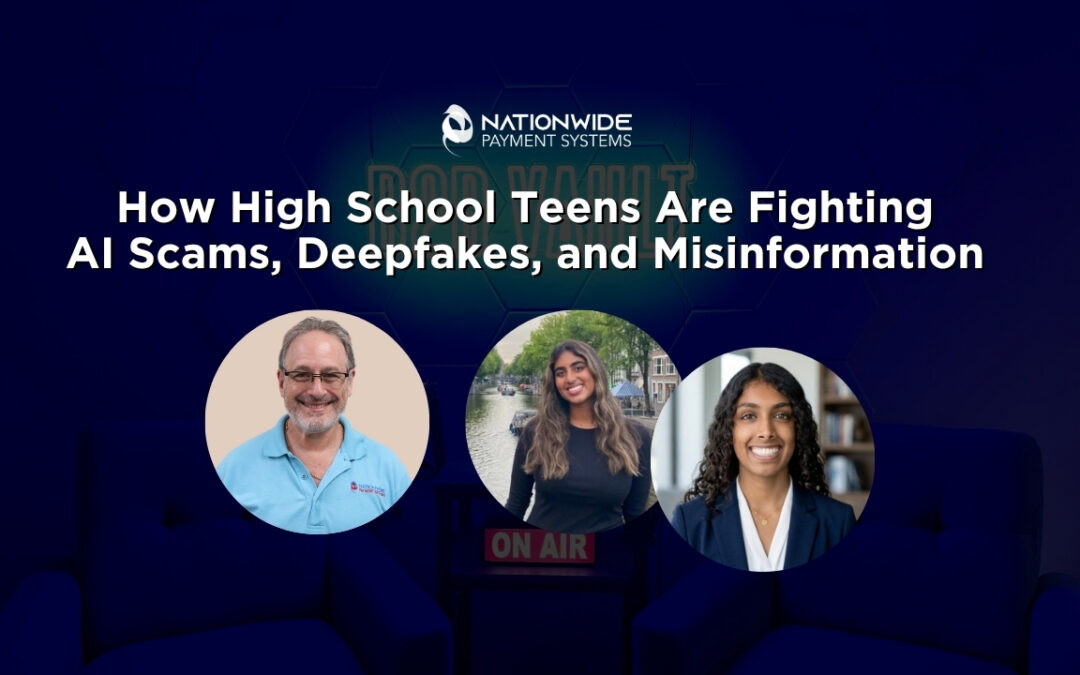
Allen sat down with Adya Tewari and Saanvi Chawla, two high school students and founders of the AI Literacy Project, to discuss AI safety, responsible AI use, deepfakes, scams, education, and why students need to be taught how to use AI instead of simply being told not to use it.
You can listen to or watch the full episode here:
Listen on Spotify:
https://open.spotify.com/episode/62iLcYUfBqAHfeClOXMLNQ?si=dc68873cbd874502
Listen on Apple Podcasts:
https://podcasts.apple.com/us/podcast/how-high-school-teens-are-fighting-ai-scams-deepfakes/id1589977495?i=1000769150374
Watch on YouTube:
https://youtu.be/yAO4lw_AxHg?si=MXVEy9bw7M0K4LYo
sponsored by

Meet Adya Tewari and Saanvi Chawla
Adya Tewari and Saanvi Chawla are high school students who saw a major gap in how people are learning about artificial intelligence.
At their school, they started an ethical AI club where students meet to discuss AI, technology, online safety, and the impact artificial intelligence is having on society.
But they quickly realized the conversation needed to go beyond their own school.
That led them to create the AI Literacy Project, an initiative focused on educating students, senior citizens, families, and communities about how AI works, how it can help, and how it can be misused.
Their work focuses on a simple but powerful idea:
AI is not going away, so people need to understand it.
You can learn more about their work here:
AI Literacy Project:
https://ailiteracyproject.co/
Why AI Literacy Matters
A few years ago, artificial intelligence felt like something from a science fiction movie.
Now it is built into everyday tools.
Students use AI to help explain homework.
Business owners use AI to write content and analyze data.
Consumers use AI search tools to ask questions.
Companies use AI for customer service, fraud detection, marketing, and automation.
But there is a big problem:
Most people have never been taught how to use AI safely.
That creates risk.
If people blindly trust AI, they may believe misinformation.
If students use AI to do all their homework, they may not learn.
If seniors receive AI-generated scam calls, they may lose money.
If kids see deepfake videos, they may not know what is real.
If businesses use AI without guardrails, they may create legal, financial, or reputational problems.
AI literacy means understanding both sides of the technology.
It means knowing how AI can help, but also knowing when to slow down, verify, and ask better questions.
The Problem With Telling Students “Don’t Use AI”
One of the most interesting parts of the episode was the discussion about how schools are handling AI.
Adya and Saanvi explained that many students are simply told not to use AI.
That may sound like a safe approach, but it does not really solve the issue.
Students are already using AI.
Some use it to explain math problems.
Some use it to create study guides.
Some use it to summarize difficult topics.
Some use it to help write emails.
Some misuse it to complete assignments without learning.
The answer is not pretending AI does not exist.
The answer is education.
Schools need to teach students how to use AI responsibly, ethically, and intelligently.
Students should understand when AI is helpful, when it is unreliable, and when using it crosses a line.
There is a major difference between using AI as a tutor and using AI as a shortcut.
That difference needs to be taught.
AI Can Be a Powerful Learning Tool
Adya and Saanvi both shared how AI can help them learn.
For example, if a student does not understand something in class, AI can explain it in a different way. It can answer follow-up questions. It can create a study plan. It can help break down a difficult subject into smaller pieces.
That can be extremely valuable.
In some ways, AI can act like a personal tutor that is available anytime.
But it still requires judgment.
Students need to check the answers.
They need to understand the explanation.
They need to avoid copying blindly.
They need to use AI to support learning, not replace learning.
That is the balance schools, parents, and students need to find.
Deepfakes Are Becoming Harder to Spot
Deepfakes were a major topic in this episode.
A deepfake is an AI-generated or AI-manipulated image, video, or audio clip that makes something appear real when it is not.
This is not just a fun internet trick anymore.
Deepfakes can be used for scams, bullying, misinformation, impersonation, fake celebrity videos, fake political content, and even harmful content involving students.
Allen brought up a serious concern: what happens when someone uses AI to put another person’s face into inappropriate or damaging content?
That is not just unethical.
It can become a legal issue, a school issue, a family issue, and a law enforcement issue.
Adya and Saanvi teach students how to look for warning signs in AI-generated content, including strange facial movement, unnatural blinking, weird shadows, distorted hands, odd audio timing, or content that seems too unbelievable to be true.
But as AI improves, deepfakes will become harder to detect.
That is why people need to build critical thinking skills now.
AI Scams Are Targeting Senior Citizens and Families
AI scams are becoming more realistic.
Allen shared examples of phone scams targeting older adults, including fake calls claiming that a grandchild is in trouble and needs money.
This type of scam is already scary.
AI makes it worse.
With voice cloning and AI-generated messages, scammers can create more convincing emotional pressure. They can make a call, text, video, or message feel personal and urgent.
That is why education for senior citizens is so important.
The AI Literacy Project is working to bring AI safety education to senior communities, including through partnerships with local safety programs.
Everyone should remember this rule:
If a message or phone call creates panic, urgency, or pressure to send money, stop and verify before doing anything.
Call the person directly.
Call another family member.
Do not use the number provided by the suspicious message.
Do not send money immediately.
Do not share personal information.
Do not click unknown links.
Scammers win when people react quickly.
Education helps people pause.
AI Is Not Always Right
Another important lesson from the episode is that AI can be wrong.
And not just a little wrong.
AI can give answers that sound confident but are completely incorrect.
That matters for students, business owners, employees, and consumers.
If you ask AI a question and it gives you a polished answer, that does not automatically mean the answer is accurate.
Adya pointed out that users need to double-check important information and verify sources.
That is especially important for:
School assignments
Medical information
Legal questions
Financial decisions
Business compliance
News and current events
Scam warnings
Technical instructions
AI is a useful tool, but it should not replace common sense, trusted sources, or expert advice.
AI Should Not Replace Human Connection
Saanvi made another important point during the conversation:
AI is not a human being.
That sounds obvious, but it is becoming more important as AI chat tools become more conversational and emotionally responsive.
AI can help explain a concept.
AI can help organize ideas.
AI can help draft a message.
But it should not replace friends, family, teachers, mentors, or real human conversations.
Especially for young people, it is important to remember that AI is a tool, not a relationship.
Sometimes the best answer is to close the laptop, put down the phone, go outside, and talk to a real person.
Schools Need to Teach More Real-World Technology Skills
Allen also raised a bigger issue during the episode: students need more real-world technology education.
AI is part of that, but it is not the only piece.
Students also need to learn:
Microsoft Office
Spreadsheets
Digital research
Prompting
Media literacy
Online safety
Basic finance
Business skills
Cybersecurity awareness
How to evaluate sources
How to recognize scams.
Too many students are expected to know these tools without being formally taught.
That creates a gap between school and the real world.
In today’s workplace, technology skills are not optional.
They are basic survival skills.
What Business Owners Can Learn From This Episode
This episode is not just for students, parents, or teachers.
Business owners should pay close attention too.
AI is changing how people search for information, how customers make decisions, how fraud happens, how employees work, and how companies communicate.
People are no longer only searching Google.
They are asking ChatGPT, Gemini, Perplexity, Claude, Copilot, and other AI tools for answers.
That means businesses need to think about how they appear in AI-driven search results.
It also means businesses need AI policies.
Business owners should be asking:
Are employees allowed to use AI?
What tools are approved?
Can sensitive customer data be entered into AI tools?
Who checks AI-generated content before it is published?
How do we prevent AI-assisted fraud?
How do we verify identity in a world of fake voices and fake videos?
How do we train our team to use AI productively?
AI literacy is no longer just a school issue.
It is a business issue.
AI Will Not Replace Everyone — But AI Skills Matter
One of Allen’s strongest points in the episode was this:
People may not lose their jobs simply because AI exists.
They may lose opportunities because they do not know how to use AI.
That is the real shift.
AI can help people become faster, more efficient, and more productive.
It can help with writing, research, customer service, sales, marketing, data analysis, payment operations, fraud detection, and everyday business workflows.
But people who refuse to learn AI may fall behind.
The same is true for businesses.
Companies that adopt AI wisely will move faster.
Companies that ignore it may become slower, more expensive, and less competitive.
Don’t Be Scared of AI — Get Educated
The message of this episode is not fear.
It is education.
AI can be dangerous when people do not understand it.
But AI can also be powerful when people use it responsibly.
Students can learn better.
Senior citizens can avoid scams.
Business owners can improve operations.
Employees can become more productive.
Communities can become safer.
Parents can help their kids navigate the digital world.
That is why the work Adya and Saanvi are doing through the AI Literacy Project matters.
They are helping people understand a technology that is already changing society.
And they are proving that young people should not just be part of the AI conversation.
They should help lead it.
About the AI Literacy Project
The AI Literacy Project was founded by Adya Tewari and Saanvi Chawla to help students, senior citizens, families, and communities understand artificial intelligence.
Their work focuses on AI safety, responsible AI use, deepfake awareness, scam prevention, media literacy, and helping people think critically about AI-generated content.
They are also encouraging students in other schools and communities to start AI literacy chapters and help expand education around responsible AI.
Learn more here:
AI Literacy Project:
https://ailiteracyproject.co/
About B2B Vault: The Biz to Biz Podcast
B2B Vault: The Biz to Biz Podcast is hosted by Allen Kopelman and powered by Nationwide Payment Systems.
The podcast features conversations with entrepreneurs, fintech leaders, business owners, students, founders, technology experts, marketing professionals, and innovators who are helping shape the future of business.
Topics include:
AI
Business
Entrepreneurship
Payments
Fintech
Marketing
Technology
Fraud prevention
Financial education
Business growth
Digital transformation
Listen to this episode here:
Spotify:
https://open.spotify.com/episode/62iLcYUfBqAHfeClOXMLNQ?si=dc68873cbd874502
Apple Podcasts:
https://podcasts.apple.com/us/podcast/how-high-school-teens-are-fighting-ai-scams-deepfakes/id1589977495?i=1000769150374
YouTube:
https://youtu.be/yAO4lw_AxHg?si=MXVEy9bw7M0K4LYo
To learn more about Nationwide Payment Systems and NPSONE, visit:
Nationwide Payment Systems:
https://nationwidepaymentsystems.com/
Key Takeaways From This Episode
AI literacy is becoming a critical life skill.
Students should be taught how to use AI responsibly instead of simply being told not to use it.
Deepfakes and AI scams are becoming more realistic.
Senior citizens and young people are especially vulnerable to AI-powered scams.
AI can help students learn when used as a tutor, not as a shortcut.
AI can be wrong, so users need to verify important information.
AI should not replace real human relationships.
Schools need to teach more real-world technology and business skills.
Business owners need AI policies, AI training, and AI fraud awareness.
The future belongs to people who learn how to use AI safely and effectively.