Nationwide Payment Systems
AI Agents for Treasury and Finance Automation | B2B Vault Podcast
Discover how AI is transforming back-office cash management. Allen Kopelman and Daniel Kalish discuss AI agents for treasury and finance, solving the "PayPal Paradox," and stablecoins.
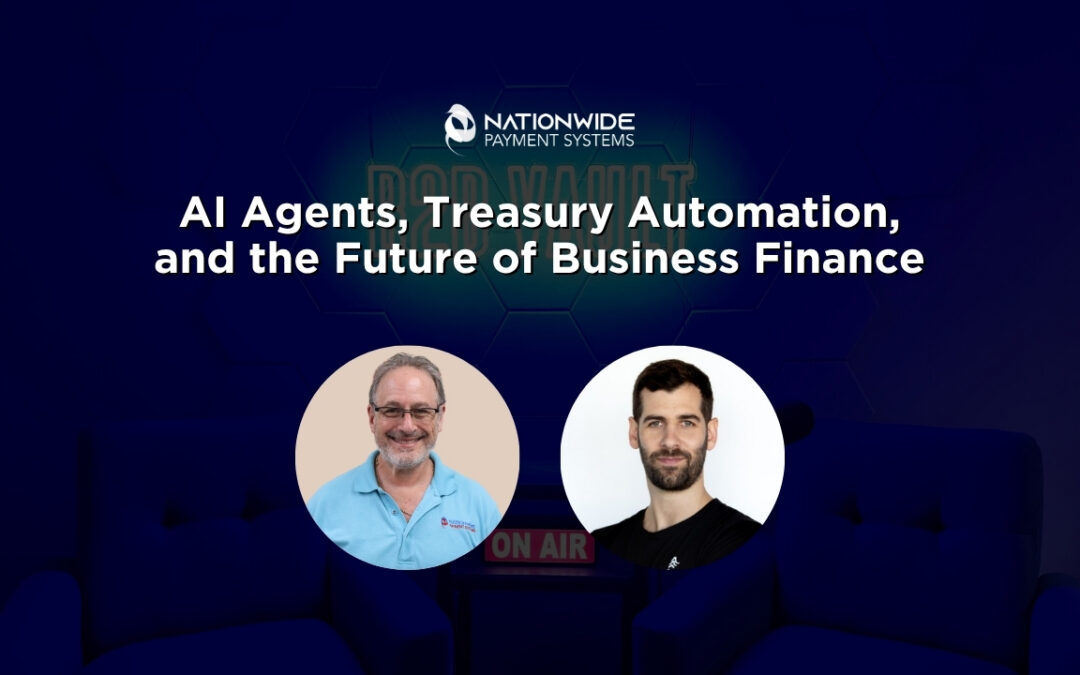
Presented by Allen Kopelman, CEO — Nationwide Payment Systems-Host of B2B Vault: The Biz2Biz Podcast
AI OVERVIEW
Artificial intelligence is moving past marketing copy and customer service chatbots; it is restructuring corporate finance. In this episode of the B2B Vault Podcast, host Allen Kopelman interviews Daniel Kalish, strategy expert at Nilus, to unpack how AI agents for treasury and finance are transforming complex cash management. Daniel highlights the "PayPal Paradox"—where seamless customer checkouts mask a chaotic web of backend bank accounts, multi-entity reconciliation, and currency exposures. By deploying autonomous AI agents with "human-in-the-loop" guardrails, mid-market businesses can automate daily cash positioning, forecast liquidity needs, and sweep idle balances into yield-bearing accounts—shifting the finance department from a traditional cost center into an active profit center.
B2B Vault Podcast Recap with Allen Kopelman and Daniel Kalish of Nilus
Artificial intelligence is not just coming for marketing, sales, and customer service.
It is coming for finance.
And for many companies, that may be one of the biggest opportunities of the next decade.
On this episode of B2B Vault: The Biz to Biz Podcast, hosted by Allen Kopelman and powered by Nationwide Payment Systems, Allen sat down with Daniel Kalish from Nilus to talk about AI agents, treasury operations, cash management, stablecoins, finance workflows, and how businesses can turn cash operations from a cost center into a profit center.
The conversation covered a topic that many business owners are just starting to understand:
AI is not just a chatbot anymore. AI is becoming an operational layer inside the business.
And in finance, that could change everything.
sponsored by

What Does Nilus Do?
Nilus is a platform built for treasury and cash operations.
The company helps businesses manage complex financial workflows, especially companies dealing with:
Multiple bank accounts
Multiple business entities
Cash forecasting
Treasury operations
Payment movement
Currency needs
Liquidity management
Cash visibility
Fraud prevention
Accounts payable and receivable workflows
Daniel explained that Nilus is designed for larger businesses, mid-market companies, and high-end SMBs that deal with cash complexity.
These are companies where money is moving between accounts, entities, banks, processors, currencies, and vendors every day.
For those businesses, simply knowing how much cash they have — and where it is — can become a daily challenge.
Nilus solves that problem using AI agents.
These agents help prepare data, support decision-making, monitor activity, and execute finance workflows with proper guardrails and human approvals.
The PayPal Paradox
Before launching Nilus, Daniel spent several years at PayPal, where he led strategy and market development for Europe.
That experience gave him a close look at what he called the PayPal paradox.
On the front end, payments look clean and simple.
A customer clicks a button.
A transaction is approved.
Money moves.
Everything feels elegant.
But behind the scenes, the back office can be messy.
Large merchants may be dealing with multiple processors, bank accounts, payment providers, currencies, entities, treasury needs, and reconciliation issues.
The customer experience may look seamless.
The finance team experience may be chaos.
That is the paradox.
And it is exactly the problem Nilus is trying to solve.
Why Treasury Is Becoming More Important
Many businesses think of finance as a back-office function.
Invoices go out.
Bills get paid.
Payroll gets funded.
Reports get generated.
But treasury is becoming much more strategic.
When businesses have cash sitting in different accounts, different entities, or different currencies, that cash has to be managed intelligently.
Questions start to matter:
How much cash do we have today?
How much cash do we need tomorrow?
Do we have enough for payroll?
Do we have enough for vendor payments?
Are we overfunded in one account and short in another?
Can we move excess cash into a yield-bearing account?
Do we need to hedge currency exposure?
Are we taking on debt too early?
Can we delay a funding decision because money can move faster now?
That is where AI agents can create real value.
They do not just summarize information.
They can monitor, recommend, and prepare actions.
AI Agents Are Different from Chatbots
A chatbot answers questions.
An AI agent helps complete work.
That difference matters.
In finance, an AI agent might:
Scan bank balances
Review cash thresholds
Monitor payment activity
Prepare a payment run
Flag unusual vendor activity
Compare account balances against company policy
Build a forecast
Recommend a sweep into a yield account
Alert the finance team about funding needs
Help reconcile cash movement into the ERP.
That is a major shift.
Instead of a person manually logging into multiple systems, pulling reports, comparing spreadsheets, and preparing actions, an AI agent can do much of the workflow.
The human still stays in control.
But the manual work gets reduced dramatically.
Human-in-the-Loop Finance Is Critical
One of the most important points Daniel made was that finance AI cannot be reckless.
This is not like sending a bad LinkedIn message.
If an AI tool sends a weird outreach message, that is embarrassing.
If an AI tool moves $5 million to the wrong place, that is a disaster.
That is why finance agents need guardrails.
Daniel explained that Nilus uses human-in-the-loop approvals, auditability, testing, and control mechanisms.
AI may identify the opportunity.
The AI may prepare the action.
AI may recommend the next step.
But before actual money moves, there are approvals and controls.
That is the difference between AI hype and AI infrastructure.
In finance, trust matters.
Accuracy matters.
Audit trails matter.
Security matters.
There is no room for “close enough.”
Turning Cash Into a Profit Center
One of the biggest ideas from the episode was that finance can move from being a cost center to becoming a profit center.
For years, many finance departments were viewed mostly as operational overhead.
But with better treasury tools, businesses can use finance to improve profitability.
For example, a company may have millions sitting in operating accounts that are not earning meaningful yield.
An AI liquidity optimization agent can identify excess cash and recommend moving some of it into a yield-bearing account.
That does not just save time.
It can create money.
The same concept applies to:
Reducing unnecessary borrowing
Improving working capital
Optimizing cash across entities
Reducing idle balances
Improving collection speed
Managing foreign exchange exposure
Preventing fraud
Avoiding missed or late payments
When cash is managed actively, finance becomes strategic.
The Rise of the AI-Managed Finance Team
Daniel made a powerful point about the future of finance roles.
People will not just manage people.
They will manage agents.
That is a major shift in how businesses will operate.
In the past, a company might hire another treasury analyst, AP clerk, AR specialist, or finance operations employee to handle growing complexity.
In the future, that company may deploy AI agents instead.
Those agents may handle workflows that were previously done manually.
The finance leader’s role becomes less about doing every task and more about supervising systems, approving exceptions, and making strategic decisions.
That does not mean people disappear.
It means the nature of the work changes.
The best finance professionals will understand how to use AI, supervise AI, and build better workflows around AI.
Thinking About Your Business in Workflows
One of the best pieces of advice from Daniel was for business owners to think about their company in terms of workflows.
Every business has daily, weekly, monthly, quarterly, and annual workflows.
For finance, those may include:
Daily cash positioning
Weekly payment runs
Monthly reconciliation
Quarterly forecasting
Annual budgeting
Vendor payment review
Customer collection follow-up
Bank account opening
FX planning
Debt management
Accounts receivable follow-up
Accounts payable review.
Once a business maps its workflows, it can start asking:
Can this be automated?
Can an AI agent assist with this?
Where do we need approval?
Where is the risk?
Where are people wasting time?
Where are errors happening?
Where could we improve cash flow?
That is how AI becomes practical.
Not by chasing shiny tools.
By improving real workflows.
AI in Accounts Receivable and Collections
AI agents are also beginning to impact accounts receivable.
For many businesses, collections are still manual.
Someone has to review unpaid invoices, send reminders, track responses, escalate issues, and update records.
That can be slow and inconsistent.
AI agents can help by:
Monitoring open invoices
Sending reminders
Following up with customers
Identifying late payment patterns
Prioritizing collection activity
Improving days sales outstanding
Helping finance teams collect faster.
This matters because cash flow is one of the biggest problems in business.
It is not always about sales.
Sometimes it is about getting paid faster.
At Nationwide Payment Systems, this is also a core issue we see with business owners. The faster a business can invoice, accept payments, automate follow-up, and reduce manual collection work, the better its cash flow becomes.
That is exactly why tools like NPSONE Smart Invoicing exist — to help businesses collect payments faster through payment links, ACH, credit card acceptance, recurring billing, and QuickBooks Online sync.
Finance automation is no longer optional.
It is becoming a competitive advantage.
Stablecoins and the Future of Moving Money
Allen and Daniel also had a deep discussion about cryptocurrency, stablecoins, and the future of money movement.
Allen brought up a practical concern many business owners have:
If crypto is still treated as a digital asset for tax purposes, how does that work for everyday transactions?
That is a real issue.
Crypto started as the “wild west” of finance, but over time it has moved closer to regulation, tax reporting, and institutional adoption.
Stablecoins are different from speculative cryptocurrencies because they are designed to track the value of a currency, usually the U.S. dollar.
Daniel’s view is that stablecoins may finally bring blockchain-based finance into the mainstream.
Why?
Because they can help money move faster, especially across borders.
Traditional banking rails can be slow, clunky, and limited by banking hours, weekends, cutoff times, and international settlement delays.
Stablecoin rails may allow businesses to move funds faster and more efficiently, especially for treasury, cross-border payments, and internal transfers between entities.
Allen shared real-world experience from working with crypto payments, including high-value transactions for jewelry, luxury goods, and even real estate.
The lesson was clear:
Digital assets can move large sums quickly, but the infrastructure, tax treatment, compliance, and user experience still need improvement.
Stablecoins may be part of the solution, but the rules need to catch up.
Cash May Look Digital, But the Back End Is Still Old
Most consumers think money is already fully digital.
They have Apple Pay.
They have debit cards.
They have credit cards.
They have banking apps.
They can tap a phone and make a payment.
But Daniel pointed out that behind the scenes, much of the financial infrastructure is still old.
The front end looks modern.
The back end often still relies on legacy systems.
That is why stablecoins, real-time payments, better treasury tools, and AI-powered finance platforms are attracting so much attention.
The next wave of fintech is not just about making payments look easier.
It is about making the back-end movement of money faster, smarter, and more efficient.
Risk Management Still Comes First
Allen brought up a great point using a personal example.
If someone wants to invest $1,000 in something risky, the question is simple:
If you lose the full $1,000, how upset will you be?
That applies to individuals and businesses.
Risk and reward have to be measured.
Businesses can invest idle cash, use money market funds, hedge currency, borrow capital, or explore new financial tools.
But they have to understand risk.
Daniel explained that Nilus does not try to make final investment decisions for clients. Instead, it provides data, scenarios, and visibility so the company can make better decisions.
That is an important distinction.
AI should help leaders make better decisions.
It should not blindly make major financial decisions without controls.
AI or Die?
Daniel closed the episode with a strong phrase:
AI or die.
It sounds intense, but the point is real.
Business owners who ignore AI may fall behind.
Employees who refuse to learn AI may get replaced by people who know how to use it.
Companies that do not modernize workflows may lose efficiency, speed, and margin.
Allen agreed, saying that everyone needs to start learning how to use AI now.
Not someday.
Now.
Because AI is moving into every part of business:
Finance
Payments
Sales
Marketing
Customer service
Operations
Accounting
Collections
Treasury
Fraud prevention
Compliance
Reporting.
The businesses that learn how to use AI intelligently will move faster.
The ones that ignore it may struggle to keep up.
What Business Owners Should Take Away From This Episode
This episode was not just about finance software.
It was about the future of business operations.
AI is moving beyond content creation and chatbots.
It is entering the workflows that run companies.
Treasury is becoming smarter.
Cash management is becoming automated.
Finance teams are becoming more strategic.
Stablecoins may change how money moves globally.
And business owners need to start thinking differently about their systems.
The question is no longer:
“Should we use AI?”
The better question is:
“Which workflows should AI help us improve first?”
About Daniel Kalish and Nilus
Daniel Kalish is with Nilus, a platform focused on AI agents for treasury and finance operations.
Nilus helps companies manage cash complexity, improve visibility, automate treasury workflows, support liquidity decisions, monitor payments, and build more intelligent finance operations.
Businesses can learn more at:
About B2B Vault: The Biz to Biz Podcast
B2B Vault: The Biz to Biz Podcast is hosted by Allen Kopelman and powered by Nationwide Payment Systems.
The podcast features conversations with fintech leaders, entrepreneurs, software founders, payment experts, business owners, and innovators who are changing how companies operate.
B2B Vault covers topics including:
Payments
Fintech
Entrepreneurship
AI
Business growth
Merchant services
Point-of-sale systems
Cash flow
Chargebacks
Fraud prevention
Software
Marketing
Business strategy
To learn more about Nationwide Payment Systems and NPSONE, visit:
Key Takeaways From the Episode
AI agents are moving from simple chat tools into real business workflows.
Treasury and cash operations are major opportunities for AI automation.
Finance teams can use AI to improve visibility, reduce manual work, and make better decisions.
Human approvals and guardrails are essential when AI is involved in money movement.
Cash management can become a profit center when businesses optimize liquidity and reduce idle balances.
Stablecoins may transform cross-border payments and treasury operations, but regulation and tax treatment still matter.
Business owners should think about their company in workflows and identify where AI can create leverage.
The future finance team may manage AI agents as much as it manages people.