Nationwide Payment Systems
B2B Vault Podcast: Financial Market Data APIs and Brokerage Partnerships
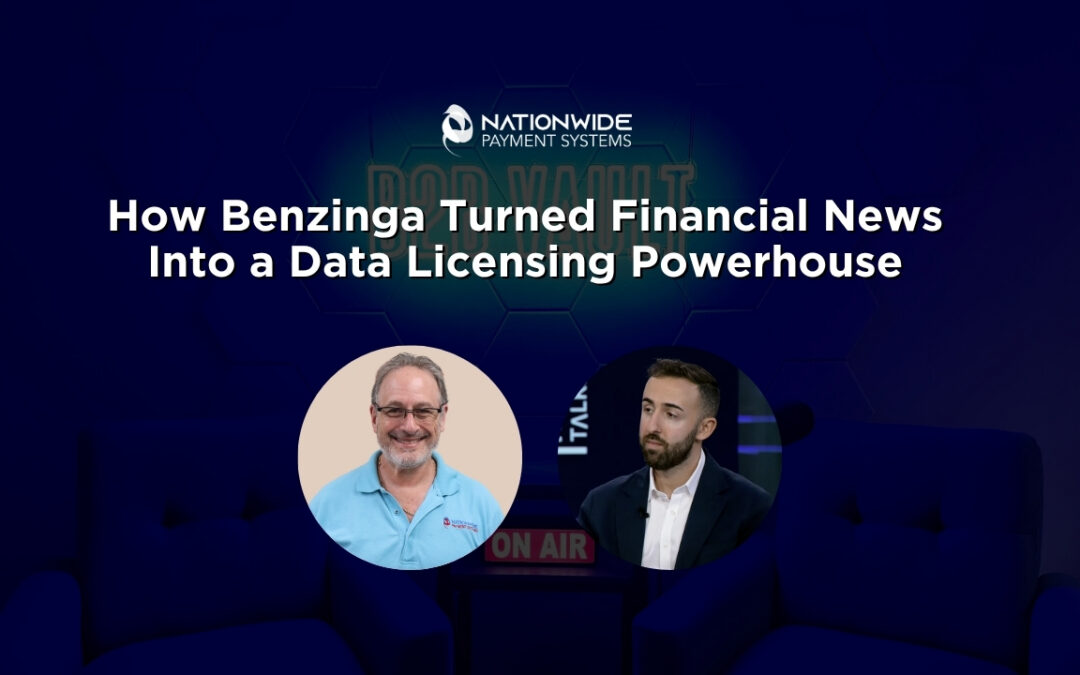
Learn how Benzinga transformed financial news into a global data powerhouse. In this B2B Vault Podcast episode, Allen Kopelman and Andrew Lebbos discuss financial market data APIs and brokerage partnerships, AI in fintech, and how companies can monetize their internal data assets.
Presented by Allen Kopelman, CEO — Nationwide Payment Systems-Host of B2B Vault: The Biz2Biz Podcast
AI OVERVIEW
Benzinga has grown from a financial news company into a major data licensing business by turning its newsroom output into APIs, analytics, and investor-ready data products. In this B2B Vault podcast episode, Allen Kopelman interviews Andrew Lebbos about fintech trends, brokerage data, AI in financial markets, crypto coverage, global demand for U.S. equities data, and how companies can monetize their own data assets.
From Financial News to Financial Data
Benzinga started in 2009 with a mission to close the information gap between institutional investors and retail investors.
Back then, if you did not have access to an expensive institutional terminal, you were often left in the dark on smaller public companies, market-moving news, and analyst insight. Benzinga changed that by creating market news in a format everyday investors could understand.
What started as a media and news business eventually revealed something bigger.
Behind every Benzinga story was a growing stream of structured information:
- company data
- analyst ratings
- earnings information
- dividends
- stock logos
- market-moving news
- trend signals
- investor intelligence
When Andrew Lebbos joined Benzinga in 2019, he saw a major opportunity. Instead of only publishing content on Benzinga’s own site, the company could package and license its data the same way larger financial information firms did.
That shift helped Benzinga build what is now one of its biggest and fastest-growing business lines.
sponsored by

What Benzinga’s Data Licensing Business Actually Does
A lot of investors interact with licensed financial data without even realizing it.
If you log into a brokerage account, 401(k) portal, trading app, or fintech platform and see:
- stock logos
- charts
- analyst ratings
- earnings data
- dividends
- market news
- sentiment or trending stock information
that data often comes from providers like Benzinga.
Andrew explained that Benzinga helps fintech platforms around the world add the features and information investors want in order to make smarter decisions. That includes a broad range of data products that support both retail investment platforms and AI companies building financial tools.
In simple terms, Benzinga is no longer just publishing market coverage. It is helping power the user experience inside investing platforms.
Why Global Demand for U.S. Equities Data Keeps Growing
One of the biggest trends Andrew highlighted is the globalization of retail investing.
Brokerages around the world want to offer access to U.S. stocks, especially as investors in Asia, Europe, Africa, and Latin America continue increasing exposure to American markets.
That creates a clear need:
if a foreign brokerage is going to let users buy U.S. equities, it also needs the supporting data to help those users research and understand those investments.
That means demand for:
- U.S. stock news
- analyst ratings
- earnings data
- dividends
- logos
- research tools
- market context
is no longer just a U.S. story.
This is one reason Benzinga’s licensing business has expanded internationally. Retail investors across the globe want access to U.S. markets, and financial platforms need quality data to support that demand.
How AI Is Changing Financial Data and Market Intelligence
No fintech conversation is complete without AI, and this episode went deep into both the upside and the limitations.
How AI helps on the back end
Andrew explained that AI has already helped Benzinga:
- speed up quality assurance.
- automate repetitive work.
- scale output
- launch products faster.
- increase operational efficiency across engineering and data teams.
Because Benzinga is large enough to have real scale, but still nimble enough to avoid legacy tech drag, the company has been able to adopt new tools quickly.
How AI is creating new customers
One of the most interesting points in the episode was this:
AI companies are now one of Benzinga’s fastest-growing customer segments.
These companies need high-quality inputs such as:
- raw text news
- conference call transcripts
- analyst ratings
- structured market data
That matters because AI models are only as good as the information fed into them. Benzinga recognized that early and created licensing structures that allow AI startups and models to work with their data.
While some competitors resisted licensing data for AI use, Benzinga leaned into the opportunity.
The downside of AI in financial data
Andrew also pointed out that AI is putting pressure on more commoditized data sets. Some products may become cheaper as more automated tools enter the space. Some new entrants are producing acceptable data quality, while others are not.
That is pushing established players to focus more on:
- proprietary data
- unique insights
- differentiated products.
- premium-quality content
In other words, AI can automate some of the plumbing, but it does not automatically replace expertise, sourcing, judgment, or credibility.
Why Human Newsrooms Still Matter in Finance
This was one of the strongest points in the discussion.
Yes, AI can summarize.
Yes, AI can reformat.
Yes, AI can accelerate workflows.
But when it comes to breaking financial news, building trust, and driving engagement, Andrew made it clear that Benzinga still relies heavily on its human newsroom.
That includes:
- writers attending conferences.
- journalists calling CEOs.
- teams talking to analysts and banks.
- reporters identifying fresh insights before others.
That human layer gives Benzinga a major edge.
In financial media and investment data, accuracy and timeliness matter. Platforms can’t afford to feed investors shallow or unreliable information—especially when real money is on the line.
The COVID Era, Retail Trading Boom, and Benzinga’s Pivot
Andrew shared a fascinating look at how Benzinga changed during and after COVID.
When 2020 hit, the company had to scale down parts of its business, including events. But then came the retail trading boom:
- more people trading from home.
- commission-free trading is becoming mainstream.
- brokerages exploding in popularity.
- wealth management moving mobile.
- self-directed research is becoming the norm.
That shift created the perfect environment for a company like Benzinga.
Instead of only serving large enterprises, Benzinga began repackaging its offerings so startups and midsize fintech platforms could afford and use its data. That lowered the barrier to entry and helped a new generation of financial companies build faster.
That move also created a flywheel:
- smaller platforms adopted Benzinga data.
- competitors saw it and responded.
- enterprises expanded usage.
- international demand increased
- the licensing business snowballed.
What Fintech Founders Can Learn About Monetizing Data
Allen asked one of the best questions in the interview:
If a fintech founder is sitting on valuable data, what are they probably underestimating about turning that data into a revenue engine?
Andrew’s answer was packed with insight.
He suggested founders think about:
- whether quantitative hedge funds might find value in that data
- whether investors would benefit from seeing it visualized in a chart or table
- whether the data helps people make better investing decisions
- whether the information is compliant and structured in a usable way
This is a huge takeaway for fintech and SaaS founders.
A lot of businesses collect data passively and think of it only as an internal byproduct. But with the right packaging, compliance, and delivery method, that data may become:
- a licensing product
- an API
- a dashboard feature
- a market intelligence feed
- a premium insight tool
Andrew gave the example of trending tickers—a product that grew out of Benzinga noticing unusual stock traffic activity on its own site. That internal signal became a data product valuable to outside investors.
That is exactly how hidden data assets turn into revenue.
Benzinga’s Approach to Crypto Coverage
The conversation also moved into crypto, where Benzinga has been active for years.
Andrew explained that Benzinga is not afraid to cover emerging or controversial markets if there is real investor interest and real capital moving into those areas. That has included:
- crypto
- marijuana stocks
- psychedelic stocks
- other emerging market themes
For Benzinga, the philosophy is simple:
if investors care about it and money is moving around it, it deserves coverage.
On the data side, that means supporting platforms with things like:
- crypto logos
- news coverage
- market context
Of course, crypto lacks some of the traditional data fields available for stocks, such as quarterly earnings or broad analyst coverage. But it is still a meaningful part of the modern investor landscape.
Stablecoins, Digital Currency, and the Reality Check
Allen and Andrew also touched on stablecoins and digital money.
The conversation took a practical angle: most people already live in a digital money environment. Paychecks land digitally, people spend through cards and apps, and balances move electronically. So, from a consumer perspective, the idea of “digital currency” is not entirely new.
Andrew was careful to make clear he was speaking personally, not for Benzinga, but the takeaway was that while alternative currency models may continue to evolve, we are still a long way from a world where traditional money fully disappears in favor of something like stablecoins for everyday transactions.
That grounded perspective fits the overall tone of the episode: stay curious but stay realistic.
Prediction Markets: A New Frontier to Watch
One of the more interesting emerging areas Andrew mentioned was prediction markets.
While some people view them as bordering on gambling, he argued there are meaningful investing use cases developing around them. For example, markets around events like Federal Reserve interest rate decisions can create signals investors may use to think about hedging, macro trends, or traditional portfolio decisions.
Benzinga has already started covering prediction markets and their possible connection to mainstream investing.
It is still early, but it is another example of the company’s willingness to move toward emerging areas rather than wait for broader industry consensus.
Fake Benzinga PR Placements? Don’t Fall for It
Allen raised a great practical question that a lot of business owners will appreciate.
He asked about those emails claiming that, for a fee, someone can “get your article published on Benzinga.”
Andrew’s answer was direct:
those offers are not legitimate.
That is a useful warning for founders, marketers, and PR teams. If someone claims they can sell guaranteed Benzinga placement through some random outreach email, that should be a giant red flag.
A Big Business Lesson From This Episode: Data Is King
Allen made a strong point that ties directly into fintech, payments, and platform businesses:
Many major fintech brands are not just payment companies. They are data companies.
That idea runs through this entire episode.
Benzinga’s success in licensing was built on recognizing that the content engine was producing a valuable data engine. Once that data was structured, packaged, and delivered the right way, it became a powerful commercial asset.
For any founder in:
- fintech
- payments
- SaaS
- media
- research
- APIs
- analytics
this is the question worth asking:
What data are we already creating that could become its own product?
Final Thoughts
This B2B Vault episode is about more than Benzinga.
It is really about how modern businesses evolve by understanding where their real value is being created.
For Benzinga, the answer was not only in publishing financial news. It was in recognizing that every article, every data point, every market signal, and every investor interaction could be turned into something bigger:
a scalable, licensable intelligence product.
It is also a reminder that while AI is changing everything, the companies that win will likely be the ones that combine:
- strong raw data
- smart packaging
- flexible APIs
- human judgment
- fast execution
That combination is what turns information into infrastructure.