Payment Processing Consulting for Complex Businesses and Payment Projects
Strategic Guidance. Real Banking Relationships. Practical Payment Solutions.
Payment processing becomes more complicated when your business is growing quickly, operating in a regulated industry, launching a new software platform, acquiring another company, or dealing with a processor that no longer supports your business model.
Nationwide Payment Systems provides strategic payment consulting for merchants, SaaS companies, software developers, investors, ISOs, payment providers, and entrepreneurs navigating complex payment environments.
Need help with a complex payment project?
Payment Processing Consulting Services
Find how Nationwide Payment Systems serves merchants and businesses in Payment Processing Consulting.
About Nationwide Payment Systems
With more than 25 years of hands-on experience in merchant acquiring, payment technology, risk, compliance, high-risk processing, and bank relationships, we help clients understand their options, avoid costly mistakes, and build payment strategies designed for long-term stability.
Whether you are developing a new payment product, purchasing a business, trying to scale transaction volume, or recovering from a processor shutdown, our team can help you determine the right path forward.
Led by Payment Industry Experience
Allen Kopelman has worked in merchant services and payment technology since 1998 and co-founded Nationwide Payment Systems in 2001.
Throughout his career, Allen has worked directly with business owners, acquiring banks, processors, payment gateways, software companies, underwriting teams, compliance providers, and regulated-industry merchants.
His consulting approach is based on understanding the complete business—not simply submitting another merchant account application. That includes reviewing the company’s products, transaction flow, marketing, technology, compliance obligations, processing history, financial exposure, and long-term growth plans.
Allen also works with a broader advisory team and network of specialists who provide additional expertise when a project involves legal, regulatory, accounting, banking, technical, or industry-specific issues

Allen Kopelman
CEO Nationwide Payment Systems
Payment Consulting Built Around Your Business
There is no universal payment solution.
A traditional retailer, a subscription-based SaaS platform, a regulated e-commerce company, and a business processing millions of dollars per month may all require completely different banking relationships, underwriting strategies, technology, compliance controls, and payment methods.
Our consulting process starts by understanding:
- What your business sells
- How and where do customers pay
- Your average transaction size
- Monthly and projected processing volume
- Refund and chargeback exposure
- Recurring or subscription billing requirements
- Regulatory and card-brand requirements
- Current processor, gateway, banking, and technology relationships
- Your short-term objectives and long-term growth plans
We then help you develop a payment strategy that aligns with your business model rather than forcing your business into a processor’s standard program.

Five kinds of payment problems that don't fit a standard application.
SaaS Companies & Software Platforms
Choosing a processor is one of the most important decisions a SaaS company will make. The wrong relationship can create integration problems, revenue-sharing disputes, limited portability, and major difficulty if the provider changes its restricted-business policies.
Businesses Buying or Acquiring a Company
Payment processing should be reviewed carefully before purchasing a business. A company may appear profitable while carrying hidden payment-related risks, including excessive chargebacks, unfavorable processing agreements, rolling reserves, compliance deficiencies, restricted products, dependence on one processor, or residual obligations owed to sales partners.
We help buyers, investors, and business owners evaluate:
High-Volume & Rapidly Growing Merchants
A processing relationship that works at $50,000 per month may not be appropriate when the business grows to $500,000, $5 million, or more. As volume increases, merchants may face new underwriting requirements, reserve exposure, processing limits, fraud concerns, approval-rate issues, transaction-routing questions, and the need for more direct relationships with acquiring banks and ISOs. We help growing and high-volume businesses evaluate:
The goal is not simply to obtain another merchant account. It is to build a payment infrastructure that can support the company’s future volume and operating requirements.
Niche & Emerging Business Models
We help you clearly explain the business, then map it to the right processing structure.
ISO, Agent & Payment Company Consulting
For entrepreneurs, agents and companies entering or expanding within payments.
Industries That May Require Registration or Enhanced Oversight
Businesses that commonly face card-brand registration, specialized underwriting, certification, or enhanced monitoring include:
Online Pharmacies and Pharmaceutical Businesses
This can include licensed internet pharmacies, veterinary pharmacies, prescription fulfillment services, pharmacy marketplaces, pharmaceutical referral platforms, and businesses facilitating the sale or delivery of prescription medication.
Nutraceuticals and Dietary Supplements
Supplement companies may face enhanced scrutiny when selling weight-loss, bodybuilding, sexual-enhancement, cognitive-performance, hormone-support, peptide-related, or other products associated with elevated regulatory or consumer risk.
CBD, Hemp and Cannabinoid Products
CBD and hemp merchants may need current certificates of analysis, proof of legal THC levels, complete ingredient labels, product testing, age restrictions, and confirmation that the processor and acquiring bank permit the specific product category.
Gambling, Gaming and Skill-Based Contests
Online gambling, sports wagering, sweepstakes, fantasy sports, skill games, lotteries, and gaming-related businesses may require licensing, geographic controls, age verification, specialized coding, and explicit approval from the acquiring bank and card brands.
Money Services and Financial Services
Money transmitters, check-cashing businesses, foreign exchange providers, remittance services, debt-related services, lending platforms, credit-repair businesses, and other financial-service providers can be subject to licensing, registration, and enhanced monitoring requirements.
Subscription and Negative-Option Programs
Continuity programs, free-to-paid trials, recurring memberships, subscription boxes, and negative-option offers can face enhanced scrutiny because of their refund, cancellation, disclosure, and chargeback risks.
Online Marketplaces and Payment Platforms
Marketplaces, payment facilitators, software platforms, stored-value programs, digital wallets, and businesses collecting funds for third parties may require a special payment structure and cannot always operate under a standard merchant account.
Telemedicine and Online Healthcare
Telehealth platforms, online medical consultations, weight-loss clinics, longevity clinics, hormone programs, addiction-treatment providers, and other healthcare businesses may require additional licensing reviews, prescriber documentation, pharmacy relationships, and third-party certification.
Tobacco, Vape and Nicotine Products
Online tobacco, electronic cigarette, vape, nicotine, cigar, and related-product merchants may require card-brand registration, age-verification controls, shipping compliance, product verification, and confirmation that the products may legally be sold in each applicable jurisdiction.
Firearms, Ammunition and Regulated Weapons
Firearms and ammunition businesses may be subject to specialized merchant coding, licensing reviews, card-brand reporting requirements, shipping restrictions, and enhanced underwriting. The processor must understand whether sales occur in person, online, through dealers, or at gun shows.
Cryptocurrency and Digital-Asset Businesses
Cryptocurrency exchanges, wallet providers, on-ramp and off-ramp services, digital-asset platforms, NFT businesses, and related financial services may require registration, enhanced identity verification, anti-money-laundering controls, licensing, and specialized transaction coding.
Adult Content and Adult-Oriented Services
Adult-content platforms, membership websites, creator platforms, dating services with adult features, and other adult-oriented businesses may require explicit card-brand registration, content-monitoring controls, age and identity verification, written consent procedures, and enhanced oversight.
Travel, Ticketing and Future-Delivery Businesses
Travel agencies, tour operators, event-ticket sellers, membership clubs, vacation services, and businesses accepting payment well before delivery may require financial reviews, reserves, proof of fulfillment capacity, and additional underwriting.
Other Niche or Emerging Industries
A business does not need to appear on a processor’s published high-risk list to receive additional scrutiny. New products, unusual fulfillment methods, hybrid business models, artificial-intelligence services, emerging healthcare concepts, and businesses that combine several regulated activities may require a custom underwriting and banking strategy.
Important: Not every business within these industries automatically requires the same registration. Requirements depend on the exact products and services, merchant category code, sales method, location, licenses, card brand, processor, and acquiring bank. Nationwide Payment Systems reviews the complete business model before recommending a path forward.
Pharmacy and Telemedicine
LegitScript Certification Assistance
Online pharmacies, telemedicine companies, and other healthcare merchants often need specialized certification before they can process card-not-present transactions or advertise through major online platforms.
LegitScript Healthcare Merchant Certification is recognized by payment providers and major card brands as part of the approval process for pharmacies, telemedicine providers, and other qualifying healthcare businesses. LegitScript states that certification is commonly necessary for card-not-present approval with Visa and Mastercard and can also support access to platforms such as Google, Microsoft, Meta, and TikTok.
Nationwide Payment Systems offers a specialized program to help eligible businesses prepare for and navigate the LegitScript application process.
Our LegitScript Certification Support May Include
- Initial business-model and eligibility review
- Website and checkout-page compliance review
- Pharmacy and telemedicine licensing review
- Review of prescriber and pharmacy relationships
- Corporate and ownership documentation
- Policy and procedure preparation
- Privacy and patient-information disclosures
- Prescription and fulfillment workflow review
- Product and service description review
- Marketing and advertising-claim review
- Assistance responding to document requests
- Coordination during the certification process
Priority and Expedited Processing for Eligible Applicants
Through our certification-support relationships, eligible applicants may have access to priority or expedited processing pathways. LegitScript’s enterprise and referral programs identify expedited and priority processing as available benefits for qualifying partners and applicants.
Expedited handling does not eliminate LegitScript’s standards, document requirements, or independent review. Certification decisions are made solely by LegitScript, and neither Nationwide Payment Systems nor any payment processor can guarantee certification or merchant-account approval.
Our role is to help the applicant enter the process properly prepared, reduce preventable delays, respond to requests efficiently, and coordinate the certification process with the merchant-account application.
Businesses That May Need LegitScript Certification
what businesses need legitscirpt
Certification requirements depend on the business model, but they may apply to:
- Online and mail-order pharmacies
- Telemedicine providers
- Online medical clinics
- Weight-loss and GLP-1 programs
- Hormone and testosterone clinics
- Longevity and wellness clinics
- Addiction-treatment providers
- Veterinary pharmacies
- Prescription discount and pharmacy-service platforms
- Businesses facilitating prescription-drug transactions
- Healthcare marketplaces and software platforms
- Certain medical-device or healthcare-product businesses
LegitScript evaluates licensing, regulatory history, business practices, pharmacy relationships, healthcare standards, website content, and operations. Applicants with unresolved regulatory actions, misleading claims, prohibited products, or incomplete licensing may not qualify.
Card-Brand Registration Is Not a One-Time Checkbox
Registration is only one part of maintaining a compliant merchant account.
Regulated merchants may also be required to maintain:
- Current licenses and registrations
- Accurate merchant category codes
- Approved products and services
- Updated certificates of analysis or laboratory reports
- Age and identity verification
- Geographic sales restrictions
- Transaction and fraud monitoring
- Chargeback controls
- Clear refund and cancellation procedures
- Proper recurring-payment consent
- Accurate marketing and health claims
- Card-brand-compliant website disclosures
- Ongoing certification or monitoring
- Immediate disclosure of material business changes

Nationwide Payment Systems helps regulated merchants maintain a payment relationship that reflects what the business is actually doing—not merely what appeared on the original application.
Does Your Business Require Card-Brand Registration or LegitScript Certification?
Do not wait until an underwriter rejects the application, freezes processing, or requests documentation the business does not have.
Nationwide Payment Systems can review your business model, website, products, licensing, payment flow, and processing history before the application is submitted.
MATCH List and Processor Shutdown Consulting
MATCH list & shutdowns
Being placed on the Mastercard MATCH list, sometimes referred to as the Terminated Merchant File, can make obtaining a new merchant account significantly more difficult. MATCH records generally remain for five years unless the acquiring institution that submitted the record removes it under permitted circumstances. (Merchant Accounts & Processing)
Nationwide Payment Systems helps business owners understand what happened and evaluate possible next steps.
We may assist with:
- Requesting or reviewing MATCH information
- Identifying the MATCH reason code
- Reviewing processor termination notices
- Organizing documentation related to the termination
- Determining whether corrective actions are possible
- Preparing an explanation for potential acquiring banks
- Addressing outstanding processor balances
- Reviewing chargeback, fraud, or compliance issues
- Exploring specialized merchant account options
- Referring clients to qualified legal counsel when appropriate

Not every account shutdown results in a MATCH listing. Businesses can also be terminated because a payment facilitator or processor changes its acceptable-use policy, reclassifies an industry, or decides that a particular business model no longer fits its risk tolerance.
We help clients distinguish between a standard processor termination, a restricted-industry issue, and a formal MATCH listing so they can take the appropriate next steps.
Debanked or Shut Down Because of Your Business Type?
Some businesses lose processing or banking services even though the underlying products or services are legal.
This can occur when:
- A processor changes its prohibited or restricted-business list
- A bank exits an entire industry
- Transaction volume increases unexpectedly
- The processor does not understand the business model
- Marketing claims raise compliance concerns
- Chargebacks or refunds increase
- The merchant begins selling a new product
- The business expands into additional states or countries
- The processor performs additional underwriting after processing begins
- An automated risk system flags the account
When a merchant is shut down, the first reaction is often to apply everywhere. That can make the situation worse.
Multiple applications with inconsistent information can create additional concerns for underwriters. We help businesses slow down, assess the actual issue, organize their documentation, and approach appropriate processors with a clear and consistent explanation.
Consulting for Niche and Emerging Business Models
Innovative businesses often struggle to secure payment processing because their products, services, or distribution methods do not fit neatly into a standard underwriting category.
A business may combine software, subscriptions, consulting, financial services, healthcare, fulfillment, marketplaces, or regulated products in a way that banks have not previously evaluated.
We help entrepreneurs and management teams clearly explain:
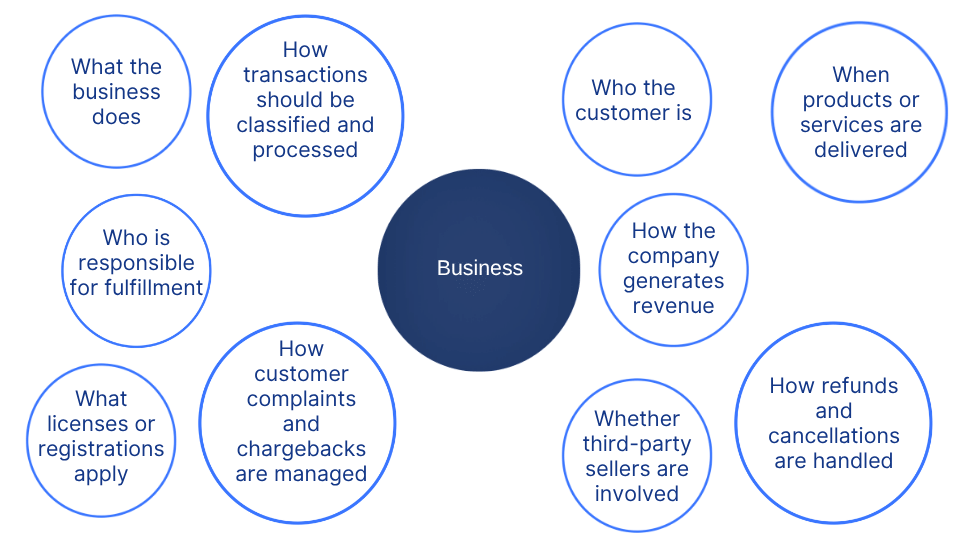
We can then help evaluate whether the business needs a direct merchant account, an ACH solution, multiple merchant accounts, a specialized acquiring bank, a marketplace solution, an ISO relationship, or another payment structure.
Card-Brand and Merchant Compliance Consulting
Payment compliance is not limited to PCI DSS.
Merchants must also follow card-brand rules, processor requirements, consumer-protection regulations, advertising standards, recurring billing requirements, and industry-specific rules.
Nationwide Payment Systems assists businesses with payment-related compliance reviews involving:
- Website policies and required disclosures
- Terms and conditions
- Privacy policies
- Return, refund, and cancellation policies
- Recurring billing disclosures
- Subscription cancellation procedures
- Checkout-page consent
- Pricing and fee disclosures
- Surcharge programs
- Dual pricing and cash discount programs
- Receipt requirements
- Card-brand registration
- Product and service descriptions
- Shipping and fulfillment timeframes
- Customer-service contact information
- Chargeback prevention procedures
- Fraud controls and transaction monitoring
Cash discount, dual pricing, and surcharge programs must be implemented carefully. Improper signage, inconsistent posted prices, incorrect receipt descriptions, or fees applied to ineligible transactions can expose merchants to complaints, card-brand enforcement, processor termination, or penalties.
Our consulting is focused on payment operations and merchant-account readiness. When a matter requires formal legal, tax, regulatory, or accounting advice, we can coordinate with or refer the client to qualified attorneys, CPAs, compliance firms, and other specialists.
Payment Technology and Processor Selection
the lowest advertised rate is not always the best payment solution.
Businesses should evaluate the complete relationship, including technology, support, underwriting, contract terms, integration requirements, funding, scalability, and the provider’s willingness to support the business model.
Payment consulting may include an evaluation of:
- Merchant acquirers and acquiring banks
- Independent sales organizations
- Payment facilitators
- Payment gateways
- Virtual terminals
- Smart invoicing platforms
- ACH providers
- Initial business-model and eligibility review
- Website and checkout-page compliance review
- Pharmacy and telemedicine licensing review
- Review of prescriber and pharmacy relationships
- Corporate and ownership documentation
- Policy and procedure preparation
ISO, Agent, and Payment Company Consulting ISO, Agent, and Payment Company Consulting
We also work with entrepreneurs, agents, ISOs, and companies that want to enter or expand within the payments industry.
Consulting projects may include:
- Starting an ISO or merchant services business
- Developing a sales and distribution strategy
- Identifying processor or bank relationships
- Reviewing agent and ISO agreements
- Evaluating residual portfolios
- Building referral and compensation programs
- Selecting gateways and technology partners
- Developing a high-risk or specialty merchant program
- Creating underwriting and merchant onboarding procedures
- Structuring software and embedded payment partnerships
- Evaluating PayFac and managed PayFac models
- Preparing a company for acquisition or sale
Nationwide Payment Systems has been operating since 2001 and can provide a practical perspective on how payment businesses are built, supported, scaled, and maintained.
Our Consulting Process
1.Discovery
We begin with a detailed conversation about the business, payment challenge, transaction flow, current relationships, and desired outcome.
2. Assessment
We review available documentation, processing statements, agreements, websites, product information, chargeback data, technology requirements, or underwriting correspondence.
3. Strategy
We identify the available options, potential risks, missing information, and recommended next steps.
4. Introductions and Implementation
When appropriate, we help coordinate introductions to processors, acquiring banks, gateways, compliance providers, attorneys, CPAs, or technology partners.
5. Ongoing Support
Some projects require continued involvement during underwriting, integration, implementation, negotiations, or scaling. Ongoing consulting and fractional payment-advisory services may be available based on the scope of the project.
Why Work With Nationwide Payment Systems?
More Than 25 Years of Payment Experience
We have worked in merchant services and payment technology through major changes in card-brand rules, e-commerce, integrated payments, payment facilitation, mobile payments, recurring billing, fraud prevention, and regulated-industry underwriting.
An Operating Payments Company
We are not looking at your business from a purely theoretical perspective. Nationwide Payment Systems actively works with merchants, banks, processors, software providers, underwriting teams, risk departments, and payment technology companies.
Low-Risk Through High-Risk Experience
Our experience ranges from traditional retail, restaurants, professional services, and B2B companies to complex, high-volume, regulated, and difficult-to-place merchants.
Direct, Practical Advice
We will tell you when a project appears viable, what documentation may be required, where the risks exist, and when a proposed payment strategy is unlikely to work.
Relationship-Based Payments
Strong payment relationships matter. A business should know who is processing its transactions, what bank supports the account, what rules apply, and who to contact when a serious issue occurs.
Payment Consulting Engagements
Every consulting project is different.
Some clients need a single strategy session. Others require document review, processor negotiations, due diligence, bank introductions, underwriting support, technology selection, or ongoing advisory services.
Consulting fees are determined based on:
- Project complexity
- Required research and documentation
- Number of companies or providers involved
- Regulatory and compliance considerations
- Technology and integration requirements
- Expected length of the engagement
- Whether ongoing implementation support is required
An initial consultation can help determine the appropriate scope.